Your Online Order Likely Arrived on a Ship That Will End Its Life on a Dangerous Beach in South Asia
The end of a container ship’s life does not happen in a high-tech laboratory or a sanitized industrial park. It happens in the mud.
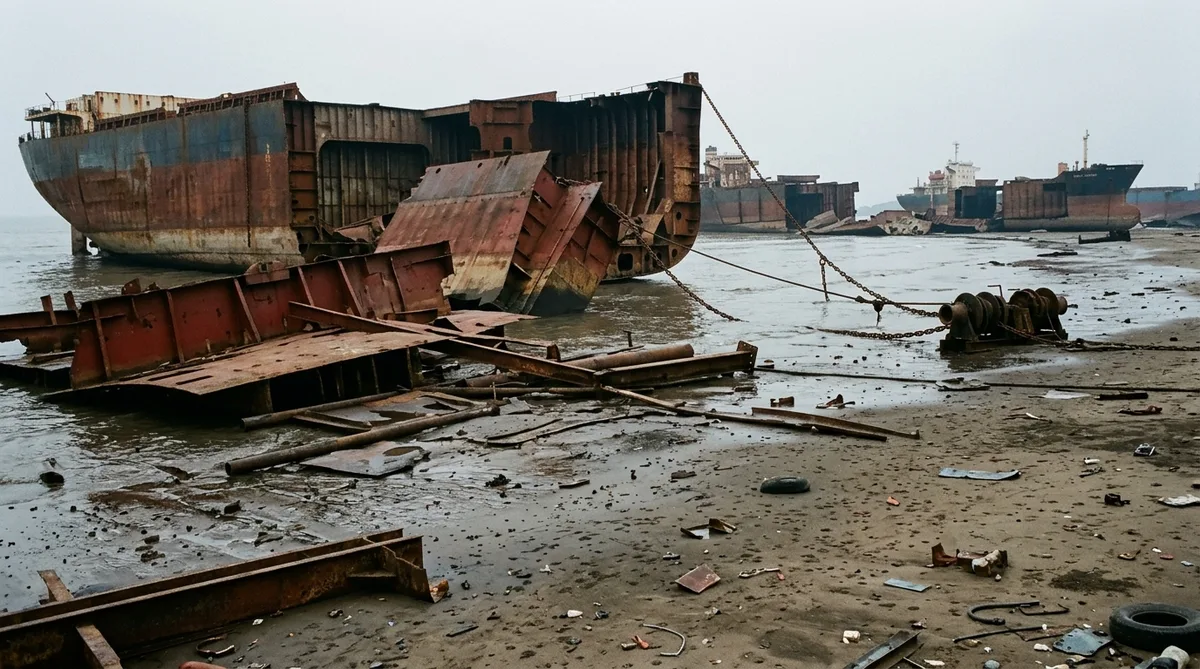
Imagine a vessel the size of a skyscraper, weighing tens of thousands of tons, steaming at full speed toward a shoreline in Bangladesh or India. The captain waits for high tide, guns the engines, and drives the hull deep into the soft silt of the beach. When the tide goes out, the ship is stranded—a steel mountain ready to be picked apart by thousands of men wielding blowtorches and sledgehammers.
This process, known as “beaching,” is how the global maritime industry manages its retired assets. In 2025, approximately 85 percent of the global ship tonnage retired from service was dismantled on tidal beaches in Bangladesh, India, and Pakistan, according to data from the NGO Shipbreaking Platform. It is an efficient recycling mechanism that fuels the economies of the Global South while creating significant environmental and occupational safety challenges.
As of late 2026, approximately 61.34 percent of the global ship recycling market continues to rely on beaching. While regulators in the European Union and the United States push for cleaner alternatives, the economic gravity of South Asian yards remains a dominant force in the shipping lifecycle.
The Economic Lifeblood of the Coast
To understand why shipbreaking persists despite the risks, one must look at the industrial requirements of nations like Bangladesh. For a country with limited domestic iron ore deposits, a retired ship represents a vital resource.
Recycled steel from ships provides roughly 50 percent of the domestic steel production in Bangladesh and 15 percent in Pakistan, according to 2026 figures from the World Bank. This material is essential for the construction of infrastructure, including bridges and factories, across developing economies.
Source: UNCTAD Review of Maritime Transport 2025
The industry serves as a major economic driver. Data published in MDPI Sustainability in November 2025 indicates that shipbreaking contributes approximately $2.1 billion annually to the national economy of Bangladesh. Furthermore, the sector supports more than 250,000 direct and indirect jobs. In the Chattogram region, these yards provide a consistent source of industrial employment that is otherwise scarce in the local economy.
India has led the effort to formalize and professionalize these operations. In 2025, India became the world’s leading ship recycling nation, capturing 35.4 percent of the global market share. This was an increase from 30.1 percent in 2024, as reported by the UNCTAD Review of Maritime Transport 2025. The Indian government has overseen the modernization of over 120 yards at Alang to align with international safety and environmental standards, seeking to capture higher-value recycling contracts from Western shipowners.
The Financial and Environmental Bill
The efficiency of the beaching method is tied to its low overhead, but this comes with measurable environmental costs. When a ship is dismantled on a beach, substances such as asbestos, PCBs, heavy metals, and residual oils can be released into the intertidal zone.
Environmental monitoring reports from September 2026 found that mercury levels in the soil at Alang, India, were up to 155 times higher than baseline levels. These contaminants can migrate into the local ecosystem, impacting the coastal fishing industries that provide food security for surrounding communities.
The human cost is documented through safety statistics. Since 2009, approximately 8,221 ships have been beached in South Asia, resulting in 480 documented worker deaths, according to figures compiled by Eco-Business and the NGO Shipbreaking Platform in July 2026.
In 2025, at least 11 workers died in South Asian yards, with 62 others injured. A notable incident occurred in early 2025 at the Ziri Subedar yard in Bangladesh, where an oil tank explosion during the dismantling of the ‘Banglar Jyoti’ injured eight workers.
Source: NGO Shipbreaking Platform / Murthy Finance Academy
The decision to utilize beaching yards is primarily driven by a significant price delta. According to shipping industry data from 2025, South Asian yards often pay between $500 and $600 per Light Displacement Tonnage (LDT) for scrap steel. In contrast, modern dry-dock facilities in Europe or North America may require shipowners to pay a disposal fee or offer significantly lower scrap prices—often less than $200 per LDT—due to higher labor costs and strict waste-handling mandates. For a shipowner, the difference can represent a $10 million to $15 million swing in the residual value of a single vessel.
A New Era of Regulation
Regulatory frameworks are shifting. On June 26, 2025, the Hong Kong International Convention for the Safe and Environmentally Sound Recycling of Ships (HKC) officially entered into force. The treaty, managed by the International Maritime Organization (IMO), requires ships to maintain an inventory of hazardous materials and mandates that recycling yards meet specific safety and environmental criteria.
As of January 2026, 17 ship recycling yards in Bangladesh had achieved Statements of Compliance with the convention. However, a significant gap remains between the HKC and the European Union’s “EU List” of approved facilities. The EU standard currently requires yards to use permanent floors or dry docks to prevent toxins from leaching into the soil—a requirement that most beaching yards cannot meet without massive capital investment. Despite these rules, only 5 percent of EU-flagged tonnage was dismantled within Europe in 2025, as owners often change vessel registration to “non-EU” flags shortly before a ship is sold for scrap.
The American Pivot and the Global Chessboard
The United States is currently attempting to decouple its maritime infrastructure from this global cycle through the 2026 U.S. Maritime Action Plan. The plan notes that less than 1 percent of the world’s new commercial ships are currently built in the U.S., and even fewer are recycled domestically.
To address this, federal policy has introduced a proposed fee of $0.01 to $0.25 per kilogram on foreign-built ships. The intent is to use these funds to subsidize domestic shipbuilding and dismantling capacity.
Current global market share
Cost per port call for a 5,000-TEU ship
Source: The White House / The Daily Economy (2026)
This policy creates a new economic calculation for shipowners. A typical 5,000-TEU containership could face a $9.4 million fee per port call under this plan, according to analysis from The Daily Economy in April 2026. By making foreign-built ships more expensive to operate in U.S. waters, the government aims to incentivize the use of domestic hulls that would eventually be recycled in U.S. facilities. However, logistics analysts suggest these fees could lead to a 2% to 5% increase in shipping costs for trans-Pacific routes, which would likely be integrated into the wholesale price of imported goods.
China’s role in this market is contradictory. While China banned the import of foreign waste vessels for scrap in 2019 to improve domestic environmental standards, Chinese shipowners topped the 2025 “Dumpers List.” Twenty-one Chinese-owned vessels were sold to South Asian shipbreakers last year, bypassing China’s own high-tech dry-dock recycling capacity in favor of the higher scrap prices offered on the beaches of Bangladesh.
The Business Outlook for 2027
The future of the shipbreaking industry will be dictated by the price of scrap steel and the enforcement of the Hong Kong Convention. Japan has already signaled a shift toward high-tech recovery, investing $6.26 billion into “urban mining” and recycling hubs in 2026 to create a closed-loop system for industrial assets.
Over the next five years, the scrap steel market is expected to face tightening supply as global decarbonization efforts increase the demand for recycled metal, which has a lower carbon footprint than virgin steel produced from iron ore. Industry analysts project that if the price of “green steel” continues to rise, the capital required to upgrade beaching yards into compliant landing facilities may finally become a viable investment for yard owners.
The transition toward a fully regulated global market remains slow because of the stark economic incentives. As long as the price delta between a South Asian beach and a European dry dock remains in the millions of dollars, the flow of steel to the mud of Alang and Chattogram will persist. The entry into force of the Hong Kong Convention has established a new baseline for the industry, but the speed of reform will depend on whether global steel demand can bridge the gap between low-cost beaching and high-cost sustainable recycling.
Sources
- UNCTAD — Review of Maritime Transport 2025
- NGO Shipbreaking Platform — Press Release: List of Ships Dismantled Worldwide in 2025
- International Maritime Organization — New Era for Ship Recycling as Hong Kong Convention Enters into Force
- MDPI Sustainability — Bangladesh's Ship Recycling Industry in the Global South: Readiness and Reform
- The Daily Economy — Can Trump's Maritime Plan Save America's Struggling Shipyards?
- https://www.lloydslist.com/LL1149472/Ship-recycling-outlook-until-2026
- https://www.eco-business.com/news/bangladesh-shipbreaking-industry-opposes-stricter-environmental-standards/
The information presented is for educational and informational purposes only and does not constitute investment advice. MainStreet uses AI to generate content — always verify with qualified financial professionals before making investment decisions. How MainStreet works →
Discussion