Why the World’s Biggest Ships End Their Lives on a Bangladeshi Beach
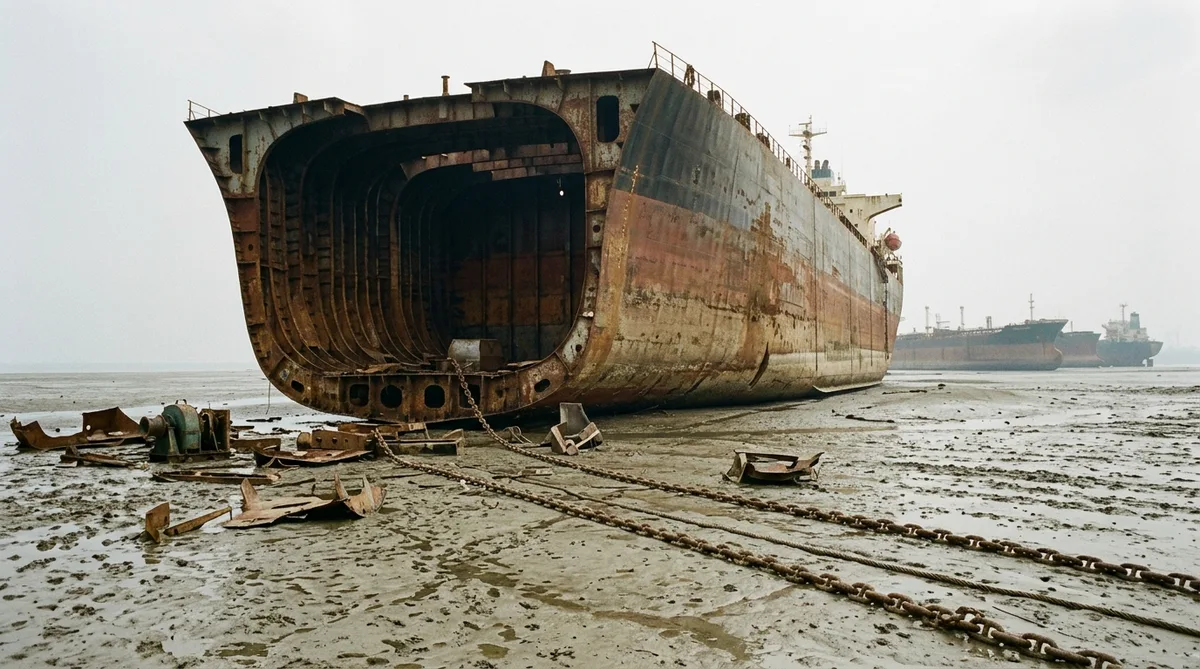
On a humid afternoon in Chittagong, a retired Very Large Crude Carrier (VLCC)—a vessel longer than three football fields—charges toward the shoreline at full speed. This is a deliberate and precise nautical operation. The captain waits for the highest tide, rams the ship into the soft mud of the intertidal zone, and leaves it there to be dismantled by hand.
This is “beaching,” the primary method by which the world’s merchant fleet is decommissioned.
In 2023, the global maritime industry scrapped 446 ocean-going vessels. According to data from the NGO Shipbreaking Platform, 325 of those ships—roughly 73 percent—were dismantled using the beaching method in Bangladesh, India, and Pakistan. This process is an economic pillar for these developing nations, though it presents significant hazards to the workforce and the local environment.
The maritime industry is currently navigating a transition toward fleets powered by green methanol and ammonia. This shift has accelerated the decommissioning of older, less efficient vessels. According to maritime industry analysts, the volume of demolition is projected to rise as stricter carbon intensity regulations take effect throughout 2024. However, while the technology of the ships is advancing, the methods used to dismantle them often rely on labor-intensive practices established decades ago.
The $5 Million Premium
For ship owners based in major maritime hubs like Athens or Hamburg, the choice of where to recycle a vessel is dictated by stark financial disparities. Owners typically choose between European dry-dock facilities, where ships are dismantled in contained environments with heavy machinery, and the tidal beaches of South Asia.
In late 2023, scrap steel prices in South Asia averaged approximately $550 per Light Displacement Tonnage (LDT)—the measure of a ship’s weight without cargo. During the same period, European recycling facilities offered roughly $250 to $300 per LDT.
For a large tanker, this price differential can result in a $5 million increase in revenue for an owner who opts for South Asian beaching yards over European dry docks.
Source: Reuters Financial Data
Market analysis indicates that South Asian yards offer higher prices because they operate with lower overhead. By utilizing the natural incline of a beach and manual labor, these yards avoid the high capital expenditures associated with heavy-duty cranes and the complex waste-management infrastructure required to contain toxins like asbestos and lead-based paint. Research from the OECD Maritime Transport Committee suggests that beaching reduces capital costs for yard owners by roughly 45 percent compared to pier-side recycling.
Steel for the Skyscrapers
The economics of shipbreaking extend beyond the balance sheets of shipowners; they are a critical component of national infrastructure in South Asia. In Bangladesh, which handled approximately 38 percent of the world’s scrapped tonnage in 2023, the industry is a vital source of raw materials.
A World Bank study highlights that ship recycling provides over 60 percent of Bangladesh’s total domestic steel. In a country lacking significant iron ore deposits, the recycled hulls of the global merchant fleet provide the structural steel for the expansion of cities like Dhaka and the construction of major infrastructure projects across the country.
Source: UNCTAD / NGO Shipbreaking Platform
The industry represents a significant economic trade-off for Bangladesh. While it provides the essential steel required for national development and supports thousands of secondary businesses—from furniture making to oxygen plants—it places a heavy burden on coastal ecosystems. This reliance creates a complex policy environment. Imposing Western-style environmental standards or banning beaching outright could significantly increase domestic steel prices, impacting the country’s broader construction sector. The industry has a direct annual economic impact of approximately $1.5 billion in South Asia, based on recent trade figures.
Labor and Safety on the Sand
The operational reality on the ground involves extreme physical risk. Shipbreaking is frequently cited by international labor organizations as one of the most hazardous industrial occupations. In 2023, monitors documented at least 15 worker deaths and dozens of severe injuries in South Asian yards, with the primary causes being gas explosions and the falling of heavy steel plates.
The risks involve both immediate trauma and long-term health complications. A single large tanker can contain up to 10 tons of asbestos and 100 tons of lead-based paint. When ships are cut open on tidal flats, these materials are often released into the mud and air.
Data from the International Journal of Occupational and Environmental Health indicates that the life expectancy for shipbreaking workers in South Asia is significantly lower than the national average. This is largely attributed to chronic exposure to hazardous substances, including polychlorinated biphenyls (PCBs) and heavy metals like mercury.
Source: World Bank, NGO Platform, ILO (2025-2026 data)
The labor force consists primarily of migrant workers. According to the International Labour Organization (ILO), a cutter’s helper in Pakistan or Bangladesh earns an average daily wage of approximately $6.20. While this is above the local minimum wage in some regions, it reflects a high-risk environment where safety equipment like respirators or specialized boots is often absent.
The Global Regulatory Divide
International efforts to standardize the industry reached a milestone in late 2023, as more nations ratified the Hong Kong International Convention for the Safe and Environmentally Sound Recycling of Ships (HKC). The treaty is scheduled to officially enter into force in June 2025. It will require shipbreaking yards to meet specific safety and environmental benchmarks to receive certification.
Despite this progress, a divide persists between international standards and European regulations. The European Union Ship Recycling Regulation (EU SRR) maintains a “White List” of approved facilities that excludes most South Asian beaching yards.
The primary point of contention is the “off-the-ground” requirement. European regulators argue that pollutants cannot be adequately contained on a beach during the tidal cycle. This creates a two-tiered market. EU-flagged vessels are legally required to be recycled at White List yards—mostly located in Turkey or Europe—which can cost ship owners an average of $150 more per ton in lost scrap revenue compared to the South Asian market.
The ‘Grey Fleet’ and Flags of Convenience
To navigate these regulatory hurdles, many ship owners utilize “Flags of Convenience.” When a vessel reaches the end of its operational life, it is frequently re-registered under the flags of nations such as Palau, Comoros, or St. Kitts & Nevis. These registries often have less stringent oversight and do not enforce the recycling regulations of the owner’s home jurisdiction.
In 2023, more than 70 percent of ships scrapped on South Asian beaches were registered under these flags for their final voyage. Greek ship owners remained the largest contributors to the South Asian shipbreaking volume in 2023, accounting for more than 20 percent of the total tonnage sent to the beaches.
Large-scale operators are beginning to respond to ESG (Environmental, Social, and Governance) pressures. Maersk, for example, has reported paying a premium of nearly $2 million per vessel to ensure dismantling takes place in HKC-compliant yards. However, for smaller independent operators, the financial incentive to use less regulated yards remains the deciding factor.
The Green Horizon
The current “scrap wave” is being driven by the maritime industry’s decarbonization goals. As companies phase out older, high-emission tankers and bulk carriers to meet International Maritime Organization (IMO) carbon targets, the volume of waste reaches new highs.
Approximately 35 percent of the vessels scrapped in 2023 were tankers, reflecting a push to modernize fleets. This creates a paradox where cleaning up the world’s active shipping fleet increases the volume of hazardous material managed on South Asian beaches.
Addressing this challenge requires a shift in how the industry views retired vessels. Moving away from treating ships as a source of profit and toward viewing them as industrial waste would require a fundamental change in maritime finance, potentially including prepaid disposal fees similar to those used in the electronics industry. Until such global financial mechanisms are in place, the beaches of South Asia will continue to serve as the primary destination for the world’s decommissioned steel.
Sources
The information presented is for educational and informational purposes only and does not constitute investment advice. MainStreet uses AI to generate content — always verify with qualified financial professionals before making investment decisions. How MainStreet works →
Discussion