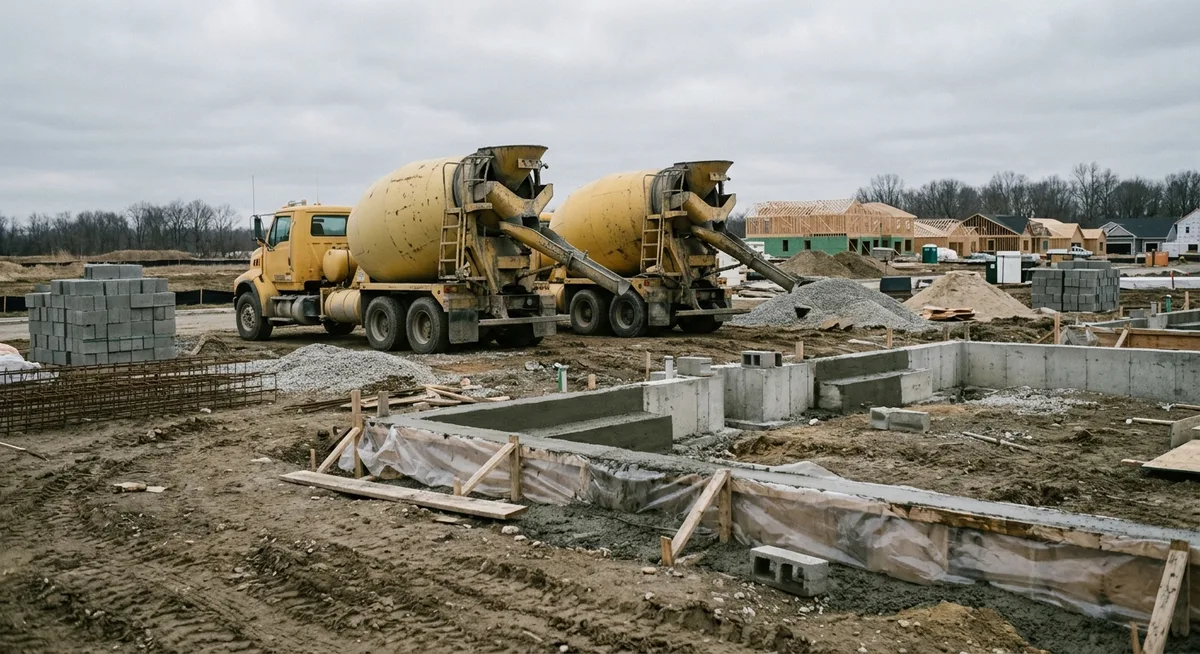
Your Next Home Might Be Built With a Greener Recipe for the World’s Most Popular Material
Concrete is the foundational material of the modern built environment. It is the most consumed substance on Earth after water, forming the structural basis for hospitals, bridges, and residential infrastructure. Global production reached approximately 4.1 billion metric tons in 2024, according to the U.S. Geological Survey (USGS) and the International Energy Agency (IEA).
This scale of production carries a significant environmental cost. The industry is currently responsible for approximately 7% to 8% of global CO2 emissions. If the cement sector were a sovereign nation, its emissions profile would rank as the third-largest in the world, following only China and the United States.
For decades, the industry was classified as “hard to abate” due to the high temperatures required for production and the inherent chemical reactions involved in the process. However, this period of relative technological stagnation is ending. A combination of evolving carbon pricing in Europe, federal industrial subsidies in the United States, and advancements in chemical engineering are forcing a shift in traditional production methods.
This transition is occurring alongside a global housing shortage and a high-interest-rate environment, which has made the “green premium”—the additional cost of sustainable materials—a central challenge for the construction sector.
The Chemistry of Production
To address cement’s carbon footprint, producers must address the chemical processes inside the kiln. Approximately 40% of the industry’s emissions result from burning fossil fuels to reach temperatures of roughly 2,700 degrees Fahrenheit.
The remaining 60%, however, is a byproduct of the chemical reaction itself. In a process known as calcination, limestone (calcium carbonate) is heated until it releases carbon dioxide to become lime (calcium oxide). According to the World Economic Forum, this calcination reaction is independent of the fuel used for heat, meaning that even a transition to 100% renewable energy would leave more than half of the industry’s emissions unaddressed.
Source: World Economic Forum, 2024
Addressing the cement problem requires a fundamental redesign of the material’s chemistry. While carbon capture, utilization, and storage (CCUS) is a primary focus for the industry, the World Cement Association has noted that the fragmented nature of production and current demand assumptions may impact the long-term feasibility of large-scale capture projects.
Market Shifts: China and Europe
The geography of cement production is undergoing a structural transformation. For two decades, China dominated the industry, accounting for over 50% of global output. However, the Chinese construction sector is cooling as the government moves to de-leverage a property market burdened by debt.
Data from the first half of 2024 indicates a decline in Chinese cement production, reflecting a broader slowdown in infrastructure spending and new residential starts. This shift is not merely cyclical; it represents a pivot away from the high-growth, construction-heavy economic model that defined the previous twenty years.
Concurrently, Europe is implementing regulatory pressures that affect global trade. The European Union’s Carbon Border Adjustment Mechanism (CBAM) entered its transitional phase in late 2023. This policy requires importers of carbon-intensive goods, including cement, to report the emissions embedded in their products. As the policy moves toward full implementation, it will effectively require importers to pay a carbon price equivalent to that paid by domestic European manufacturers.
This regulatory framework has turned decarbonization into a competitive necessity for exporters in India, Turkey, and North Africa who wish to maintain access to the European market.
Source: USGS / IEA, 2024-2026
U.S. Industrial Policy and Innovation
In the United States, decarbonization efforts are being driven by federal incentives rather than carbon taxes. In March 2024, the Department of Energy (DOE) announced a $6 billion investment program for industrial decarbonization. This included significant grants for projects such as Heidelberg Materials’ carbon capture facility in Indiana and National Cement Company’s initiatives in California.
While some large-scale carbon capture projects have faced financing hurdles, the focus has increasingly shifted toward tax-credit-based models. Section 45Q of the tax code provides a fixed dollar amount for every ton of carbon captured and sequestered, providing a more predictable revenue stream for developers.
These incentives have also accelerated the growth of startups attempting to bypass limestone-based chemistry. Brimstone, based in California, recently achieved third-party ASTM C150 certification for cement made from calcium silicate rock. Because this process does not use limestone, it eliminates the CO2 byproduct of calcination at the source.
Other firms, such as Fortera, are focusing on “bolt-on” technologies. Their “ReAct” process captures CO2 from traditional lime production and mineralizes it back into the cement product. In mid-2024, the company moved toward scaling this technology to meet commercial demand, leveraging existing plant infrastructure to reduce the capital requirements for new facilities.
The Economics of the “Green Premium”
Despite technological progress, the economic reality for the construction industry remains difficult. The market for green construction materials is growing, but these materials currently carry a premium of 2% to 7% over traditional products, according to industry cost estimates.
In the current economic climate, even a small increase in material costs can disrupt project viability. According to data from the National Association of Home Builders (NAHB), the U.S. faces a shortage of roughly 1.5 million housing units. As of 2024, high mortgage rates and elevated construction costs have rendered a median-priced home unaffordable for a significant majority of U.S. households.
The Associated General Contractors of America (AGC) has noted that while there is strong interest in lower-carbon materials, procurement decisions remain heavily influenced by budget constraints. In 2024, some low-carbon material providers reported a slowdown in demand as builders prioritized immediate cost savings over long-term sustainability goals. When interest rates are high and margins are thin, the “eco-friendly” option often faces significant headwinds.
-
DOE Industrial Grants
$6B federal program announced for decarbonizing US heavy industry.
-
GCCA Low Carbon Rating
Standardized 'A-F' rating system launched for green cement globally.
-
EU CBAM 'Definitive Phase'
World's first mandatory carbon border tax enters full effect for cement imports.
-
EU Anti-Greenwashing Law
Directive (EU) 2024/825 takes effect, banning vague eco-claims without data.
Source: DOE / GCCA / EU Commission, 2024–2026
Standardization and Global Adoption
To address the lack of clarity in the market, the Global Cement and Concrete Association (GCCA) has worked to implement standardized “Low Carbon Ratings.” Similar to energy efficiency labels, these ratings allow architects and government procurement officers to compare the carbon intensity of different products.
In India, the industry is increasingly adopting Limestone Calcined Clay Cement (LC3). By blending calcined clay with limestone, producers can reduce emissions by up to 40%. India has become a primary testbed for this technology, as it utilizes clay—which is abundant—to replace a portion of traditional limestone. This suggests that decarbonization strategies can be adapted for developing economies where traditional raw materials may be scarce.
Logistics are also being scrutinized. UltraTech Cement, India’s largest producer, has begun deploying heavy-duty electric trucks as part of a broader effort to reduce the emissions associated with transporting the finished product.
The Outlook for Construction
The road ahead is characterized by economic uncertainty. The Portland Cement Association (PCA) has forecasted fluctuations in U.S. cement consumption, driven by high borrowing costs and geopolitical volatility that affects energy prices.
Regulatory pressure is also increasing. New European regulations against “greenwashing” are designed to ensure that environmental claims are backed by rigorous data. Companies will increasingly be required to provide transparent Life Cycle Assessments (LCAs) for their products.
For the construction sector, the next several years will be a period of calibration. Lower-carbon cement recipes are becoming commercially available, but their adoption depends on the industry’s ability to absorb higher costs during a housing crisis. The fundamental chemistry of the modern world is changing; the challenge lies in balancing the urgency of decarbonization with the economic necessity of affordable infrastructure.
Sources
The information presented is for educational and informational purposes only and does not constitute investment advice. MainStreet uses AI to generate content — always verify with qualified financial professionals before making investment decisions. How MainStreet works →
Discussion