How Cheap Water from the Ocean Is Changing Where We Can Live
For six millennia, the rule of human civilization was written in mud and silt: if you wanted to build a city, you found a river. From the Nile to the Hudson, the geography of wealth was the geography of freshwater.
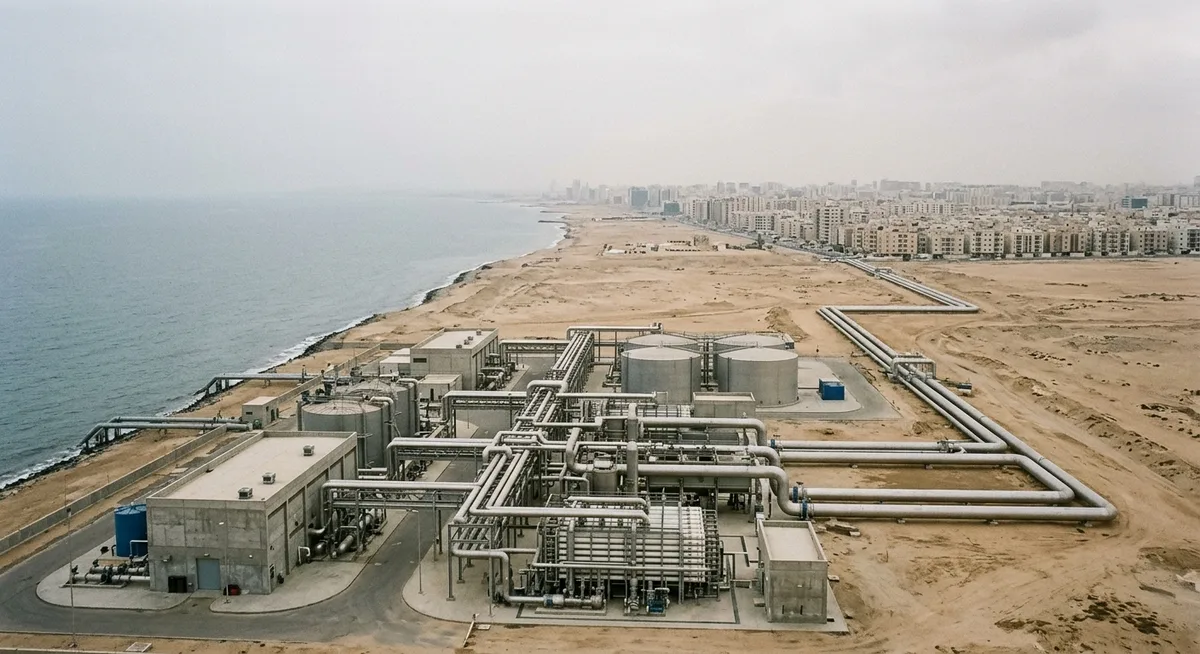
That rule is now being revised. In regions where traditional water sources have reached their physical limits, the reliance on seawater is moving from a luxury of last resort to a foundational infrastructure. Israel provides the most comprehensive example of this shift; by 2065, the nation is projected to require 3.7 billion cubic meters of water annually to sustain its population and industry. This is a massive increase from the 0.5 billion cubic meters required in 2020. To bridge this gap, the country is scaling a system where the majority of its potable water is manufactured rather than diverted from natural sources.
The technology to strip salt from the sea—once a bank-breaking alternative—has reached an economic tipping point. The falling cost of Seawater Reverse Osmosis (SWRO) is turning the world’s oceans into a primary resource, altering the requirements for where people can live, where businesses can build, and the long-term stability of municipal water rates.
The Sub-Dollar Breakthrough
For decades, desalination was the “break glass in case of emergency” option for water managers. It was expensive, energy-intensive, and prone to political backlash. But the economic math has shifted.
According to data from Elemental Water Makers, modern large-scale SWRO systems have achieved production costs ranging from $0.40 to $0.80 per cubic meter. To put that in perspective, a cubic meter is approximately 264 gallons—enough to sustain a typical American household for two to three days. At these prices, ocean water is becoming competitive with the cost of pumping, transporting, and treating groundwater in many arid regions that previously relied on distant reservoirs.
This drop is not the result of a single breakthrough but a compounding series of engineering improvements. Technical advances in Energy Recovery Devices (ERDs) have been central to this trend. By capturing the pressure from the brine stream and recycling it back into the system, modern plants have significantly lowered their energy requirements. This reduction in power consumption is the primary driver behind the sub-dollar cubic meter, making desalination a viable baseline supply for growing coastal economies.
Source: Elemental Water Makers, May 2026
The San Diego Case Study
In the United States, the Carlsbad Desalination Plant in San Diego County serves as the leading test case for large-scale seawater integration. For years, the facility faced scrutiny because the water it produced was more expensive than the supplies the county imported from the Colorado River.
However, recent drought cycles in 2024 and 2025 have changed the narrative. While other parts of California faced mandatory rationing and significant agricultural reductions, San Diego’s plant provided a “drought-proof” buffer, supplying 10 percent of the county’s total water. This reliability has had a measurable impact on the regional economy. San Diego’s commercial sector, including its multi-billion dollar biotechnology industry and its cluster of over 150 craft breweries, maintained full operations and consistent water quality while neighboring regions faced supply cuts of up to 35 percent.
The economics for local residents have also begun to stabilize. In 2025, the San Diego County Water Authority reported that mandated intake upgrades at the Carlsbad plant resulted in $29 million in savings for ratepayers. These efficiency gains are part of a broader trend where the capital-heavy nature of desalination is offset by the long-term predictability of the supply, insulating the local economy from the price volatility of imported water during shortages.
Global Growth and Circular Economies
While some nations view desalination as an insurance policy, others have made it their primary engine of growth. Growth trends identified in reports from the World Bank and the OECD suggest that the global reliance on manufactured water will continue to accelerate through 2030 as traditional aquifers are depleted.
Israel has coupled its desalination capacity with a “circular” water economy that serves as a global blueprint. The country does not treat desalination as a standalone solution; instead, it reuses 87 percent of its treated wastewater, primarily for agriculture. This dual-track approach—creating new water from the sea and recycling it for industrial and farming use—allows for a high degree of water security despite a growing population and limited natural rainfall. This model demonstrates that desalination is most effective when integrated into a broader strategy of resource management.
Source: International Desalination Association / Cognitive Market Research, 2026
The New Industrial Demand: Data Centers
A significant driver of recent desalination market activity is the cooling requirement for high-end computing and data centers. As artificial intelligence infrastructure expands, so does the demand for consistent, high-volume water supplies to manage heat in server farms.
To mitigate risks to their operations, data center operators are increasingly collaborating with municipalities to finance desalination and reuse programs. According to Global Water Intelligence, these operators are more proactive than other industrial sectors in seeking out collaborative projects to build regional resilience.
However, this corporate intervention introduces new points of friction. While tech companies provide the capital to accelerate projects that might otherwise stall in local planning commissions, the partnership models often raise concerns about priority access. When a private entity finances a significant portion of a plant’s capital costs, they may secure “take-or-pay” contracts that guarantee their cooling supply even during periods of extreme scarcity, potentially insulating corporate assets from the rationing measures that apply to local residential zones.
The Friction of Progress
Despite falling costs, desalination is not a perfect solution. There are two primary points of friction: the environmental impact and the political cost of infrastructure.
The process of removing salt produces brine—a highly concentrated saline byproduct. If not managed with advanced diffusion technology, this discharge can settle on the ocean floor and impact marine ecosystems. Furthermore, while the energy required for reverse osmosis has decreased, it remains higher than the energy needed to treat surface water, keeping the process sensitive to fluctuations in the power grid.
Then there is the political challenge. In many coastal communities, the resistance to the industrial footprint of a desalination plant is significant. The total cost of a project is often determined more by the duration of the legal and permitting battles than by the price of the steel and membranes. As noted by Global Water Intelligence, the ultimate cost of these facilities is frequently tied to the strength of local opposition.
However, the alternative is increasingly difficult to ignore. The World Bank reported in 2025 that as traditional freshwater sources decline, the lack of reliable supply poses a greater threat to urban stability than the costs associated with manufacturing water.
Source: OECD / Fluence Corp / GWI
A Manufactured Commodity
As the decade progresses, the shift in water management is becoming clear. For the average resident or business owner, these macro-trends manifest in the form of stability. It means new housing developments in coastal regions that would otherwise lack the water permits to build, and it means more predictable costs for water-intensive industries that no longer have to fear the next seasonal drought.
Water is no longer a fixed geographic constraint determined by the path of a river or the depth of a well. It is becoming a manufactured commodity. In an environment characterized by increasing continental drying, this shift is the factor that determines whether a regional economy can continue to expand or is forced to contract. Managing water as a precious, produced resource is becoming the hallmark of modern development.
Sources
- Elemental Water Makers — How much does desalination cost per cubic meter in 2026?
- World Bank — Governance and Economics of Desalination and Reuse (2025)
- Global Water Intelligence — Christopher Gasson Commentary (2026)
- San Diego County Water Authority — Desalination Plant Upgrades Save Ratepayers $29 Million
- OECD — Financing Water Security Report (July 2026)
- Nature — npj Clean Water: Effects of population growth on Israel's demand for desalinated water
The information presented is for educational and informational purposes only and does not constitute investment advice. MainStreet uses AI to generate content — always verify with qualified financial professionals before making investment decisions. How MainStreet works →
Discussion