Why Your Neighbor’s Rooftop Solar Panel Is Changing Who Runs the Power Grid
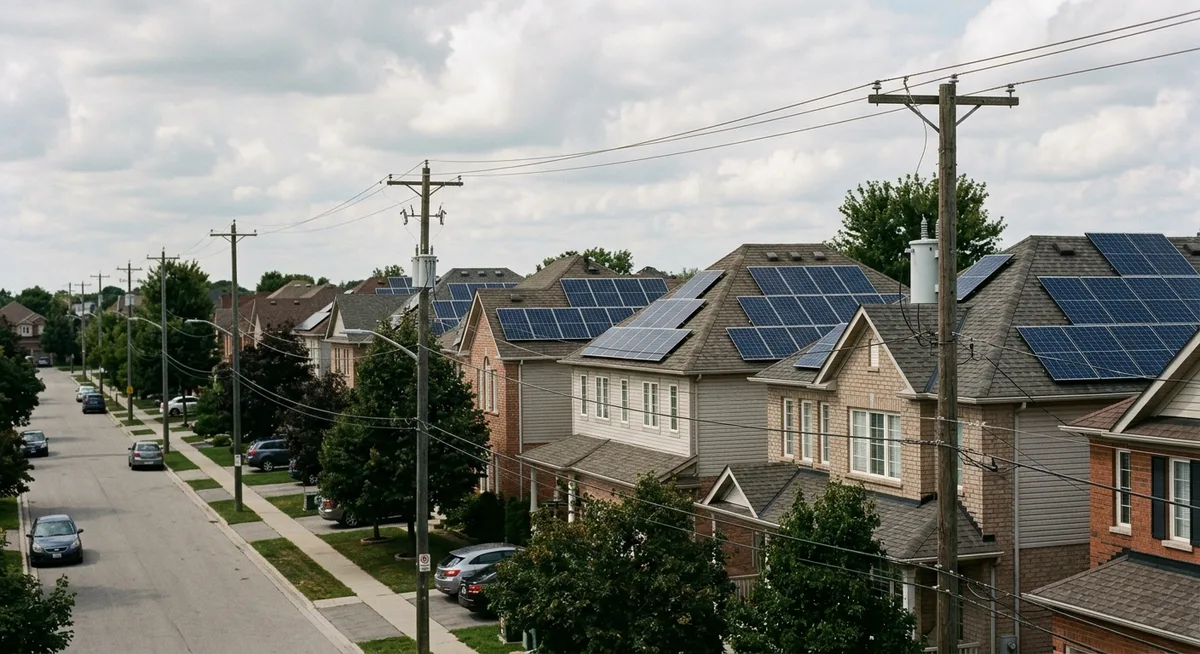
On a clear afternoon in late 2023, the power grid in South Australia achieved a milestone that had previously been viewed as a technical impossibility. At approximately 1:30 PM, rooftop solar panels alone met more than 100 percent of the state’s total electricity demand. For a period of nearly an hour, the large-scale generators that typically anchor the grid were no longer required to meet the needs of the population, marking a significant shift in how regional energy systems operate.
This event was a practical demonstration of a global trend. The traditional model of electricity—a system of centralized, utility-owned power plants transmitting current to passive consumers—is undergoing a fundamental transformation. In its place, a decentralized network of “prosumers” is emerging: individuals and businesses who generate and store their own electricity.
The era of the distributed grid is currently being defined by rapid infrastructure deployment. As cumulative global solar capacity surpassed the 2-terawatt milestone in late 2024—having doubled in approximately two years—the focus of the energy sector has shifted toward the management and ownership of the infrastructure required to carry this power.
Source: IEA / Trident, 2024
The Ownership Transition
For the past century, the power grid functioned as a capital-intensive monopoly, requiring significant state or corporate investment and specialized engineering. Today, the accessibility of solar and battery hardware is decentralizing that structure.
According to BloombergNEF, solar and battery storage are projected to fundamentally shift the economics of global power markets over the coming decade. As solar generation becomes abundant during daylight hours, the business model for utilities that rely on high peak-time electricity prices is facing increasing pressure.
The distribution of this infrastructure varies significantly by region. In China, which installed a record 277.57 gigawatts of new solar in 2024, the state-owned sector remains the primary driver. Approximately 80 percent of China’s rooftop solar capacity is managed by state-owned energy companies, with the remaining 20 percent held by individual households.
In contrast, markets like Australia and Brazil are driven by private residential and commercial investment. In Australia, over 40 percent of free-standing homes have installed solar systems, the highest penetration rate globally. In Brazil, the small-scale solar market grew fivefold between 2019 and 2024. In these regions, the responsibility for generation has shifted from public or corporate entities to individual property owners.
The Rise of the Virtual Power Plant
The proliferation of individual batteries and panels has necessitated new methods of coordination. The Virtual Power Plant (VPP) has emerged as a primary solution. Unlike a physical power station, a VPP is a software-based system that aggregates thousands of individual home batteries into a single resource. This allows grid operators to tap into residential storage during periods of high demand.
Next Kraftwerke, which operates one of Europe’s largest virtual power plants, manages thousands of decentralized units that function collectively as a single resource to stabilize the grid. This model allows for the deployment of capacity without the need for traditional plant construction.
Growth in this sector is accelerating. By the end of 2024, North American VPP capacity reached 37.5 gigawatts, representing a 14 percent annual increase. In California, these assets are providing essential grid support. The state’s Demand Side Grid Support (DSGS) program reached 1.1 gigawatts of enrolled capacity by 2025, demonstrating that residential storage can provide the equivalent capacity of a conventional gas-fired power station.
Source: Wood Mackenzie / Ohm Analytics, 2026
This shift is also reflected in consumer purchasing patterns. Data from the first quarter of 2024 indicates that 45 percent of new residential solar installations in the U.S. included a storage battery. This trend is driven by a desire for energy autonomy and a response to rising utility rates and grid reliability concerns.
Technical and Regulatory Challenges
The rapid adoption of decentralized energy is creating technical challenges for existing infrastructure. The surge in midday generation creates what engineers call the “Duck Curve”—a sharp drop in net demand during the day followed by a steep ramp-up in the evening as the sun sets and residential consumption peaks.
This volatility requires utilities to maintain expensive standby capacity and invest in advanced voltage management systems. Consequently, traditional utilities are advocating for regulatory changes to address the costs of maintaining the physical grid.
California’s Net Energy Metering (NEM 3.0) policy is a prominent example of this friction. Under the updated regulations, the credits paid to homeowners for exporting excess solar energy to the grid were reduced by approximately 75 percent. Regulators designed the policy to encourage the installation of batteries, incentivizing homeowners to store their own power rather than exporting it during periods of midday surplus. However, this has significantly altered the financial profile of solar investments, increasing the payback period for systems without storage.
Reports from the Australian Energy Market Operator (AEMO) indicate that the integration of decentralized resources requires significant upgrades to network technical capabilities. Managing a system where power flows in two directions, rather than just from a central plant to a home, requires a more sophisticated and flexible grid architecture.
The Global Front Lines
The geography of the solar transition is not limited to traditional energy leaders. Currently, the Netherlands holds the world title for solar capacity per capita at 1,337 watts, followed by Australia at 1,224 watts.
In developing economies, the adoption of rooftop solar is frequently driven by the need for cost stability. Pakistan accounted for 3 percent of all global solar capacity additions in 2024. This growth was largely a response to rising electricity tariffs, which made individual solar installations a more predictable financial option for consumers compared to the national grid.
Source: REN21 / IEA-PVPS, 2025
The influx of decentralized energy is placing unprecedented strain on existing transmission and distribution networks. BloombergNEF estimates that global power grids will require approximately $811 billion in annual investment to integrate renewable sources and meet net-zero targets. Most of these grids were originally designed for one-way electricity flow and must now be re-engineered to handle multi-directional traffic.
The Speed-to-Power Era
The energy sector is moving into a phase where speed of deployment is a critical factor. While utility-scale projects often face multi-year delays due to environmental reviews and supply-chain constraints, rooftop solar can be deployed in weeks.
Lazard’s 2024 Levelized Cost of Energy analysis shows that while utility-scale solar remains highly competitive, with costs between $29 and $92 per megawatt-hour, the speed-to-power advantage of decentralized systems is driving adoption. In many markets, the ability to deliver capacity quickly is becoming as valuable as the cost of the energy itself.
The long-term role of the utility is also being redefined. Federal Energy Regulatory Commission (FERC) frameworks, such as Order 2222, envision a future where utilities transition into managers of distribution platforms. In this model, the utility acts as an operator for a decentralized economy, facilitating energy flows between various producers and consumers.
As the sun sets in South Australia, the grid-scale generators resume their role, providing the necessary power for the evening peak. However, the operational data suggests a permanent shift. The grid is evolving from a top-down hierarchy into a complex, participatory system where the distinction between the provider and the consumer is increasingly blurred.
Sources
- IEA — Technology: Solar PV and wind – Global Energy Review 2026
- BloombergNEF — Solar Set to Rule World's Power Supply: Three Things to Know
- SEIA — Solar Market Insight Report Q2 2026
- RMI — Grid-Scale Virtual Power Plants are Here. Have Utilities Noticed?
- pv magazine Global — Rooftop solar meets 99.9% of South Australia electricity demand
- REN21 — Renewables 2025 Global Status Report
- Department of Energy — Virtual Power Plants Projects
The information presented is for educational and informational purposes only and does not constitute investment advice. MainStreet uses AI to generate content — always verify with qualified financial professionals before making investment decisions. How MainStreet works →
Discussion