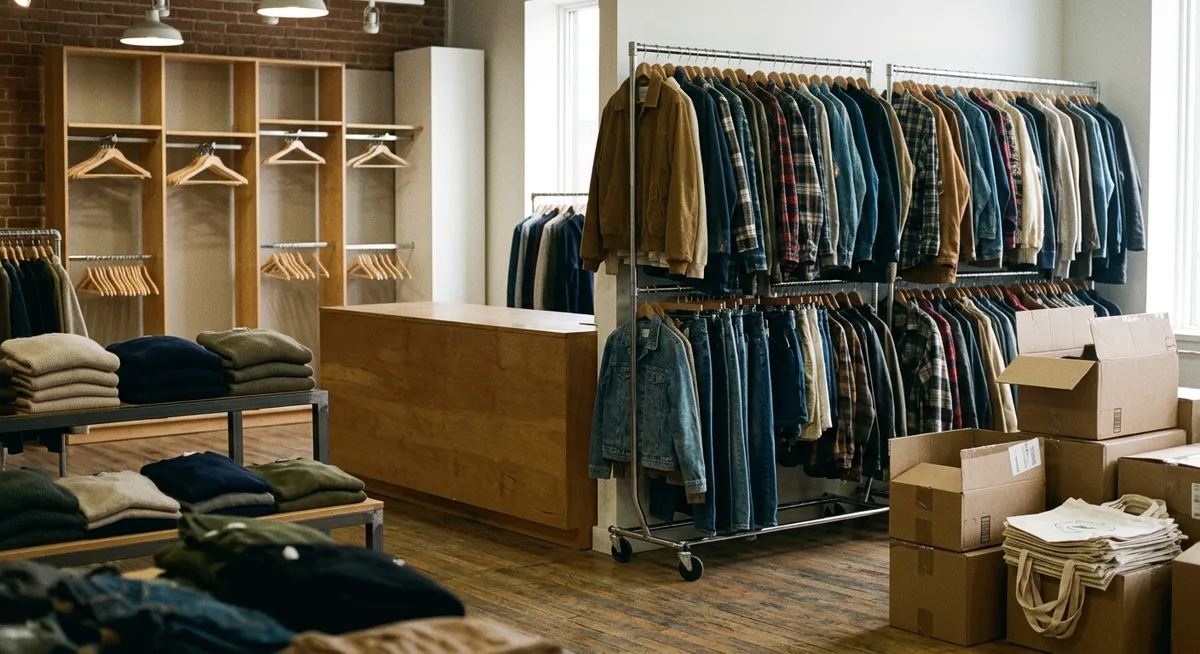
Your Used Clothes Are Now Big Business — and Traditional Stores Are Rushing to Keep Up
In 2023, a significant shift in the French economy highlighted the growing dominance of the circular economy. Vinted, an online marketplace for used clothing, surpassed traditional retailers—including global fast-fashion leaders—to become the country’s leading clothing retailer by total sales volume. This transition indicates that the secondhand market is no longer a niche segment for bargain hunters, but a structural component of modern commerce.
This trend extends globally. According to the 2024 ThredUp Resale Report, the global secondhand apparel market is on track to reach $350 billion by 2028. In the United States, the transformation is accelerating. In 2023, the U.S. secondhand market grew by 11 percent, expanding seven times faster than the broader retail clothing market, which saw modest gains according to GlobalData.
The retail model is moving away from a linear “make, sell, discard” lifecycle toward a circular system. Consumers increasingly view their purchases as assets with residual value rather than disposable goods. The following data compares the growth rates of the resale sector against traditional retail, illustrating a widening gap in consumer preference.
Source: GlobalData 2026 Market Sizing
The Corporate Pivot: Managing Margin and Market Share
Traditional retailers previously viewed the resale market with caution, concerned that used sales would cannibalize new product revenue. However, as the U.S. secondhand market is projected to reach $73 billion by 2028, brands are actively entering the after-market.
“We’ve transitioned from resale being something committed brands do because it’s good for the environment to something all kinds of brands do because it’s good for business,” said Terry Boyle, CEO of Trove, a company that manages resale platforms for major brands.
Data from branded resale programs—platforms where companies like Levi’s, Patagonia, and J.Crew manage the lifecycle of their own goods—shows a threefold increase in brand participation between 2021 and 2023. These programs serve as customer-acquisition channels; Trove reports that a significant majority of branded resale customers are new to the brand. Furthermore, a substantial portion of these customers eventually transition to purchasing new, full-price items.
Despite the enthusiasm from platform providers, some financial analysts remain cautious. Reports from McKinsey & Company suggest that while resale can drive engagement, it often carries higher operational costs due to the logistics of cleaning, authenticating, and individual SKU management. For many retailers, these programs currently operate at lower margins than traditional retail, serving more as a defensive strategy to retain brand control and customer data rather than a primary profit driver.
Even the home goods sector is adopting this model. In 2023, IKEA’s Buy-Back & Resale program processed over 430,000 items globally. According to IKEA’s 2024 Sustainability Report, this initiative is a core component of the company’s strategy to decouple growth from resource consumption. The global secondhand furniture market is now projected to grow steadily, reaching a valuation of approximately $16.6 billion by 2032.
Financial Necessity and the Seller Economy
While sustainability is a frequently cited benefit, the primary driver of the resale boom is financial necessity. In a 2024 study by GlobalData, more than half of U.S. consumers identified “value” as their primary motivation for shopping secondhand, prioritizing cost savings over environmental impact.
On the supply side, the “seller” has emerged as a critical economic actor. As of late 2023, aggregate data from the Bureau of Labor Statistics and independent surveys indicate a rise in supplemental income activities. For many, this involves the selection and listing of used goods on peer-to-peer platforms. According to a 2023 PYMNTS report, a significant percentage of consumers engaging in side hustles do so to cover essential living expenses, including housing and groceries.
Source: SurveyMonkey / 2025-2026 US Side Hustle Trend Survey
The income generated by these activities varies widely. While the median monthly earnings for casual sellers remains modest, a professionalized tier of “power sellers” has emerged. These individuals operate with the efficiency of traditional retailers, using data-driven pricing and high-volume turnover.
“Resale is no longer just growing, it’s taking direct market share,” said James Reinhart, CEO of ThredUp. He noted that the integration of technology to manage inventory will be the next phase of market evolution.
The Global Regulatory Squeeze
Regulatory frameworks are also accelerating the adoption of circular models, particularly in Europe. In 2024, the European Union’s Ecodesign for Sustainable Products Regulation (ESPR) introduced measures that include a ban on the destruction of unsold apparel and footwear for large enterprises.
This legislation forces a change in inventory management. Previously, some luxury and fast-fashion brands destroyed unsold stock to preserve brand exclusivity. The ESPR mandate effectively creates a continuous supply of “new-with-tags” inventory for the secondary market. Currently, Europe accounts for roughly 28 percent of the global secondhand fashion market, supported by these stringent environmental policies.
In Japan, the market is driven by different factors. The Japanese “reuse” market has grown for over a decade, reaching approximately ¥3 trillion in 2023. Research from the University of Tokyo and Mitsui & Co. suggests that Japanese households hold “hidden assets”—unused items—valued at an estimated 91 trillion yen ($570 billion). This represents significant untapped economic value sitting in domestic storage.
Source: McKinsey / Real Gaijin / EU Commission
The Demographic Engine: Gen Z and Social Commerce
Market growth is heavily concentrated among younger demographics. Gen Z and Millennials are projected to account for the majority of resale market growth through 2030. For these consumers, the shopping experience is increasingly integrated with social media.
“The global secondhand market is entering a more competitive, structurally complex phase,” said Neil Saunders, Managing Director at GlobalData. He noted that for younger cohorts, discovery is driven by social feeds rather than traditional storefronts.
This shift is reflected in the scale of peer-to-peer platforms. While brand-led resale programs are growing, they represent a small fraction of the total active listings compared to platforms like Depop or eBay. The volume of listings on these peer-to-peer exchanges suggests that individual sellers currently hold more market influence than corporate programs.
The Paradox of the “Moral License”
The environmental impact of the secondhand market is subject to ongoing academic debate. A 2023 study from researchers at Yale University explored the psychological phenomenon of “moral licensing” in the context of apparel consumption.
The findings suggest that the availability of secondhand options may not always lead to a net reduction in consumption. In some cases, consumers who purchase used items feel they have earned a “moral license” to buy additional new products. Furthermore, the high resale value of certain brands can encourage the initial purchase of expensive new items, as consumers factor the eventual resale price into their budget, effectively lowering the perceived cost of high-frequency consumption.
“Secondary markets may inadvertently encourage unsustainable purchasing patterns,” noted researcher Meital Peleg Mizrachi. The study suggests that for resale to truly benefit the environment, it must replace a new purchase rather than supplement it.
Share of total projected market growth
Portion of market expected to be digital by 2029
Source: ThredUp 2026 Resale Report
A Re-evaluation of Product Longevity
The maturation of the secondhand market is changing the consumer’s definition of quality. In a market where resale value is a known variable, durability becomes a financial consideration. If a product can be resold for a significant portion of its original price, the total cost of ownership is reduced.
“Shoppers are prioritizing quality as resale value becomes an increasingly important factor in purchasing decisions,” noted Alice Price, an apparel analyst at GlobalData.
This shift pressures manufacturers to prioritize product longevity. In an economy where items are frequently recirculated, products with low durability have little to no residual value. For the growing segment of consumers who view their wardrobe as a revolving portfolio, zero resale value is increasingly a dealbreaker.
The retail landscape is evolving into a global exchange where an item’s value is no longer fixed at the point of sale. Driven by financial necessity and new regulatory standards, the “used” designation has lost its previous stigma. It has been replaced by a system where the utility of a product is measured by its ability to sustain a second or third life in the hands of a new owner.
Sources
The information presented is for educational and informational purposes only and does not constitute investment advice. MainStreet uses AI to generate content — always verify with qualified financial professionals before making investment decisions. How MainStreet works →
Discussion