Africa’s Population Is About to Double — and It Will Change How the World Works
Every year, Nigeria records approximately 7.5 million births—a figure that nearly equals the combined annual births of the entire G7: the United States, United Kingdom, Germany, France, Japan, Italy, and Canada. While the world’s established powers in Europe and East Asia are graying, closing schools, and managing shrinking tax bases, a very different story is unfolding across the African continent.
By 2050, the population of Africa is projected to nearly double to 2.5 billion people. According to the United Nations World Population Prospects 2024, this trajectory suggests that one in every four people on the planet will be African. This is a statistical certainty grounded in current birth rates and age structures. The global economy is experiencing a fundamental redistribution of human resources. As China’s population is projected to drop below 1 billion by the end of the century, the center of global labor is moving. The youngest continent on Earth is becoming the primary engine for future demographic growth.
“Africa’s demographic transition offers a unique opportunity for the continent to become the next global engine of growth, provided it can harness its human capital,” says Kristalina Georgieva, managing director of the International Monetary Fund (IMF).
Africa’s working-age population—those between 15 and 64—is expected to grow by approximately 70 percent between 2020 and 2050. This shift will add 796 million people to the global labor force, positioning the continent as the primary provider of the world’s future workforce.
The Great Labor Hand-Off
As of 2024, the median age in Sub-Saharan Africa was 18.8 years. In contrast, the median age in Japan is 49, and in the European Union, it is 44.
Source: UN Population Division / World Bank
While the Global North adapts to an expanding retiree population, African nations face the challenge of absorbing a massive influx of young workers. By 2040, the IMF Regional Economic Outlook suggests Africa will have a larger workforce than either China or India.
The potential for a “demographic dividend”—a period of rapid economic growth that occurs when the working population outnumbers dependents—depends on the ability of regional governments to educate and employ this youth cohort. The World Bank estimated in 2023 that this dividend could increase Africa’s GDP by as much as 15 percent.
The window for policy intervention is narrow. The African Development Bank (AfDB) estimates that the continent needs to create between 12 million and 15 million new jobs every year just to keep pace with the number of young people entering the market.
“The challenge is that we need to create 12 million to 15 million jobs every year,” said Akinwumi Adesina, president of the African Development Bank. “If we do not create jobs for this youth population, the demographic dividend will become a demographic burden.”
Nigeria: The World’s Next Third-Place Finisher
By 2050, the UN World Population Prospects 2024 projects that Nigeria will surpass the United States as the third most populous country in the world. This growth is driving a significant expansion in consumer power. The Brookings Institution projected in 2024 that by 2030, Africa’s combined consumer and business spending would reach $6.7 trillion. For global corporations, from technology firms in North America to manufacturers in Europe, the African consumer base represents the primary frontier for market expansion.
The growth is increasingly fueled by digital transformation. Internet penetration on the continent surged from a negligible 2.1 percent in 2005 to over 36 percent by 2024. A report by Google and the International Finance Corporation (IFC) expects Africa’s digital economy to reach $180 billion by 2025.
Source: Brookings / Google / IMF (2024)
In tech hubs like the Yaba district in Lagos, often called “Yabacon Valley,” and Nairobi’s “Silicon Savannah,” real-world human capital is already materializing. These hubs support over 1,500 active tech startups in Kenya alone and have fostered unicorns like Nigeria’s Flutterwave, which attained a $3 billion valuation by solving regional payment friction. Many African nations have bypassed legacy infrastructure entirely—skipping landline telephones for mobile and traditional retail banking for mobile money. According to the World Bank, remittances to Sub-Saharan Africa reached $54 billion in 2023, a figure that frequently exceeds official development assistance to the region.
The Infrastructure and Energy Gap
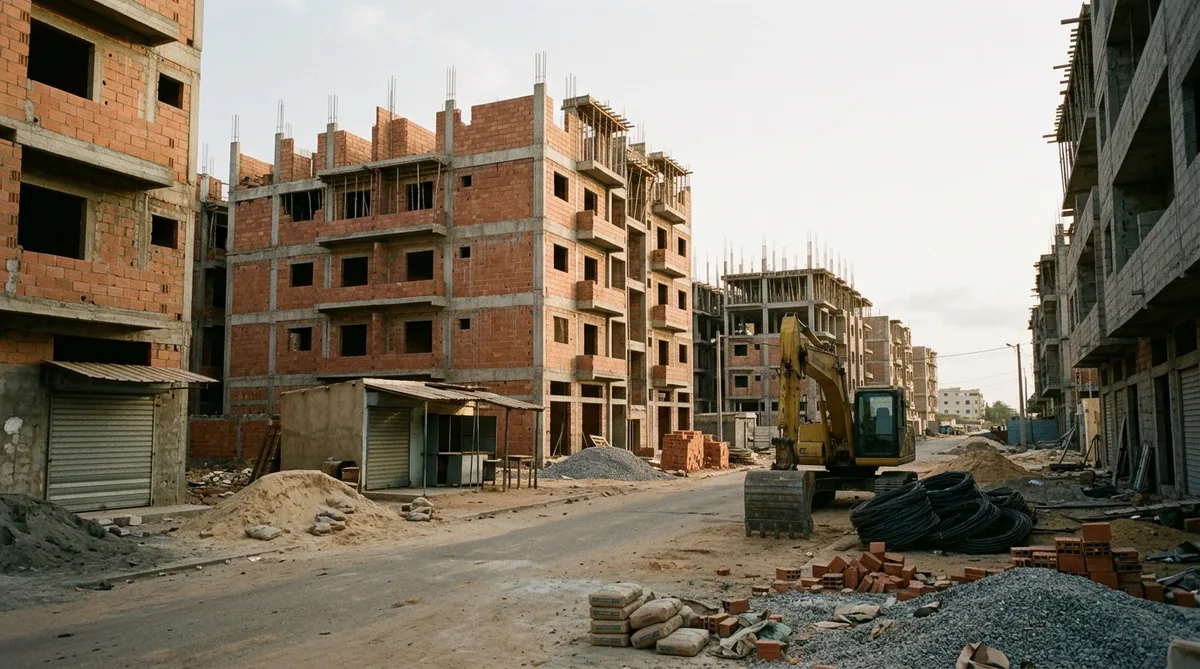
Physical infrastructure remains a critical bottleneck for continental growth. Doubling a population requires a commensurate expansion of roads, power plants, and urban services.
As of 2024, approximately 600 million Africans—or 43 percent of the population—lack access to electricity, according to the International Energy Agency (IEA). Industrial growth at scale is difficult to sustain on decentralized power sources or expensive generators. The African Development Bank estimates the annual infrastructure financing gap is between $68 billion and $108 billion.
600M people still lack access
Up to $108B annual gap remains
Grown from 2.1% in 2005
Source: IEA / AfDB 2024
Urbanization is currently the primary driver of market density. Over 50 percent of Africans are expected to live in cities by 2035, up from 40 percent in 2020. This migration to megacities like Lagos, Cairo, and Kinshasa creates massive, concentrated markets but also places immense strain on housing, sanitation, and transport networks.
Simultaneously, Africa holds 30 percent of the world’s critical mineral reserves, including the cobalt and lithium essential for the global energy transition. This resource density gives African nations significant leverage in trade negotiations with the U.S., China, and Europe as the world moves toward green energy.
“You cannot solve global climate or labor issues without Africa at the table,” says Vera Songwe, former Executive Secretary of the United Nations Economic Commission for Africa.
The Global Ripple Effect
The implications of Africa’s growth reach far beyond its borders. In a world where labor is becoming scarce and expensive in the West, Africa is the only region with a substantial surplus.
By 2050, while Europe’s working-age population is expected to shrink by 20 percent, Africa’s will have increased by 70 percent. This global mismatch will likely redefine migration patterns, trade flows, and foreign policy for the next three decades.
Internal trade is also evolving. The African Continental Free Trade Area (AfCFTA), if fully implemented, could raise real income in Africa by 9 percent and lift 50 million people out of extreme poverty by 2035, according to World Bank analysis. For the U.S., which remains Africa’s largest source of Foreign Direct Investment (FDI) with over $43 billion invested as of 2023, a unified African market represents a historic commercial opportunity.
A significant challenge to this growth is climate change. The African Development Bank warned in 2024 that climate shifts could shrink Africa’s GDP by 2 to 4 percent by 2040. This affects a continent that contributes less than 4% of global emissions but maintains an agricultural workforce comprising 50 percent of the population.
A Necessary Partnership
As we assess the global outlook for 2024 and beyond, the era of viewing Africa primarily as a recipient of aid is ending. It is being replaced by an era where Africa is a necessary partner for global stability.
“Africa is where the global labor force is going to be,” says Abebe Aemro Selassie, Director of the African Department at the IMF. “By the end of this century, one out of every three people on the planet will be African.”
The success or failure of the African demographic expansion is a global concern. If the 12 to 15 million jobs required annually do not materialize, the impact will extend beyond Nairobi or Dakar, affecting every nation that relies on global trade and labor stability.
As Mo Ibrahim, founder of the Mo Ibrahim Foundation, has noted: “If we don’t invest in the skills of these young people, we are not just failing Africa; we are failing the global economy which will soon rely on them.”
The world is aging, but Africa remains young. In that youth lies a critical opportunity for sustained global economic growth in the latter half of the 21st century.
Sources
- United Nations — World Population Prospects 2024
- IMF — Regional Economic Outlook: Sub-Saharan Africa 2024
- African Development Bank — African Economic Outlook 2024
- OECD — Africa's Development Dynamics 2024
- https://www.reuters.com/world/africa/africas-population-boom-demographic-dividend-or-disaster-2023-09-01/
The information presented is for educational and informational purposes only and does not constitute investment advice. MainStreet uses AI to generate content — always verify with qualified financial professionals before making investment decisions. How MainStreet works →
Discussion