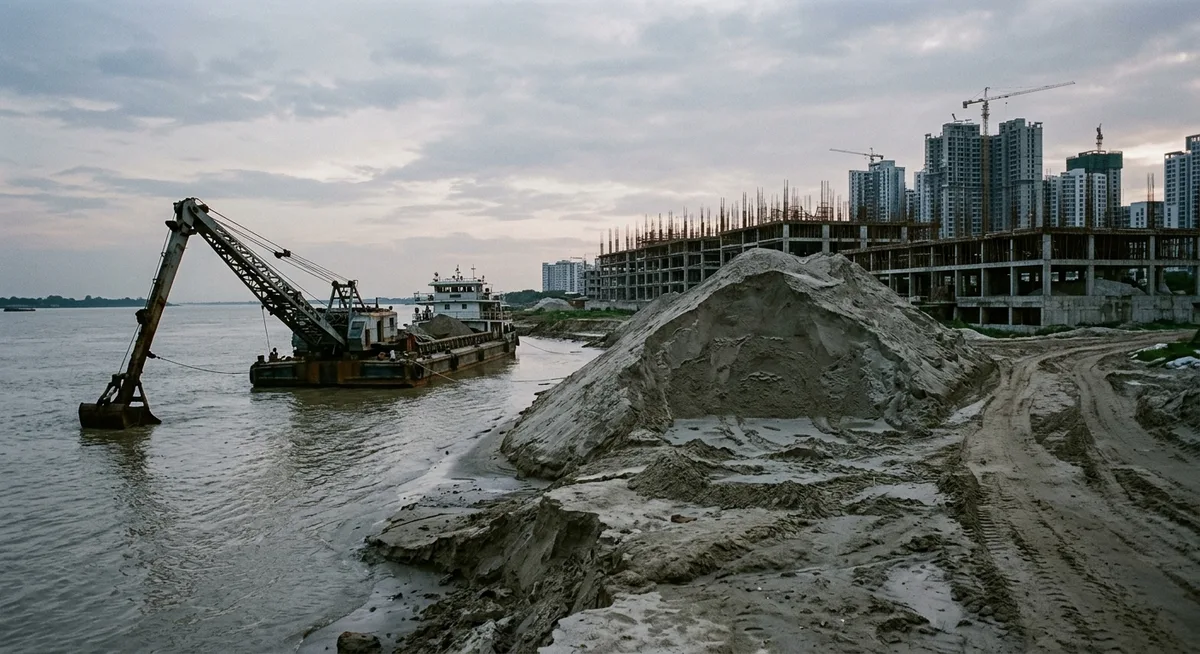
The World Is Running Out of the Sand We Need to Build Cities—and the Cost Is Starting to Show
For concrete suppliers and real estate developers across the United States, the cost of the most basic building block of construction has become a volatile line item. The Producer Price Index for construction sand and gravel reached historic highs in 2023 and 2024, forcing a recalibration of project budgets from the American Sun Belt to the Midwest.
According to the United Nations Environment Programme (UNEP), sand and gravel are the literal foundation of the modern world. They are the essential components of the concrete in our skyscrapers, the glass in our windows, the asphalt on our roads, and the silicon chips in our electronics. Sand is the second most-used resource on the planet, surpassed only by water. However, a 2022 UNEP report highlights a growing crisis: the world now consumes approximately 50 billion metric tons of sand and gravel annually. Global sand consumption has tripled over the last two decades, a pace of extraction that the United Nations has deemed fundamentally unsustainable.
Source: UNEP, 2026
The Quality Paradox
While vast deserts like the Sahara cover large portions of the globe, the physics of construction are unforgiving. Desert sand is shaped by wind erosion, which rounds the grains until they are as smooth as marbles. These rounded grains cannot bind together effectively to form the stable matrix required for concrete.
For construction and infrastructure, the world requires “angular” sand—the kind shaped by the movement of water in rivers, lakes, and oceans. Because desert sand is functionally useless for building, the global economy is focused on stripping riverbeds and coastlines.
“Until now we may have considered sand as a common material,” noted a collective expert recommendation in the 2022 UNEP Sand and Sustainability Report. “It is time to reassess and recognise sand as a strategic material.”
In the United States, the economic consequences of this strategic shift are already appearing on balance sheets. According to the U.S. Geological Survey (USGS), the average value of industrial sand and gravel per metric ton jumped from $45.30 in 2022 to $54.00 in 2023—a nearly 20 percent increase in a single year. These price spikes represent a significant headwind for the construction sector, where materials often account for a substantial portion of total project costs.
The Fracking Factor
While most of the world uses sand to build up, the United States uses a staggering amount of it to dig down. The U.S. industrial sand market is unique due to the specific requirements of the shale energy sector.
The USGS estimated domestic industrial sand production at 130 million tons in 2023, valued at approximately $7.0 billion. However, the majority of this tonnage is not destined for glass or concrete. Approximately 81 percent of that volume was used as “frac sand” for hydraulic fracturing and well-packing.
This creates a specific American tension: the same raw material required to sustain domestic energy production is also needed to expand the housing supply. When the price of sand rises, it creates a dual impact across two of the most critical sectors of the economy simultaneously. For developers, this competition for a limited resource means higher procurement costs and potential delays in securing the high-quality angular sand necessary for structural concrete.
Source: St. Louis Fed (FRED)
A Global Appetite
To understand the true scale of the sand rush, one must look toward the rapid urbanization of Asia. China’s infrastructure expansion is the most sand-intensive event in modern economic history. Data from the USGS and Our World in Data shows that China produced more cement—the primary proxy for sand usage—in just two years (2020–2021) than the United States used during the entire 20th century.
This massive appetite has turned sand into a significant geopolitical leverage point. Singapore, the world’s largest importer of sand per capita, provides a striking case study in the risks of resource dependency. The city-state has historically relied on imported sand for massive land reclamation projects. This demand has led neighboring countries, including Indonesia and Cambodia, to periodically ban sand exports to Singapore, citing the total disappearance of small islands and the collapse of local marine ecosystems due to aggressive dredging.
The Impact on River Systems
The economic pressure of sand extraction is particularly acute in Vietnam’s Mekong Delta. As a critical agricultural hub, the delta accounts for a significant portion of Vietnam’s GDP. However, the physical landscape is being altered by extraction rates that far exceed natural replenishment.
A report from the Center for Strategic and International Studies (CSIS) found that sand extraction rates in the Mekong are significantly higher than the rate at which the river can naturally replace sediment. Between 2015 and 2022, riverbed incision—the deepening of the river due to mining—resulted in a drop of nearly half a meter in some areas.
This deepening of the riverbed allows saltwater from the ocean to intrude further inland, impacting the productivity of rice paddies and destabilizing the land. For the regional economy, the depletion of the exploitable sand supply represents a looming threat to both food security and infrastructure stability.
Regulatory Arbitrage and Supply Chain Risk
Because sand is heavy and expensive to transport, it is almost always sourced locally. This localized demand, combined with high prices, has given rise to “sand mafias”—organized criminal groups that mine sand illegally from protected areas.
UNEP reports that illegal sand mining is now active in over 70 countries. In many regions, this has become a multi-billion dollar illicit industry. For multinational construction firms and institutional investors, these operations represent a significant supply chain auditing failure. The lack of transparency in the sand market creates substantial ESG (Environmental, Social, and Governance) and legal risks for companies that may unknowingly source materials from unregulated or illegal dredgers.
The Marine Sand Watch, a monitoring initiative launched by UNEP, has begun using satellite data and AI to track dredging vessels globally. “The whole supply chain of this sands market is not well known,” says Arnaud Vander Velpen, Sand Industry and Data Analytics Officer at UNEP/GRID-Geneva. “In many countries, it is either unregulated or it is unmonitored.” This lack of oversight makes it difficult for “clean” companies to verify the origin of their raw materials, potentially exposing them to regulatory scrutiny and reputational damage.
Seeking a Circular Solution
If the world is to continue urbanizing safely, the construction industry must transition away from a reliance on virgin river sand. Solutions are beginning to emerge as the market responds to scarcity and rising costs.
One promising alternative is “ore-sand,” a byproduct of mineral processing that was previously treated as waste. By refining these tailings into construction-grade sand, the mining industry can create a circular secondary market while reducing the environmental impact of both mining and dredging. Additionally, recycled construction and demolition waste are increasingly being used as aggregate in new concrete, reducing the demand for raw materials.
In some jurisdictions, crushed glass is being trialed as a replacement for beach sand in coastal restoration projects, and researchers are exploring the use of volcanic ash and processed desert sand as partial replacements in specialized concrete mixes.
The shift toward a circular economy for sand is no longer just an environmental imperative; it is a business necessity. Pascal Peduzzi, Director of the UNEP Global Resource Information Database, notes that managing the most extracted solid material in the world is essential to averting a long-term supply crisis.
As the construction sector adapts to these new market realities, the focus is shifting toward high-tech alternatives and more rigorous supply chain management. The sand that builds our world is a finite resource, and its future availability depends on the industry’s ability to innovate beyond the riverbed.
Sources
- UNEP — Sand: Wanted dead and alive. Use it wisely, warns the UN
- USGS — Mineral Commodity Summaries 2024: Sand and Gravel (Industrial)
- FRED St. Louis Fed — Producer Price Index: Construction Sand and Gravel Mining
- UNEP/GRID-Geneva — Sand and Sustainability: 10 Strategic Recommendations to Avert a Crisis (2022)
- CSIS — Hindering Economic Prosperity? Vietnam's Illegal Sand Mining Industry
The information presented is for educational and informational purposes only and does not constitute investment advice. MainStreet uses AI to generate content — always verify with qualified financial professionals before making investment decisions. How MainStreet works →
Discussion