How Melting Arctic Ice Is Cutting Weeks Off Global Shipping Times—and Reshaping the World Economy
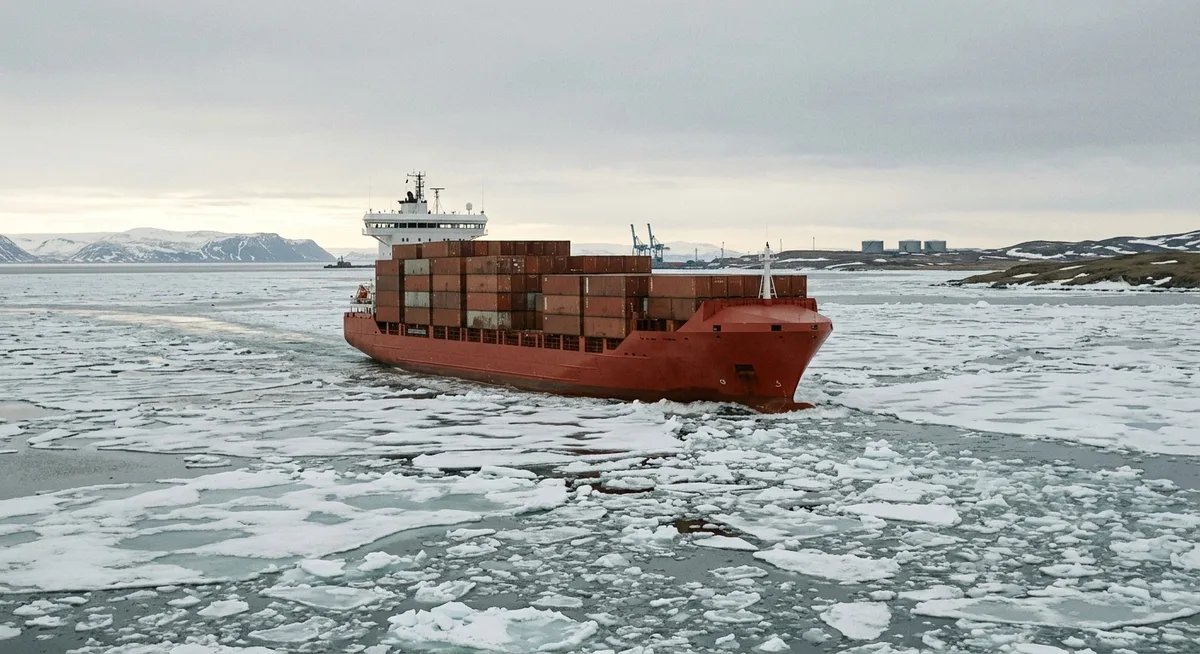
The sun rarely sets on the East Siberian Sea in August, but the view from the bridge of a modern cargo vessel is changing faster than the seasons. Where captain’s logs once recorded impenetrable walls of white, today’s merchant mariners see vast stretches of open, steel-gray water. For the global logistics industry, this isn’t just a climate milestone; it is the opening of a multibillion-dollar redirection in the world’s trade map.
In 2021, global logistics faced a critical vulnerability as the Ever Given, a skyscraper-sized container ship, wedged itself into the banks of the Suez Canal. For six days, nearly 12 percent of global trade was delayed, resulting in an estimated $9.6 billion in lost trade value every 24 hours according to data from Lloyd’s List. While this event exposed the fragility of traditional supply chains, it provided a strategic opening for Arctic development. Since then, there has been a concentrated effort to market the Northern Sea Route (NSR)—a path hugging Russia’s Siberian coastline—as a high-speed alternative to the aging maritime arteries of the Middle East.
This shift is no longer a projection. In 2023, cargo traffic along the Northern Sea Route reached a record 36.25 million tonnes, according to data released by Rosatom in early 2024. This exceeded official government targets by a quarter-million tonnes. Looking toward 2026, the route is expected to see significant infrastructure completions as part of a legislative push to reach 150 million tonnes of annual cargo by 2030. Analysis from The Arctic Institute indicates that the region is shifting from a peripheral concern for global trade into a central theater of economic activity as seasonal ice coverage continues to decline.
The 40 Percent Efficiency Gain
The financial incentives for this Arctic pivot are driven by metrics that are increasingly difficult for corporate leadership to disregard. A standard voyage from Yokohama, Japan, to Rotterdam in the Netherlands typically takes about 35 days via the Suez Canal, covering roughly 11,500 nautical miles. By taking the Northern Sea Route, that distance drops to 7,000 nautical miles—a 40 percent reduction.
For a shipping industry focusing on fuel efficiency and carbon optimization, shaving 13 to 15 days off a transit represents a significant operational advantage. It results in fewer tons of fuel burned, lower crew expenses, and a faster turnaround for high-value electronics and machinery.
Source: OECD iLibrary / Reuters
However, the transition presents significant operational challenges. The Arctic is a volatile environment where 20th-century shipping models meet the changing physical conditions of the 21st century. While the distance is shorter, reports from the Arctic Marine Shipping Assessment indicate that the “just-in-time” delivery model is often disrupted by the region’s inherent unpredictability, where shifting ice floes can delay cargo for several days despite the overall reduction in mileage.
The Polar Silk Road
If the northern geography provides the path, international capital is providing the momentum. Under the framework of the “Polar Silk Road,” the Arctic has been integrated into the broader Belt and Road Initiative. As of early 2024, investment in Arctic energy projects—primarily liquefied natural gas (LNG)—has exceeded $30 billion, according to the Brookings Institution.
This partnership is materialized in the “Arctic Container Line,” a joint venture established to manage logistics between Shanghai and Arkhangelsk. The operational goal is to move from seasonal windows to a permanent, year-round schedule.
To support this, the ‘Project 22220’ nuclear-powered icebreaker program is nearing completion. The latest vessel in this fleet, the Chukotka, is scheduled for commissioning by 2026 to ensure that winter ice in the eastern Arctic does not impede the flow of goods. Research from the University of Washington suggests this creates a “Polar Silk Road” where capital and technology from East Asia are matched with northern geography and ice-breaking infrastructure.
The Economics of Cold Trade
For global markets, an Arctic shipping expansion suggests the potential for faster delivery cycles, but the economics of the North involve high entry costs. These are not standard routes, and they require specialized hardware and administrative oversight.
The primary hurdle is the cost of the vessels. A standard container ship cannot operate safely in these conditions; “ice-class” ships with reinforced hulls, specialized steel, and winterized engines are required. The OECD and the International Transport Forum estimated in 2023 that building these PC4 or PC7 class vessels costs between 25 and 50 percent more than a standard ship of the same capacity.
Furthermore, insurance remains a complex variable. Because the Arctic lacks the dense network of Search and Rescue (SAR) infrastructure found in more temperate waters, insurance premiums for Arctic transits are often two to three times higher than Suez routes. Allianz Global Corporate & Specialty noted in 2023 that hydrographic uncertainties—the fact that many Arctic waters lack modern, high-resolution mapping—create risks that many Western insurers remain hesitant to cover.
Source: OECD / Allianz, 2023
These financial barriers explain why major shipping lines, including MSC, Hapag-Lloyd, and CMA CGM, have maintained public stances against using Arctic routes. While environmental commitments are often cited, the financial volatility and the requirement for specialized fleets play a decisive role in corporate decision-making.
ESG Risks and Regulatory Headwinds
The commercial opening of the Arctic creates a complex regulatory and environmental environment. The region is warming at a rate 3.8 to 4 times faster than the global average, a phenomenon known as Arctic Amplification. This creates “stranded asset risk” for traditional infrastructure that was built on permafrost that is now becoming unstable.
According to research published in Nature Communications in 2023, the first ice-free summer in the Arctic could occur as early as 2030. While this would permit the seasonal use of the Transpolar Sea Route—a path across the North Pole that avoids territorial waters—it introduces significant ESG (Environmental, Social, and Governance) risks for investors.
Regulatory pressure is also increasing. The International Maritime Organization (IMO) implemented a ban on Heavy Fuel Oil (HFO) in the Arctic effective July 1, 2024. While some vessels operate under waivers that extend to 2029, the shift toward more expensive distillates or LNG propulsion is a mandatory cost for new entrants. Data from the Clean Arctic Alliance indicates that black carbon—soot from ship exhausts—settles on the ice, darkening the surface and reducing the albedo effect, which in turn accelerates heat absorption and localized melting. This creates a cycle of environmental change that necessitates further regulatory intervention.
Geopolitical Infrastructure and the Icebreaker Gap
As maritime access increases, the geopolitical focus on northern infrastructure has intensified. The Arctic is no longer a zone of isolated scientific research; it is an active theater of infrastructure competition. The most significant disparity is found in the hardware of polar power: icebreakers.
As of 2024, the world’s only fleet of nuclear-powered icebreakers is operated by Russia, with seven active vessels. In contrast, the United States maritime presence in the high latitudes relies on a single heavy icebreaker, the USCGC Polar Star, which was commissioned in 1976. This “icebreaker gap” has led to increased Western focus on building polar-capable fleets to ensure presence in a region where new military bases and search-and-rescue centers are being established.
Source: Congressional Research Service / Rosatom
Legal frameworks regarding water rights also remain a point of contention. Canada defines the Northwest Passage (NWP) as “internal waters,” while the U.S. and the European Union view it as an “international strait” with the right of transit. While the NWP recorded 41 complete transits in 2023, it remains less commercially developed than the Northern Sea Route due to more complex ice patterns and the absence of a centralized management authority equivalent to the Northern Sea Route Administration. Policy briefs from the Fridtjof Nansen Institute suggest that control over these primary links between Asia and Europe is a cornerstone of northern economic strategy.
The Transshipment Model
Strategic positioning is also occurring within Western nations. Norway is developing the Port of Kirkenes as a potential “Arctic Gateway” to Europe. This model involves Kirkenes acting as a transshipment hub where specialized ice-class ships can offload cargo onto standard vessels for the final leg to major European ports like London or Hamburg. This allows for the efficiency of the NSR to be captured without requiring entire global fleets to be upgraded to ice-class specifications.
This tension between the extraction-based economic models and the conservation-focused strategies of the EU defines the current era of northern trade. The speed of delivery is being weighed against long-term climate stability and carbon accounting.
Looking toward the 2030s, the Arctic trade map will be defined by how the industry manages these regulatory hurdles and physical changes. For now, shipping volume continues to trend upward, following the receding ice into an era of deep-water logistics.
-
Suez Crisis
Ever Given blockage spurs interest in NSR as a 'reliable alternative'.
-
HFO Ban
IMO ban on Heavy Fuel Oil takes effect to protect Arctic waters.
-
Chukotka Commissioning
Completion of latest Project 22220 nuclear icebreaker for year-round transit.
-
Ice-Free Projection
First projected ice-free summer, opening the Transpolar Sea Route.
Source: Nature Communications / Rosatom / IMO
Sources
- Reuters — Russia's Northern Sea Route cargo hits record in 2023, January 2024
- The Arctic Institute — The Future of Arctic Shipping, 2024
- Nature Communications — Ice-free Arctic projections, June 2023
- Rosatom — Official NSR Performance 2023, January 2024
- Financial Times — China-Russia Arctic Shipping Ventures, 2024
- OECD iLibrary — The Ocean Economy in 2030, 2023
The information presented is for educational and informational purposes only and does not constitute investment advice. MainStreet uses AI to generate content — always verify with qualified financial professionals before making investment decisions. How MainStreet works →
Discussion