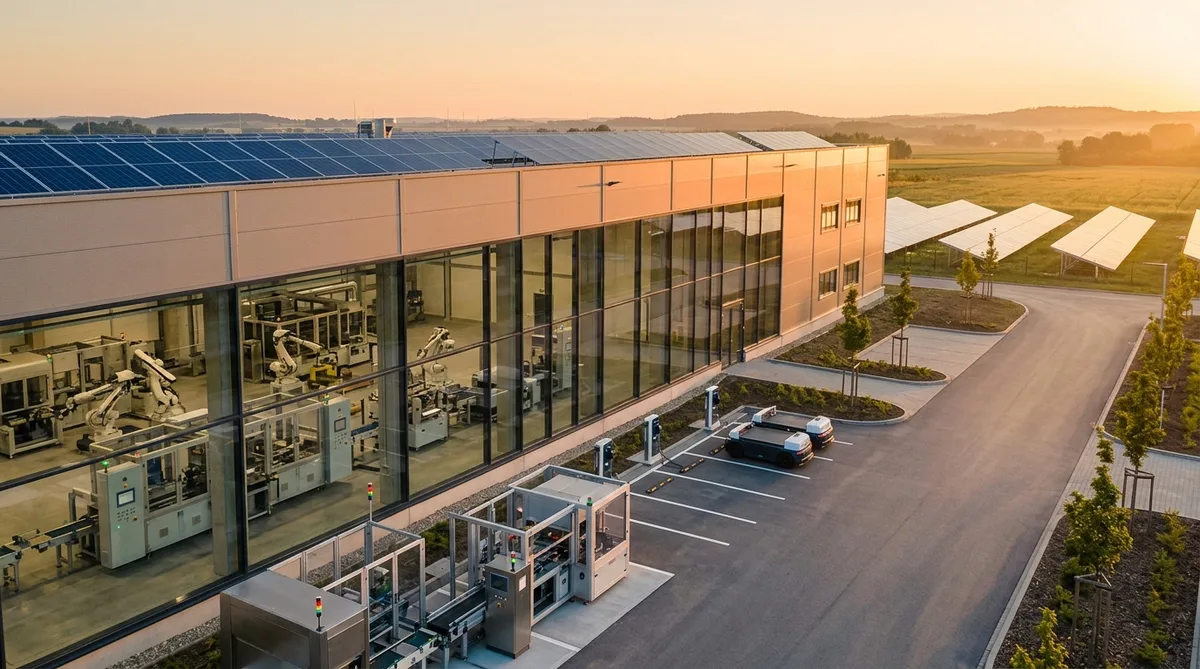
Poland Now Makes More Money per Person Than Spain — Here Is How They Did It
In 1990, the landscape of Gdańsk was defined by the rust-colored skeletons of the Lenin Shipyards—a symbol of industrial struggle and a $66 billion economy that was little more than a satellite of the crumbling Eastern Bloc. By March 2026, that image has been replaced by the high-tech cleanrooms of the LG Energy Solution plant in Wrocław. This transformation culminated in a quiet but monumental shift in the continent’s economic gravity: for the first time in modern history, Poland’s nominal Gross Domestic Product (GDP) surpassed $1 trillion.
Back in 1990, the average Pole earned less than one-tenth of their German neighbor. Today, that disparity has nearly evaporated. According to Eurostat estimates released in March 2026, Poland’s GDP per capita, adjusted for purchasing power, has reached 81 percent of the European Union average—a staggering climb from the 44 percent recorded in 1995.
This is a three-decade sprint. While much of Europe has spent the last 20 years managing stagnation, debt cycles, and the structural fallout of Brexit, Poland has maintained a trajectory of nearly uninterrupted growth. Data from Kozminski University suggests this “convergence machine” is the result of deep institutional absorption of open-market rules rather than a simple reliance on EU development funds.
Source: Eurostat (March 2026)
The New Industrial Heart of Europe
The growth is anchored in a strategic pivot toward future-facing manufacturing. In Wrocław, LG Energy Solution now operates the largest electric vehicle (EV) battery factory in Europe. As of May 2026, the plant maintains a capacity of 86 GWh, with a stated target of 115 GWh to supply global manufacturers including BMW, Audi, and Ford.
Poland has transformed into the lithium-ion battery capital of the continent. According to data from the Polish trade portal trade.gov.pl, the sector contributes approximately 3 percent to the national GDP and 2.4 percent of total exports. By moving aggressively into the EV supply chain, Poland achieved technological leadership in a field where legacy industrial powers were slower to pivot.
Industry reports from electric bus manufacturer Solaris indicate that early adoption of electric vehicle technology allowed Polish firms to secure a dominant market share. Poland is currently the largest producer of lithium-ion batteries in Europe, a position that was nonexistent a decade ago.
This industrial shift is fueled by “nearshoring.” As global corporations de-risk supply chains by moving production closer to European consumers, Poland has emerged as a primary beneficiary. In a 2026 survey of German firms conducted by ING and ThisDayLive, 56 percent of companies planning investments in Central and Eastern Europe identified Poland as their top destination. The logistics are compelling: nearshoring to Poland offers companies up to 50–70 percent faster delivery times compared to sourcing from Asia. A shipment from a Polish factory reaches Western Europe in one to three days, compared to the four to eight weeks required for maritime transport from China or Vietnam.
Surpassing the Old Guard
For decades, the “PIGS” countries—Portugal, Italy, Greece, and Spain—represented the standard of Western European living. In 2025, Poland broke that hierarchy.
According to data from Eurostat and the Central European Times, Poland’s per capita income (measured by purchasing power parity) reached approximately €49,650 in 2025, moving past Spain’s €49,465. This is reflected in “Actual Individual Consumption” (AIC) per capita—a measure of the goods and services households actually use. Last year, Poland’s AIC reached 88 percent of the EU average, leading all ten of the Eastern member states that joined the EU during the 2004 expansion.
Source: European Commission (May 2026)
The physical infrastructure has expanded to meet this demand. Poland’s warehouse and industrial market surpassed 36 million square meters in 2025, making it the fifth-largest logistics market in Europe. This supports an economy that is more trade-dependent than many global peers; exports accounted for 52 percent of Poland’s GDP in 2024, significantly higher than Italy’s 22 percent or Japan’s 15 percent. International Monetary Fund (IMF) analysis attributes this triumph to the country’s transition from the economic hardship of the communist era to a dynamic market economy supported by macroeconomic stability and strong institutions.
The Silicon Steppe
Beyond manufacturing, a tech-driven intelligence is scaling rapidly. Poland now hosts over 400,000 IT specialists, and the software development outsourcing market is on track to reach $3.84 billion in revenue by the end of 2026.
This talent pool has triggered massive infrastructure commitments from global tech leaders. Microsoft moved forward with a PLN 2.8 billion ($704 million) investment in February 2025 to expand hyperscale cloud and AI infrastructure, which is expected to be fully online by June 2026. Similarly, Google committed $2 billion to a new data center in 2025. Internal industry projections suggest that AI integration alone could eventually boost Poland’s GDP by as much as 8 percent.
Targeting 115 GWh to supply European BMW/Audi fleets
Driving $3.84B in software outsourcing revenue
36M+ square meters of warehouse space
Source: Trade.gov.pl / Introl (2026)
This activity has led to a reversal of the “brain drain” that characterized the early 2000s. Poland’s human capital flight index dropped to 4.3 in 2024, a score lower than the global average, signaling a “brain gain” era. Data from the Polish Economic Institute shows a significant trend of professional returnees; as the wage gap with London and Berlin narrows and purchasing power in Warsaw increases, thousands of engineers and architects are relocating back to the Polish market.
The Forward View: Headwinds and Horizons
The engine is running hot, and the fuel—human labor—is running low. Poland’s breakneck growth has resulted in a tight labor market that is reaching its limit. While the working-age population (15-64) still comprises 65 percent of the total, demographic data indicates a looming contraction.
Economic analysis from ING Bank Slaski suggests that the country’s high-quality, relatively low-cost workforce is nearing exhaustion, necessitating a reassessment of immigration policies and talent attraction. The care sector is particularly strained; European Commission data from 2024 and 2026 shows Poland has only 0.4 long-term care workers per 100 seniors, compared to an EU average of 3.3.
Fiscal challenges are also mounting. Poland’s deficit is projected to reach 7 percent of GDP in 2025 and 6.5 percent in 2026. While the IMF assesses the risk of sovereign debt stress as “medium,” the cost of infrastructure expansion is significant. The Centralny Port Komunikacyjny (CPK)—a project including a high-speed rail hub and “Cargo City”—announced tenders worth €9.3 billion in April 2026.
There have also been strategic setbacks. In July 2025, Intel cancelled a planned $4.6 billion semiconductor facility near Wrocław, citing global cost-cutting measures. This served as a stark reminder that even high-growth economies remain vulnerable to the fluctuations of the global tech cycle.
A New Blueprint for Resilience
Despite these pressures, Poland enters the second half of 2026 with considerable momentum. In May 2026, the European Commission projected that Poland’s economy will grow by 3.5 percent this year. In contrast, Germany, Poland’s largest trading partner, is struggling to reach 0.9 percent growth.
Source: Central European Times / Eurostat (2026)
Poland has successfully transitioned from a low-cost assembly hub to a diversified, trade-open economy. By moving up the value chain into battery production and AI infrastructure, the nation has largely avoided the “middle-income trap” that often hinders developing states.
The Polish model provides a case study in how strategic integration and rapid adaptation can build national wealth. It suggests a global shift where economic influence is defined less by historical status and more by the ability to shorten supply chains, dominate electric mobility, and integrate data. As cranes continue to shape the skyline of Warsaw, they are not merely adding office space; they are marking the arrival of a new center of European economic influence. Poland did not just catch up to the West; it is currently defining the parameters of modern growth.
Sources
- Eurostat — Purchasing power parities and GDP per capita - preliminary estimate 2025
- IMF — Republic of Poland: 2025 Article IV Consultation-Press Release
- Trade.gov.pl — Poland strengthens its position in Europe's battery industry
- European Commission — Economic forecast for Poland (May 2026)
- Microsoft — Microsoft announces a PLN 2.8 billion investment in Poland
- Notes from Poland — How Poland became Europe's growth champion
- https://www.worldbank.org/ext/en/country/poland
- https://www.theglobalist.com/poland-economy-gdp-european-union/
- https://xyz.pl/poland-unpacked/closing-the-gap-polands-path-toward-eu-income-convergence-2154/
- https://www.imf.org/en/Countries/POL
- https://www.oecd.org/en/countries/poland.html
- https://www.oecd.org/en/publications/oecd-economic-surveys-poland-2025_48c77317-en.html
- https://www.tomshardware.com/pc-components/cpus/intels-big-dollar5-billion-bet-on-ireland-aims-to-right-the-wrongs-of-the-cancelled-magdeburg-germany-complex
The information presented is for educational and informational purposes only and does not constitute investment advice. MainStreet uses AI to generate content — always verify with qualified financial professionals before making investment decisions. How MainStreet works →
Discussion