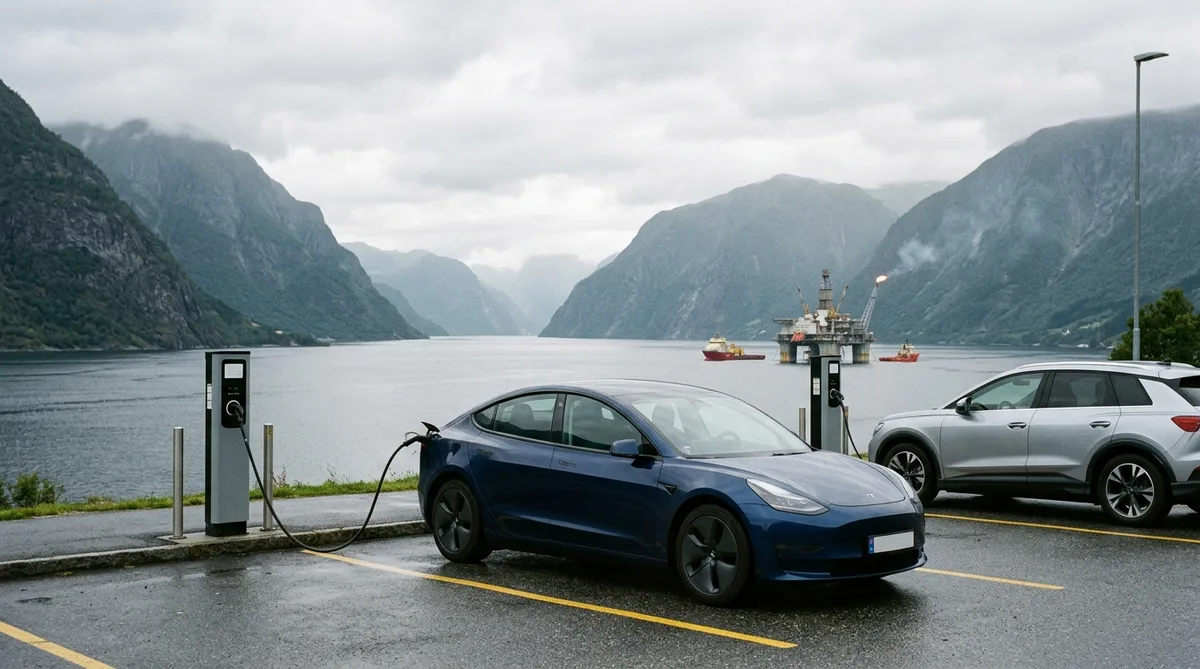
Norway Sells the World Oil While Going Fully Electric at Home
Oslo’s Karl Johans gate is eerily quiet for a capital city, the silence provided by an electric vehicle fleet that now accounts for nine out of every ten new registrations. But 300 miles offshore, the North Sea is roaring with the machinery of oil rigs that paid for this transition. Norway, a nation of 5.5 million people, has become a global laboratory for electric transport by acting as a primary gas station for the rest of Europe.
Domestic transport is decarbonizing at a rate unseen anywhere else in the world, yet this shift is being underwritten by the disciplined extraction of petroleum. By exporting its carbon footprint, Norway has amassed a sovereign wealth fund capable of dismantling the fossil fuel market within its own borders.
The $1.8 Trillion War Chest
At the heart of this transition lies the Government Pension Fund Global (GPFG), the world’s largest sovereign wealth fund. According to Norges Bank Investment Management and recent reporting from Fortune, the fund reached a valuation of approximately $1.8 trillion in 2024. That is roughly $330,000 for every Norwegian citizen—a fiscal cushion that allows the state to absorb billions in lost annual car taxes while maintaining a high level of public service.
Source: Norges Bank Investment Management
This capital is the fiscal bedrock that allows the Norwegian government to forego traditional revenue streams to encourage EV adoption. Historically, Norway has used its oil and gas revenues to build a portfolio that makes the national budget more resilient to energy price volatility and more dependent on global financial markets. The fund currently holds stakes in more than 9,000 companies worldwide.
This global investment strategy provides the Norwegian state with what economists call a “structural non-oil deficit”—a budget gap filled by fund returns. According to the IMF, this deficit was projected to reach 10.3 percent of trend mainland GDP in 2024, reflecting the extent to which petroleum wealth supports domestic social and environmental policy.
The Carrot and the Whip
Norway’s success in moving the needle on EVs is a result of a “polluter pays” principle that makes internal combustion engine (ICE) vehicles significantly more expensive than their electric counterparts. While many nations offer modest subsidies to lower EV prices, Norway’s system is designed to tax traditional cars until they become the luxury option.
Source: OFV / CleanTechnica (2026)
Data from The Driven indicates that by 2024, electric vehicles accounted for approximately 90 percent of all new registrations. However, as the market matures, the government has begun to adjust the incentives that fueled this growth. For years, EVs were exempt from the 25 percent Value Added Tax (VAT) applied to other goods. Today, that exemption only applies to the first 500,000 NOK (approximately $47,000) of a vehicle’s price. Any amount above that threshold is subject to the standard 25 percent VAT, a move designed to ensure that the wealthiest buyers still contribute to the tax base.
Furthermore, the government has introduced weight-based registration taxes that apply to all vehicles, including EVs. These adjustments signal a transition toward a post-subsidy era where electric transport is the default rather than a subsidized alternative. The goal is to manage a mature market while beginning to recover the revenue needed for infrastructure maintenance.
Europe’s Essential Gas Station
The domestic shift away from oil is occurring at a time when Norway’s importance as a global energy supplier is at its peak. Following the 2022 invasion of Ukraine and the reduction of Russian gas supplies, Norway became the European Union’s largest provider of natural gas. By 2024, Norway supplied approximately 30 percent of all EU gas imports.
Data from the Norwegian Offshore Directorate confirms that natural gas exports have remained near historical highs to meet European demand. In 2023, the country exported roughly 109 billion standard cubic meters of gas. This role as a regional energy guarantor has led to a national debate regarding Norway’s identity as a green leader, a tension often described in international media as a form of “climate hypocrisy.” While domestic emissions fall due to EV adoption, the emissions generated by Norway’s exported fossil fuels remain a significant contribution to the global total.
A Global Outlier
Norway’s experience provides a striking contrast to the rest of the world. While Norway’s EV market share has surpassed 90 percent, the European Union average has historically hovered much lower, often between 15 and 21 percent. In the United States, adoption has faced logistical and political hurdles that led some manufacturers to adjust their production targets in 2024.
Source: IEA / WRI / OFV
The Norwegian model is supported by factors that are difficult to replicate elsewhere. Norway lacks a domestic car manufacturing industry, which simplifies the politics of the transition. Unlike nations with large automotive sectors, the Norwegian government does not have to balance environmental goals against the protection of domestic jobs in the internal combustion engine supply chain. This allowed for aggressive taxation on ICE imports without significant industrial pushback.
Geography and infrastructure also provide a unique tailwind. The Norwegian electricity grid is roughly 90 percent hydroelectric. When a driver plugs in a vehicle, it is powered by renewable energy from rain and snowmelt. This stands in contrast to regions where the electrical grid is still heavily dependent on coal or natural gas. To support this, Norway has invested in a robust charging network that, by the end of 2024, included over 10,000 chargers, effectively reducing range anxiety even in the northernmost regions.
Economic and Social Frictions
Despite the statistical success, the transition has introduced economic and social friction. The aggressive taxation of gas cars and the introduction of new EV fees have created a divide between urban and rural populations. In cities like Oslo and Bergen, where charging infrastructure is dense and commutes are short, the transition is seamless. However, for residents in rural areas or those in lower income brackets, the rising cost of maintaining older diesel or petrol vehicles—which they may still rely on for long-distance travel or work—presents a financial challenge.
Data from the OECD suggests that the “polluter pays” model can be regressive, as lower-income households often spend a higher percentage of their earnings on transportation and may lack the capital to purchase a new electric vehicle, even with tax exemptions. To mitigate this, the government has maintained some balance: while zero-emission vehicles still enjoy perks, they are no longer free. EVs are now charged a portion of the road toll rates applied to conventional vehicles, and the annual Road Traffic Insurance Tax has been adjusted to help offset the decline in fuel tax revenue.
Lessons from the S-Curve
Norway’s path suggests that the “S-curve” of EV adoption moves with surprising speed once a certain threshold is crossed. While the Norwegian model highlights the immense cost of such a transition—a luxury afforded by its $1.8 trillion sovereign wealth fund—it also proves that policy can fundamentally rewire a nation’s transport economy in less than two decades.
For countries without such massive reserves, the transition will likely depend more on private sector innovation and the declining cost of battery technology. The streets of Oslo prove that the internal combustion engine is not an inevitability, but the drilling rigs in the North Sea serve as a reminder that the green transition is currently supported by a carbon-heavy economic foundation.
Norway offers a glimpse of a destination many nations hope to reach. The defining question of the next decade’s economic policy will be whether other countries can find a different way to finance the journey.
Sources
- Norges Bank Investment Management — Annual Report 2025
- IMF — Norway: 2025 Article IV Consultation
- The Driven — EVs account for 9 out of 10 new passenger car sales in Norway in 2024
- Fortune — How sparsely populated Norway amassed $1.8 trillion sovereign wealth fund
- The Week — Is Norway a climate hypocrite?
- Norwegian Offshore Directorate — Production forecasts
- OECD — Norway's evolving incentives for zero-emission vehicles
- https://www.nbim.no/en/
- https://www.iea.org/countries/norway
- https://www.regjeringen.no/en/dep/fin/organisation/minister-of-finance-jens-stoltenberg/
The information presented is for educational and informational purposes only and does not constitute investment advice. MainStreet uses AI to generate content — always verify with qualified financial professionals before making investment decisions. How MainStreet works →
Discussion