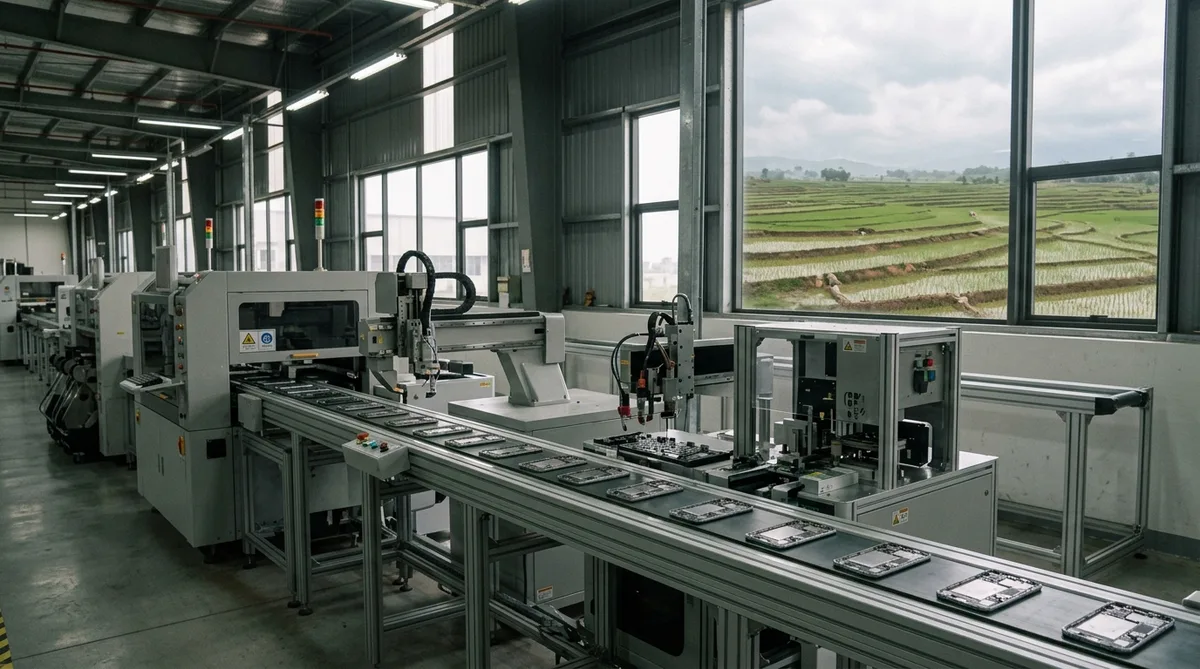
How Vietnam Went From Farming Rice to Building iPhones in One Generation
In 2023, the cost of operating a high-tech assembly line in Vietnam’s northern provinces became a primary factor in global electronics procurement. Driven by a widening wage gap, the average monthly salary for a factory worker in Vietnam hovered between $140 and $202, while similar roles in Chinese manufacturing hubs such as Guangdong often exceeded $400. This 50% delta in labor costs has accelerated a migration of capital that is fundamentally altering the flow of consumer electronics.
Inside the high-tech corridors of Bac Ninh and Thai Nguyen, the landscape is defined by the expansive facilities of global electronics firms. These campuses serve as the primary output centers for a significant portion of the world’s mobile hardware. In 2023, Samsung’s Vietnamese subsidiaries recorded a total revenue of approximately $64.8 billion. According to data from Vietnam’s General Statistics Office (GSO), this output represented a significant portion of the nation’s total Gross Domestic Product, highlighting a transition from low-value textiles to sophisticated hardware assembly.
Vietnam has emerged as a central component in the global high-tech supply chain. By the end of 2023, the country provided nearly 30 percent of all smartphones imported into the United States, positioning it as the second-largest smartphone exporter to the American market. This shift reflects an industrial transformation that saw Vietnam move from 47th in global electronics export rankings in 2001 to the top 10 by the early 2020s. This growth is the result of a deliberate strategy to leverage regional trade agreements and a shifting geopolitical climate that favors geographical diversification.
The Scale of Industrial Concentration
The current industrial landscape was largely shaped by early institutional investments. As of late 2023, Samsung had committed a cumulative $22.4 billion to its Vietnamese operations, which include six factories and a dedicated research and development center in Hanoi.
Source: National Statistics Office / VnEconomy, July 2025
The scale of this presence has significantly impacted the national trade balance. In 2023, Samsung’s export turnover was valued at approximately $55.7 billion, accounting for a double-digit percentage of the country’s total export value. This concentration has made Vietnam a global production center for high-end mobile devices, maintaining high operational capacity even during periods of global demand volatility.
“Vietnam has moved toward becoming a smart-production hub, attracting billions in foreign direct investment from corporations like Samsung and Foxconn,” noted Đỗ Thị Thúy Hương, an executive board member at the Vietnam Electronic Industries Association (VEIA). This trend is reflected in the Industrial Production Index (IIP), which showed continued growth in the electronics sector throughout 2023 and the first half of 2024. The sector now contributes over 30 percent of Vietnam’s total export turnover, according to the Ministry of Industry and Trade.
The Expansion of the Component Ecosystem
The momentum established by early movers has been augmented by the rapid expansion of Apple’s supply chain within the country. Seeking to diversify production and mitigate risks associated with single-source dependency, Apple has increased its reliance on Vietnamese facilities.
In 2016, Apple’s supplier list included 18 companies with operations in Vietnam. By 2023, that number had grown to 28, according to Apple’s official supplier reports. This expansion includes major contractors such as Foxconn, Luxshare, and Goertek, which have moved assembly lines for products including AirPods, iPads, and the Apple Watch to Vietnamese provinces.
Source: Apple Supplier Report, May 2025
Market forecasts from late 2023 suggested that Vietnam is on track to produce a significant majority of global AirPods and a growing share of the iPad and Apple Watch market by 2025. This transition involves more than just final assembly; it requires the integration of increasingly complex sub-components. During a visit to Hanoi in early 2024, Apple leadership indicated a commitment to further increasing spending on local suppliers, signaling a long-term shift in where the company’s hardware is sourced for global markets.
Competitive Advantages and Trade Policy
The primary driver for this relocation is the “China+1” strategy, a corporate framework used to hedge against supply chain shocks and trade tariffs by establishing secondary production hubs. Vietnam offers a combination of proximity to established component ecosystems in East Asia and a network of international trade agreements.
In 2024, the wage disparity remains a critical factor. While Chinese wages have risen due to a shrinking labor pool and a shift toward service-oriented growth, Vietnam’s manufacturing sector continues to offer competitive rates for high-volume assembly.
Beyond labor, Vietnam has utilized trade policy to secure its market position. The country is a signatory to 16 free trade agreements, including the Comprehensive and Progressive Agreement for Trans-Pacific Partnership (CPTPP) and the Regional Comprehensive Economic Partnership (RCEP). These agreements allow manufacturers based in Vietnam to export to major markets with reduced or zero tariffs, a benefit not always available to China-based facilities.
Source: SVI Global, May 2026
According to reports from market analysts like Beacon Filing, Vietnam’s positioning as a pure export platform distinguishes it from other emerging markets. While countries like India are often viewed as competitors, manufacturing in India is frequently driven by the desire to access the domestic Indian market. In contrast, the infrastructure in Vietnam is specifically optimized for global distribution.
The Value-Added Challenge
Despite record export figures—with electronics exports reaching approximately $110 billion in 2023—the Vietnamese economy faces a structural hurdle. It currently functions primarily as a processing and assembly hub, which necessitates high volumes of imported components.
To assemble a high-end device, factories in Vietnam must import sophisticated parts, including semiconductors, display panels, and specialized sensors, from China, South Korea, and Taiwan. In early 2024, imports of electronic components and computer parts frequently exceeded $6 billion per month to sustain assembly operations.
The current localization rate—the value added by domestic Vietnamese firms—remains between 10 and 15 percent. Local firms face significant barriers to entering the primary supply chains of global giants. Of the hundreds of Vietnamese companies currently operating in the electronics support industry, only a small fraction have achieved the technical certification required to become tier-1 suppliers. Most domestic firms are relegated to tier-2 or tier-3 roles, providing packaging, plastic molding, or basic mechanical parts.
To address this, the Vietnamese government has prioritized the development of “supporting industries.” The goal is to increase the localization rate significantly by 2030, encouraging domestic firms to move up the value chain from basic assembly to the production of high-precision components.
Infrastructure and Economic Sustainability
The surge in industrial activity has bolstered national growth figures. In 2023, the International Monetary Fund (IMF) noted that Vietnam’s economy showed resilience, with growth supported by robust exports and foreign direct investment (FDI). Paulo Medas, IMF Mission Chief for Vietnam, observed in an assessment that supportive policies and resilient FDI helped the economy navigate a challenging global environment.
However, the rapid influx of factories has placed pressure on the national infrastructure. The electricity grid, in particular, has struggled to keep pace with the energy-intensive requirements of 24-hour manufacturing facilities. During the summer months of 2023, some industrial zones faced power stability issues, prompting calls for increased investment in renewable energy and grid modernization to ensure long-term reliability for high-tech tenants.
Mariam J. Sherman, the World Bank’s Country Director for Vietnam, noted in a 2024 report that while the growth outlook is positive, the country must manage external risks and invest in human capital to sustain its momentum. The shift toward high-tech manufacturing requires a workforce capable of operating automated systems and managing complex logistics.
Global Market Implications
For the global consumer, the “Made in Vietnam” label represents a restructuring of the global economic map. The relocation of manufacturing has served as a stabilizing force for electronics prices during a period of rising costs in other regions.
The industry remains sensitive to external shocks. Research analysts at Counterpoint Research have noted that the sector is currently navigating fluctuations in semiconductor pricing and shifting consumer demand in major Western markets. These factors affect the profit margins of assembly-heavy operations in Vietnam, which must manage high import costs for raw materials.
Vietnam’s industrial evolution has moved beyond the production of low-cost commodities. A generation ago, the country’s primary exports were agricultural products and raw materials. Today, the monthly value of electronics exports regularly exceeds $10 billion. As new investments from firms like Foxconn—including a $500 million expansion in Bac Giang—come online in 2024 and 2025, the country’s role as a critical node in the global silicon age continues to solidify. Vietnam has transitioned from a peripheral participant to an essential player in the technology that defines modern commerce.
Sources
- World Bank — Viet Nam Macro Monitoring, January 2026
- IMF — Executive Board Concludes 2025 Article IV Consultation with Vietnam
- World Bank — Vietnam Overview
- Nikkei Asia — Apple ramps up India, Vietnam production
- https://asia.nikkei.com/Economy/Trade/Global-manufacturers-are-flocking-to-Vietnam.-Is-it-ready
- https://asia.nikkei.com/Spotlight/Coronavirus/Samsung-says-Galaxy-factories-in-Vietnam-are-at-full-capacity
- https://www.imf.org/en/Countries/VNM
- https://www.gso.gov.vn/en/homepage/
- https://oec.world/en/profile/bilateral-product/electrical-machinery-and-electronics/reporter/vnm
The information presented is for educational and informational purposes only and does not constitute investment advice. MainStreet uses AI to generate content — always verify with qualified financial professionals before making investment decisions. How MainStreet works →
Discussion