The 500 Undersea Cables That Carry the World's Internet — and the Race to Control Them
In January 2022, the residents of Tonga suddenly found themselves disconnected from the modern world. A massive undersea volcanic eruption severed the single fiber-optic cable connecting the archipelago to the rest of the world. For weeks, the nation was forced to revert to paper banking and door-to-door communication to share news, as the essential connection that provided everything from international credit card processing to basic internet search lay broken on the Pacific floor.
While the Tonga incident was a natural disaster, it revealed a fundamental truth about our modern lives: the global economy does not live in the “cloud.” It lives in a few hundred fragile, garden-hose-sized tubes resting in the silt of the deep ocean.
As of early 2024, these undersea fiber-optic cables carry an estimated 99 percent of all intercontinental data traffic. They are the circulatory system of global capitalism, facilitating approximately $10 trillion in daily financial transactions, according to the Center for Strategic and International Studies (CSIS). Without them, the global financial system would not just slow down; it would cease to function.
This invisible infrastructure is currently undergoing its most significant transformation since the first telegraph wires were laid in the 1850s. For decades, these cables were built and owned by consortia of national telecommunications companies. Today, a new group of dominant technology firms is taking over the seabed.
Google, Meta, Amazon, and Microsoft—often called “hyperscalers”—now control approximately 75 percent of all international bandwidth. This is up from negligible levels as recently as 2010, according to data from TeleGeography. This shift is turning a once-public utility into a private strategic asset, sparking an intense competition for control of the ocean floor.
The $10 Trillion Daily Pulse
To understand why tech giants are moving to the bottom of the sea, one must look at the scale of capital flowing through these glass fibers. The pulse of the global economy is measured in petabits per second.
A single major international bank can move trillions of dollars per day through subsea cables. When a card is swiped in London for a purchase processed by a server in Virginia, the data doesn’t go to space; it dives into the Atlantic.
The impact of these lines is most visible when they fail. When a cable in the Red Sea is damaged, the impact is felt immediately by individuals like a logistics coordinator in Rotterdam, whose real-time tracking software for thousands of shipping containers suddenly lags, delaying critical offloading schedules and rippling through European supply chains. For the millions of remote developers in South Asia who provide backend support for Western firms, a millisecond of latency can halt entire production cycles.
Contemporary life is inseparable from an operational internet, functioning as a utility that underpins basic economic participation. Global bandwidth demand has skyrocketed, tripling between 2019 and 2023 to reach approximately 5 Petabits per second (Pbps). The growth is particularly aggressive in emerging markets; Africa saw a 50 percent compound annual growth rate in demand through early 2024. This persistent growth in data consumption pushed investment in new subsea projects to a projected $10 billion to $12 billion for the 2024-2026 period.
Source: TeleGeography, January 2025
The Hyperscaler Takeover
The move from telecom ownership to tech-giant ownership is a change in the very logic of how the internet is built. In the past, companies like AT&T or Orange built cables to sell capacity to others. Now, Google and Meta build cables primarily to carry their own traffic—video streaming, social media feeds, and the massive data sets required to train artificial intelligence.
Meta is a primary backer of the “2Africa” cable, a 45,000-kilometer fiber-optic system connecting Africa, Europe, and Asia. It is one of the longest subsea projects ever attempted. Google has invested in more than 30 subsea projects worldwide, including the “Nuvem” transatlantic cable and the “Firmina” cable connecting North and South America.
This dominance allows tech companies to bypass the traditional internet infrastructure. Because this traffic is often routed over fully private, “dark fiber” subsea segments, it remains invisible to traditional carrier networks. This renders massive data volumes opaque to the telecom companies that once managed the world’s data flows.
Source: TeleGeography, June 2026
Fragility and Sabotage
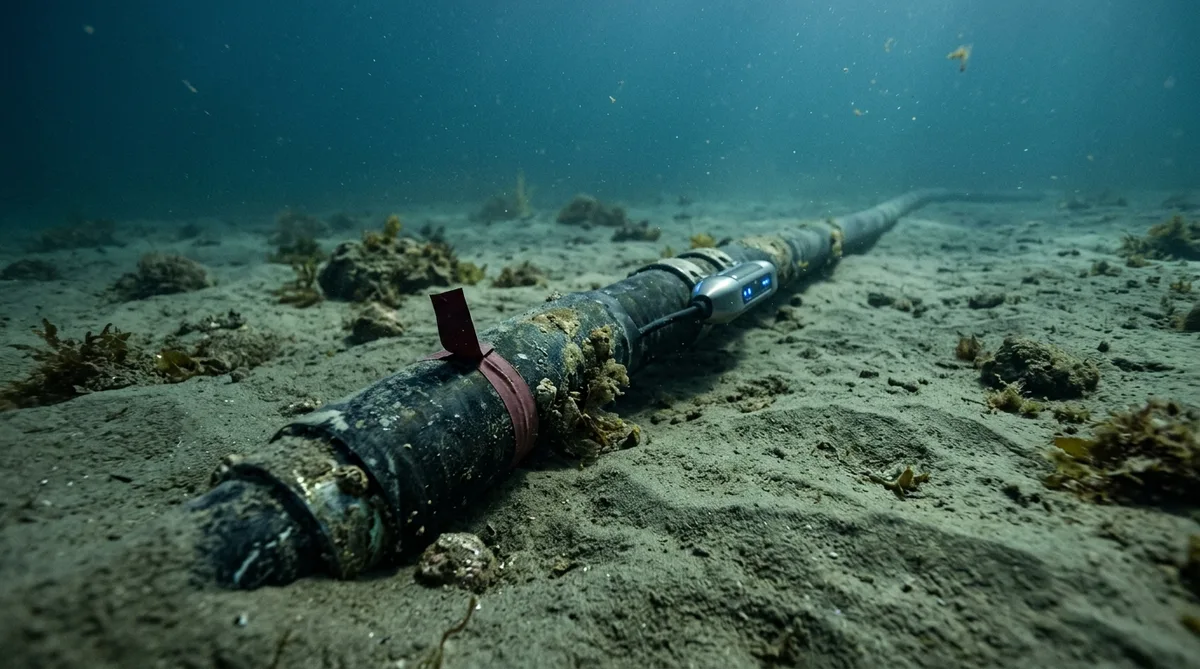
For all their economic importance, these cables are surprisingly vulnerable. They are roughly the thickness of a garden hose, protected by layers of steel wire and plastic. Once they reach the deep ocean, they often sit exposed on the seabed.
Nearly 98 percent of cable faults occur within a nation’s 200-nautical-mile Exclusive Economic Zone (EEZ), where fishing and anchoring activity is densest. However, the threats are increasingly intentional.
In March 2024, the dragging anchor of a damaged vessel severed three major cables in the Red Sea, disrupting an estimated 25 percent of internet traffic between Asia and Europe. In September 2023, multiple cable cuts near Jeddah, Saudi Arabia, caused significant service degradation for cloud users across the Middle East.
In response to these vulnerabilities, NATO established the Maritime Centre for the Security of Critical Underwater Infrastructure in May 2024. This followed multiple incidents of damage to data cables in the Baltic Sea, where authorities investigated the role of commercial shipping in interfering with undersea links between Finland and Estonia in late 2023.
The Geopolitical Chessboard
The cables have become the front line of a new technological splintering. Control over where a cable lands and who builds it is now a matter of national security.
In mid-2024, the U.S. Federal Communications Commission (FCC) advanced regulatory updates aimed at securing subsea cable landing licenses. These measures focus on the security of the supply chain, reflecting concerns over the participation of certain foreign suppliers in systems that connect to U.S. territory.
This competition is playing out in real-time contracts. The SeaMeWe-6 cable project, linking Singapore to France, saw its contract awarded to U.S.-based SubCom after a period of intense diplomatic and economic competition regarding the original selection of a Chinese supplier.
This shift moves the internet away from a unified global architecture toward a fragmented landscape. As nations increasingly mandate specific routing protocols and security standards for cables landing on their shores, businesses may face a “splintered” internet where data pathways are dictated by political alignment rather than technical efficiency. Despite these pressures, China’s HMN Tech remains a significant global subsea cable builder, reflecting the ongoing bifurcation of the world’s digital infrastructure.
Global Resilience and the AI Era
As dependence on these lines grows, the focus is shifting toward resilience. Ireland has emerged as a critical global nexus, with a significant portion of subsea cables in the Northern Hemisphere passing through or near Irish waters as of early 2024.
The European Commission’s 2024 Action Plan on Submarine Cable Security provided a framework for new “Cable Hubs” to decentralize connectivity. The goal is to reduce reliance on geographical chokepoints like the Red Sea or the Strait of Luzon. Similarly, the OECD has called for standardized international indicators for subsea cable stability, noting that economic security is now synonymous with cable security.
Source: European Commission / CSIS, 2025-2026
Looking ahead, the demand for subsea capacity is expected to accelerate. The development of large language models and generative AI requires moving gargantuan amounts of data between specialized data centers located in different corners of the globe.
According to data from the U.S. International Development Finance Corp, the infrastructure requirements for AI and eventually quantum computing are driving the need for a denser, more resilient subsea network. This ensures that competition over undersea infrastructure will only intensify.
Trillions of dollars move daily through a network of glass on the ocean floor. It is a world of extreme pressure and invisible data. While the internet is often discussed as a wireless or celestial phenomenon, its true heart is anchored in the deep mud of the seabed.
The companies currently under scrutiny for how they moderate content and handle user privacy are now the landlords of the physical internet. This vertical integration grants them unprecedented control over the global data flow, positioning private corporations as the primary arbiters of international connectivity and infrastructure security. The map of the ocean floor has become a map of modern power, and the transition from public utility to private corridor will determine the stability of the global economy for decades to come.
Sources
- CSIS — Protecting Subsea Cables: Detect to Deter, Sue to Secure, July 2025
- OECD — Resilience of communication networks report, May 2025
- European Commission — Security and Resilience of EU Submarine Cable Infrastructures, October 2025
- Oxford Internet Institute — Meta's longest undersea cable: infrastructure and geopolitics
- https://www.atlanticcouncil.org/in-depth-research-reports/report/cyber-defense-across-the-ocean-floor-the-geopolitics-of-submarine-cable-security/
- https://www.csis.org/analysis/safeguarding-subsea-cables-protecting-cyber-infrastructure-amid-great-power-competition
- https://resources.telegeography.com/2023-mythbusting-part-3
- https://www.submarinecablemap.com/
- https://www.reuters.com/investigates/special-report/us-china-tech-cables/
- https://www.hudson.org/technology/part-your-world-us-china-competition-under-sea
The information presented is for educational and informational purposes only and does not constitute investment advice. MainStreet uses AI to generate content — always verify with qualified financial professionals before making investment decisions. How MainStreet works →
Discussion