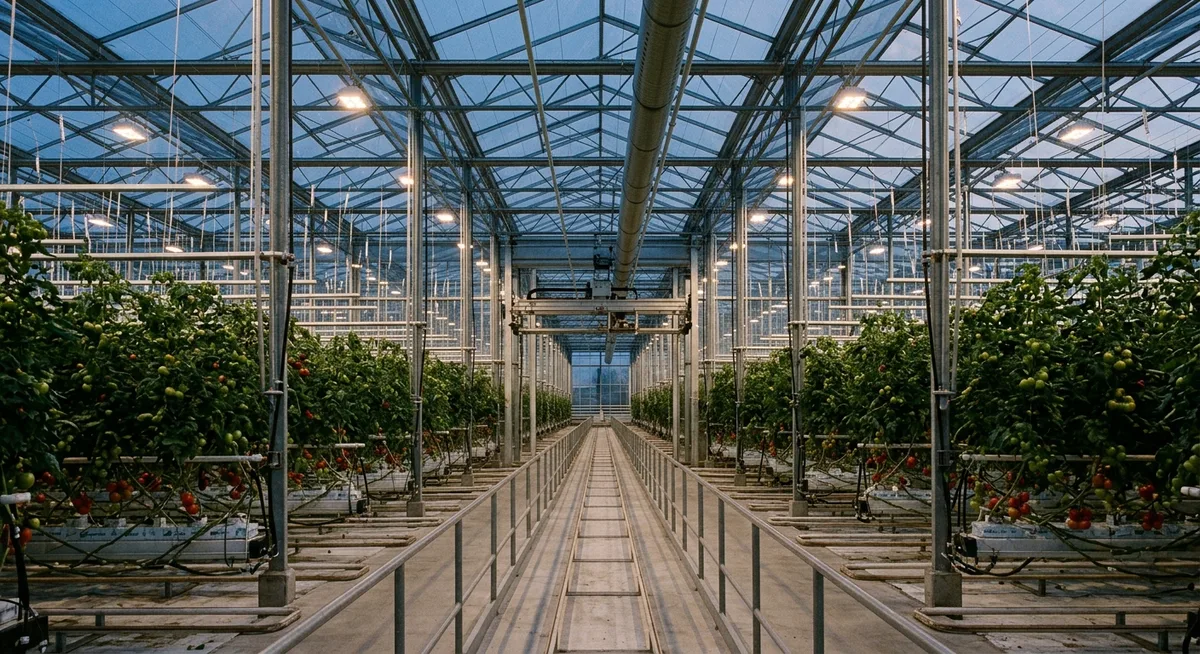
How a Country the Size of Maryland Became the World's Second-Largest Food Exporter
To understand the future of global food security, look at a tomato growing in a glass fortress outside Rotterdam.
This tomato does not live in soil. It hangs from a vine in a climate-controlled greenhouse, its roots bathed in a precise nutrient mist. It requires roughly half a gallon of water to reach maturity. To grow that same pound of tomatoes in a traditional open field—the kind found in the American Midwest or the Mediterranean—would require 28 gallons of water, according to data from Wageningen University & Research (WUR).
The Netherlands is a waterlogged nation roughly 1.3 times the size of Maryland, yet it has spent the last decade defying the laws of geography. By value, this country is the world’s second-largest exporter of agricultural products, trailing only the United States—a nation with roughly 270 times its landmass.
Statistics Netherlands (CBS) and WUR released figures in early 2024 showing that Dutch agricultural exports reached record highs in 2023. This marked an increase of over 8 percent compared to the previous year, continuing a long-term trend of growth. For a world grappling with climate-induced droughts and a population heading toward nine billion, the Dutch model provides a blueprint for doing more with radically less.
High-Tech Harvests
The secret sits inside 24,000 acres of glass—an area nearly twice the size of Manhattan. These are high-tech laboratories where every variable is managed by artificial intelligence to ensure optimal growth.
Source: WUR / Statistics Netherlands, 2025-2026
In these environments, one acre of greenhouse can produce yields equivalent to 10 acres of traditional dirt farming. The efficiency extends to pest management. According to CBS data, biological pest control has become the standard for the vast majority of Dutch greenhouse crop cultivation. The use of predatory mites and other biological agents has largely replaced traditional chemical pesticides in these controlled environments, creating a closed-loop system that minimizes runoff.
This collaborative approach is known as the “Triple Helix” model. It brings together the national government, private entrepreneurs, and research institutions like WUR to solve specific technical bottlenecks. When the industry needed to reduce water usage, this partnership funded the transition to hydroponics. To manage energy costs, the sector pioneered the use of geothermal heat and the capture of waste CO2 from industrial plants to stimulate plant growth.
A Global Hub for Processing and Transit
The Netherlands’ position as an export giant relies on its role as a sophisticated agricultural clearinghouse. The country does not just grow food; it manages the flow of it across the European continent.
Approximately two-thirds of Dutch agricultural exports are of Dutch origin, meaning they were produced or substantially processed within the country. The remaining third consists of re-exports: goods that enter the Port of Rotterdam from global markets—including South America, Africa, and the United States—only to be sorted, packaged, and shipped out again.
Source: Statistics Netherlands (CBS), 2026
According to Wageningen Economic Research, Dutch agriculture plays an essential role in international trade chains as a producer, processor, and transit hub. This explains why both exports and imports are substantial and grow in tandem. For international trade partners, the Netherlands serves as the primary entry point for processed food exports into the European Union, utilizing a logistics network that is among the most efficient in the world.
The Stikstofcrisis: The Cost of Intensity
Being the world’s most intensive agricultural producer comes with a heavy environmental footprint that the Dutch legal system is no longer willing to ignore. The nation currently faces the stikstofcrisis, or nitrogen crisis.
The Netherlands has the second-highest nitrogen surplus per hectare in Europe. Decades of intensive livestock farming have resulted in high levels of ammonia emissions, which threaten local biodiversity and have led to court rulings halting infrastructure projects. In response, the government has moved to implement nitrogen reduction targets to protect sensitive natural areas.
This policy shift has triggered a visual transformation of the Dutch countryside. In many rural provinces, the traditional red-white-and-blue Dutch flag is flown upside down from farmhouses and overpasses—a symbol of protest against the proposed mandates. The intensity of the livestock sector, which includes some of the highest densities of cows and pigs in the world, has become a flashpoint for a national debate over the future of land use.
The Dutch cabinet has maintained that these measures are necessary for the long-term survival of the sector and the restoration of ecological balance. Without significant reductions in ammonia and nitrate runoff, the country faces an economic and environmental standstill that could prevent the construction of new housing and infrastructure.
Exporting the Architecture of Farming
Because of these domestic constraints, the Netherlands is increasingly shifting its focus from exporting food to exporting the technology used to grow it. This includes greenhouse materials, automated harvesting machinery, and advanced irrigation sensors.
Source: USDA / WUR / CBS, 2025-2026
This shift is increasingly visible in the United States. In states like Kentucky and Virginia, massive greenhouse complexes are appearing, modeled directly on the Dutch system. These facilities aim to provide year-round produce to the Eastern Seaboard while using a fraction of the water required by the drought-stricken fields of the American West.
The Dutch experiment suggests that food security is increasingly a matter of engineering. As climate change makes traditional outdoor farming more volatile, the lessons learned in the greenhouses of South Holland are becoming a global standard for resilience.
Data from WUR suggests that hunger is more often a matter of logistics and buying power rather than an absolute shortage of production capacity. For the average consumer, the evolution of this technology means that grocery store produce will increasingly come from high-tech indoor facilities. The farms of the future are moving away from the image of rolling pastures toward the reality of glass cities, managed by sensors and driven by a necessity for absolute efficiency.
Sources
- Statistics Netherlands (CBS) — Value of agricultural exports up by over 8 percent in 2025, March 2026
- The Washington Post — Cutting-edge tech made this tiny country a major exporter of food, November 2022
- DutchNews.nl — Cabinet stands firm on nitrogen plans after heated debate, July 2026
- National Geographic — This Tiny Country Feeds the World, September 2017
- Wageningen University & Research (WUR) — Agricultural exports continue to grow, imports grow faster, January 2026
- U.S. Department of Commerce (trade.gov) — Netherlands Country Commercial Guide, Agriculture
The information presented is for educational and informational purposes only and does not constitute investment advice. MainStreet uses AI to generate content — always verify with qualified financial professionals before making investment decisions. How MainStreet works →
Discussion