South Korea Is Running Out of Babies — and the Rest of the World Is Watching
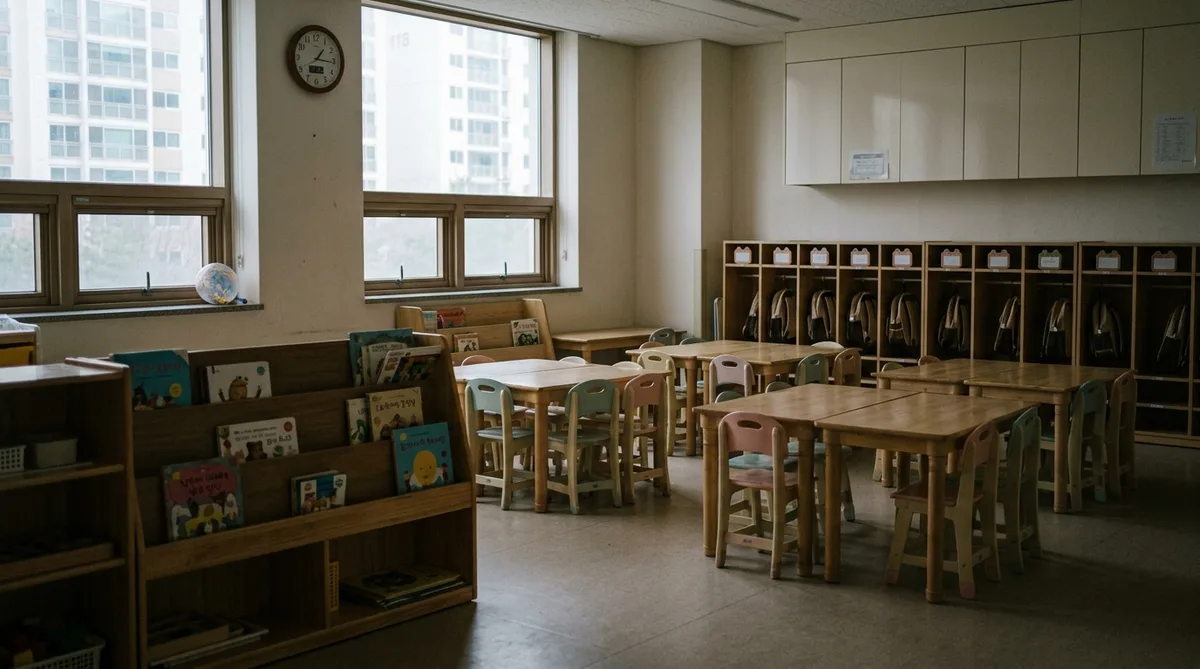
In 2024, 157 elementary schools across South Korea did not hold an entrance ceremony. There were no children to enroll.
What was once a localized phenomenon in shrinking rural villages has now reached the heart of Seoul. The capital city recently saw the closure of Dobong High School, the first general high school in the city to shut its doors due to a lack of students. Across the country, elementary schools are being repurposed into senior welfare centers, a physical manifestation of the country’s shifting demographic profile. The playgrounds are quieter, the private academies — the famed hagwons — are consolidating, and the very foundation of the South Korean economy is beginning to change. In a world where a fertility rate of 2.1 is required to keep a population stable, South Korea has entered uncharted territory.
The current situation represents a significant structural challenge. The country’s total fertility rate — the average number of children a woman is expected to have in her lifetime — reached a record low of 0.72 in 2023, according to Statistics Korea. Projections for 2024 indicate the figure may drop further to 0.68, with some quarterly data already dipping to 0.65.
Statistics Korea reports that these figures indicate a period of potential structural stagnation. As the labor force contracts, the South Korean economy faces a fundamental realignment of its productive capacity.
South Korea is currently a primary example of a phenomenon economists call the “demographic crunch.” While almost every developed nation is seeing birth rates fall, South Korea is the only member of the OECD where the rate has remained consistently below 1.0. For the global community, Seoul serves as a case study for a future where productivity must be maintained even as the working-age population declines.
The Strained Balance Sheet
The demographic shift is straining the nation’s balance sheet. In 2023, the number of newborn babies in South Korea dropped to 230,000, a 7.7 percent decrease from the year prior. This represents a significant decline from the 1970s, when the country recorded nearly one million births per year.
This collapse has sustained what demographers call the “Death Cross,” the point where annual deaths exceed annual births. South Korea crossed this threshold in 2020, and the gap has widened every year since. In 2023, the natural population decline reached 122,800 people.
Source: Statistics Korea, June 2026
The economic implications are substantial. The South Korean National Pension Service (NPS) is navigating a changing financial landscape. With a shrinking pool of young workers to contribute to the system and an expanding population of elderly recipients, the National Pension Service projected in 2023 that the fund could be depleted by 2055 without reform.
This creates a significant pressure on the country’s younger generation. They are tasked with driving economic growth while supporting an elderly population that, according to 2023 OECD data, has a poverty rate of 40.4 percent — the highest among member nations.
Policy Response and Economic Realities
Since 2006, the South Korean government has allocated roughly 380 trillion won — approximately $286 billion — toward initiatives designed to increase the birth rate. These funds have supported monthly stipends, subsidized childcare, and housing credits.
In 2024, the Ministry of Land, Infrastructure and Transport expanded the “Newborn Low-Interest Loan,” which allows parents who have a child to borrow up to 500 million won ($375,000) for housing at interest rates as low as 1.6 percent.
Despite these significant state interventions, the fertility rate has continued to decline. Economic analysis from the KDI School of Public Policy and Management suggests that financial incentives often address the symptoms rather than the root causes of the decline. These include a rigid corporate culture that often penalizes parental leave and a social structure where the cost of child-rearing, particularly private education, remains high.
South Korean parents spend more on private tutoring per capita than almost any other population. This expenditure is a response to an ultra-competitive job market where stability is often associated with a few elite positions at major conglomerates. For many young couples, the choice is framed as a trade-off between starting a family and maintaining economic security.
The ‘N-po’ Generation and the Seoul Squeeze
Housing costs remain a primary barrier. Real estate prices in Seoul, where nearly half the population resides or commutes, increased by over 80 percent between 2017 and 2022. In a 2024 survey conducted by the Korea Real Estate Board and Statistics Korea, 40 percent of young couples identified housing costs as the leading reason for delaying marriage or children.
This environment has led to the rise of the “Sampo Generation” — a term for those opting out of dating, marriage, and children. This has expanded into the “N-po Generation,” where “N” represents a variety of traditional milestones being deferred or abandoned, ranging from homeownership to social engagement.
Source: OECD, Eurostat, CDC (2024 Data)
Cultural shifts are also evident in the data. A 2023 survey by the Korea Institute for Health and Social Affairs (KIHASA) found that only 28 percent of South Koreans in their 20s and 30s viewed marriage as an essential life event.
Research from KIHASA indicates that the traditional family structure is undergoing a transition under the weight of high competitive pressure and urban living costs. Women, in particular, face specific professional hurdles. While female labor participation is high, the gender wage gap in South Korea was the widest in the OECD at 31.2 percent in 2023. Career interruptions for childcare are often perceived as a significant professional risk, contributing to the fact that the average age for a woman giving birth to her first child is 33.0 years — the oldest in the OECD.
A Global Context
While South Korea is an extreme outlier, it is part of a broader global trend of aging populations. Japan maintained a fertility rate of 1.20 in 2024. Italy and Spain, which have the lowest fertility rates in Europe, were recorded at 1.24 and 1.16 respectively, according to Eurostat data.
Even the United States, which has traditionally balanced falling birth rates through immigration, reached a record low fertility rate of 1.62 in 2023, according to the CDC. China’s 2023 fertility rate was estimated at 1.0, leading to concerns regarding its long-term economic growth potential as its working-age population begins to contract.
Shrinking from 330k (2020) to 190k (2035)
Impact on GDP growth potential per OECD
Projected depletion of National Pension Service
Source: S. Korean Ministry of Defense / NPS / OECD, 2024
The velocity of the decline in South Korea presents unique challenges for national infrastructure. The South Korean military, which operates on mandatory conscription, is managing a manpower shortage. The Ministry of National Defense projected in 2023 that the pool of 20-year-old men will shrink from 330,000 in 2020 to approximately 190,000 by 2035. This has accelerated the integration of autonomous systems and AI into defense strategy.
Global economic analysis suggests that South Korea is currently a testing ground for how a high-income society functions when human reproduction is secondary to industrial and professional output.
Economic Remodeling and Adaptation
The South Korean government is beginning to shift its focus from attempting to reverse the birth rate to adapting the country’s infrastructure for a smaller population. This transition involves discussions on raising the retirement age, increasing the use of automation in the service and manufacturing sectors, and reviewing immigration policies to address labor shortages.
However, the 2024 OECD Economic Survey of Korea warned that without significant structural changes, the country’s working-age population (15-64) is projected to drop by 35 percent over the next 30 years. This shift would impact GDP growth potential and increase the fiscal burden on the remaining workforce to support social safety nets.
As 2024 progresses, the data from Seoul suggests that financial incentives alone may not address the underlying structural issues. If the core costs of living — including housing, education, and the professional opportunity cost of parenthood — remains high, the demographic trajectory is unlikely to shift through government spending alone.
Demographic research from Oxford University indicates that without a focus on work-life balance and gender equality, the current trend of depopulation will require a total remodeling of the modern state. The quiet playgrounds in Seoul are no longer just a local concern; they are a signal being monitored by central banks and ministries worldwide as they prepare for a graying global economy.
Sources
- Statistics Korea (KOSTAT) — 2023 Birth and Death Statistics, Feb 2024
- OECD — Society at a Glance 2024: OECD Social Indicators
- Reuters — South Korea's fertility rate drops to record low despite $270 billion flurry of subsidies, 2024
- The Economist — Why South Koreans are not having babies, 2024
- World Bank Open Data — Fertility rate, total (births per woman) - Korea, Rep.
- KDI School — Demographic Crisis and Policy Response in Korea
The information presented is for educational and informational purposes only and does not constitute investment advice. MainStreet uses AI to generate content — always verify with qualified financial professionals before making investment decisions. How MainStreet works →
Discussion