The $400 Billion Bill to Fix America’s Crumbling Bridges Is Finally Coming Due
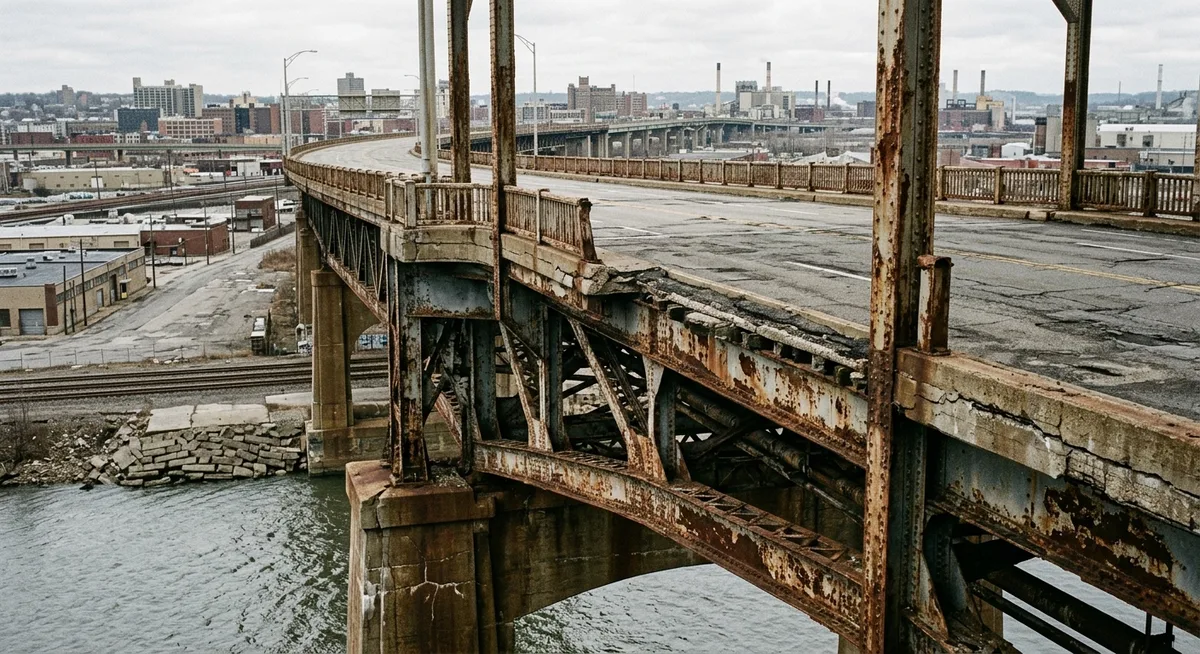
In Harrisburg, Pennsylvania, the I-83 South Bridge serves as a primary transit corridor for 125,000 vehicles every day. Built in 1960, the structure is currently the subject of a massive $1.1 billion replacement plan designed to prevent the imposition of weight restrictions that would reroute heavy freight through local neighborhoods. The bridge is a high-profile example of the systemic maintenance backlog currently facing the American transportation network.
According to the 2025 ARTBA Bridge Report, motorists in the United States cross bridges in poor condition 167 million times every day. These structures, historically classified as “structurally deficient,” are struggling to keep pace with the increasing volume and weight of modern freight.
The data reveals a nation attempting to address decades of deferred maintenance. As of early 2026, approximately 36 percent of all U.S. bridges—nearly 221,800 structures—require major repair work or full replacement. Despite the infusion of federal funding over the last several years, the total estimated cost to clear this backlog is approximately $319 billion.
According to the Department of Transportation, current federal investments represent the most significant commitment to bridge infrastructure since the creation of the Interstate Highway System. However, for the average family, the impact of these aging spans is felt primarily in economic terms. The American Society of Civil Engineers (ASCE) notes in its “Failure to Act” analysis that continued infrastructure underinvestment is projected to cost the average American household $3,300 in lost annual disposable income by 2039. This economic drain is the result of vehicle damage, increased fuel consumption due to detours around load-restricted bridges, and logistical delays that inflate the cost of consumer goods.
Source: ARTBA / ASCE, 2025-2026
The 75-Year Logistical Gap
A central challenge in 2026 is that record-level spending is struggling to outpace the rate of structural decline. The U.S. transportation construction market is projected to reach $209 billion this year, supported by a 3 percent growth in combined federal and state investment.
Yet, the scale of the maintenance deficit remains substantial. At the current rate of repair, ARTBA analysis indicates it would take nearly 75 years to resolve the existing backlog of bridges in poor condition. For a structure designed with a 50-year service life, a 75-year timeline for major rehabilitation effectively renders the structure an obsolete liability before its first major overhaul is even scheduled.
The crisis is geographically concentrated in regions with older inventories. In the Midwest, the situation is particularly acute; Iowa currently has more than 4,500 structures classified in poor condition. In these rural corridors, weight restrictions on a single bridge often require heavy agricultural equipment and freight to utilize significantly longer alternative routes, increasing the overhead for regional supply chains.
Global Variations in Infrastructure Management
The challenge of maintaining mid-century infrastructure is a global phenomenon, with varied national strategies emerging to address the decay.
In Japan, the government has implemented a ¥20 trillion resilience plan to manage an aging crisis where half of the nation’s bridges will exceed 50 years of age by 2033. Facing a shrinking construction workforce, Japan is prioritizing automated maintenance and the deployment of advanced sensors to monitor structural integrity in real-time.
Data from the RAC Foundation in Great Britain shows a similar struggle with local infrastructure; as of 2025, approximately 3,100 bridges managed by local councils were classified as “substandard,” meaning they are unable to carry the heaviest vehicles. The cost to clear this local backlog has continued to rise due to material inflation and labor shortages.
Source: OECD / ITF, 2025
Meanwhile, China continues to outpace Western investment levels. Data from the OECD and International Transport Forum indicates China spends more than 2 percent of its GDP on inland transport infrastructure, compared to an average of 0.5 to 1 percent in the U.S. and Europe. While China’s first generation of expressways is now reaching a phase requiring maintenance, its aggressive expansion of new capacity provides a level of structural redundancy currently absent in older Western networks.
The Funding Cliff and Project Delivery
The most immediate concern for state-level planners is the scheduled expiration of the Bipartisan Infrastructure Law (IIJA) on September 30, 2026. This legislative deadline is creating a “funding cliff” that has introduced caution into state Department of Transportation (DOT) planning.
While $21.2 billion in formula bridge funds had been distributed to states by mid-2025, Department of Transportation data shows that only 55 percent of those funds had been committed to active projects. State agencies are frequently hesitant to initiate large-scale, multi-year reconstructions without the certainty of long-term federal matching funds beyond 2026.
Escalating costs are further complicating the recovery. The Bureau of Labor Statistics’ Producer Price Index for highway and street construction has shown sustained increases in the cost of steel, concrete, and asphalt. Industry analysis from AASHTO suggests that rising labor costs and material inflation have significantly eroded the purchasing power of current infrastructure grants.
In states like Virginia and Georgia, quantitative cost-benefit selection tools have been used to prioritize projects with the highest economic impact, keeping backlogs manageable. Conversely, states in the Northeast and West, such as New York and California, continue to face much higher per-mile costs and longer timelines for project delivery.
The Shift Toward Resilience
The focus of civil engineering in 2026 has transitioned from simple repair toward “resilience” spending. The ASCE identifies extreme weather events and shifting environmental conditions as primary stressors on bridge foundations.
Modern bridge design is increasingly incorporating higher clearances to account for rising water levels and reinforced piers to withstand increased hydraulic pressure. According to the ASCE 2025 Report Card for America’s Infrastructure, these aging systems are becoming more vulnerable to natural disasters, which introduces avoidable risks to public safety and regional economies.
-
IIJA Signed
Infrastructure Investment and Jobs Act allocates record funding
-
BIP Awards
$5 billion awarded for 13 'Large Bridge Projects'
-
Funding Commitment
States commit only 55% of available bridge formula funds
-
Funding Deadline
IIJA set to expire, creating future project uncertainty
Source: ARTBA / USDOT
To manage these risks, engineering firms are deploying “Digital Twins”—virtual replicas of physical bridges that utilize real-time sensor data to identify structural fatigue. While manual visual inspections remain the regulatory standard, there is a growing push for a national transition to sensor-based monitoring.
However, the high upfront cost of this technology often limits its application to major highway spans. In the U.S. and Great Britain, smaller, locally-owned bridges frequently lack the funding for advanced monitoring, leading to a widening gap in reliability between major interstates and the secondary roads that connect them.
Infrastructure and the Industrial Economy
A disconnect is emerging between private sector expansion and public sector capacity. While significant capital is being directed toward the construction of AI data centers and high-tech manufacturing facilities, the physical infrastructure required to move the heavy equipment and personnel these industries require is under strain.
The growth of power-intensive industries like AI has increased the demand for heavy electrical equipment, such as large-scale transformers. Transporting these oversized loads requires bridges with high weight tolerances—capacities that are often unavailable on routes with poor-condition structures.
Federal Highway Administration records indicate that reinvestment in these vital connections is essential for maintaining access to education, healthcare, and employment. However, with the IIJA expiration approaching, the window to secure the next phase of American mobility is narrowing.
When a critical link like the I-83 South Bridge requires a billion-dollar intervention just to maintain existing service levels, it serves as a baseline for the high cost of deferred maintenance. For the drivers crossing the 42,000 bridges currently rated in poor condition, the stability of the economy remains inextricably linked to the spans that support its commerce. As the next decade of infrastructure policy is debated, the focus remains on whether new investment can arrive before existing structures reach the end of their functional utility.
Sources
- ARTBA — 2025 Takeaways: Bridge Report
- FHWA — Biden-Harris Administration Announces $5 Billion to Restore Large Bridges
- ASCE — 2025 Report Card for America's Infrastructure
- RAC Foundation — GB Bridge Maintenance Backlog Grows (2026 Update)
- OECD / ITF — Global Transport Infrastructure Investment Data 2025
- Asia News Network — Japan Faces Shrinking Construction Workforce as Govt Expands Infrastructure Plan
- AASHTO Journal — ASCE Issues 2025 National Infrastructure Report Card
The information presented is for educational and informational purposes only and does not constitute investment advice. MainStreet uses AI to generate content — always verify with qualified financial professionals before making investment decisions. How MainStreet works →
Discussion