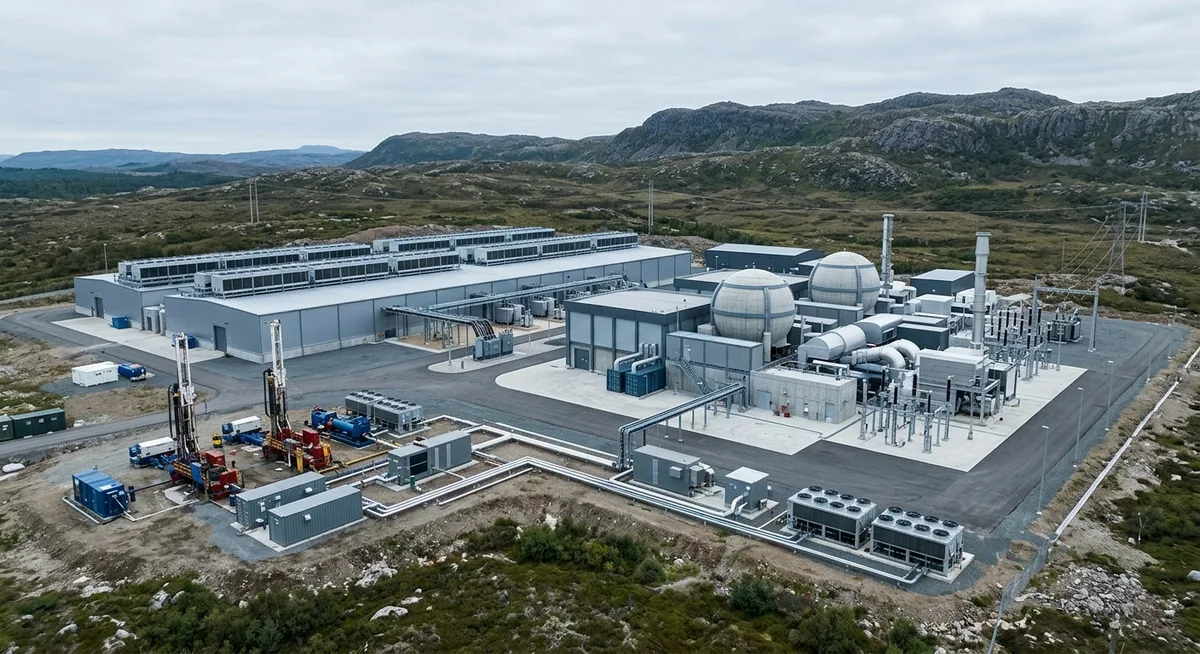
Big Tech Companies are Now Funding Their Own Nuclear and Geothermal Plants to Power the AI Boom
The intersection of silicon and steam has moved from the laboratory to the balance sheet. In the three years since the generative artificial intelligence boom began, the primary bottleneck for the world’s largest technology companies has shifted from a shortage of high-end chips to a shortage of the electricity required to run them. This energy demand is now forcing a fundamental realignment of how the American power grid is financed and built.
For decades, the standard corporate energy strategy involved buying credits from existing wind or solar farms to offset carbon footprints. According to the International Energy Agency (IEA) in its Electricity 2024 report, data center electricity consumption is expected to rise significantly as the sector expands. Goldman Sachs Research projects that data center power demand will grow 160% by 2030, driven by the intensive computational requirements of large language models. This shift is driving capital toward physical infrastructure and “firm” power sources that can provide constant output.
By 2024, the concentration of this demand in specific regions began to impact local grid planning. The IEA notes that while global data center demand currently accounts for a small percentage of total supply, its rapid acceleration is requiring massive grid upgrades. These upgrades have drawn scrutiny from federal lawmakers; in December 2024, U.S. Senator Elizabeth Warren and other members of Congress launched an investigation into the impact of data center expansion on residential electricity rates and grid reliability.
Source: International Energy Agency (IEA), 2026
The Transition to Firm Power
The search for energy that is available 24 hours a day, regardless of weather conditions, has led technology companies to move beyond intermittent renewables. The industry is increasingly focused on energy sources that can provide a “baseload” for data centers that never power down. This has prompted a pivot toward nuclear energy and advanced geothermal concepts that offer carbon-free, steady-state electricity.
Just as solar prices declined through manufacturing scale, the tech industry is betting that repeatable, modular energy projects can drive down the cost of firm power. The focus is no longer on simply offsetting carbon, but on securing the physical electrons necessary to keep servers running. This move toward “hard iron” infrastructure represents a departure from the software-centric investment models of the previous decade.
Small Reactors and Capital Influx
While the energy industry has historically relied on massive, gigawatt-scale projects, the current focus has shifted toward Small Modular Reactors (SMRs). These factory-built units are designed to be deployed in fleets, offering a more predictable construction timeline than traditional large-scale nuclear plants.
In October 2024, Google signed an agreement with Kairos Power to deploy a fleet of SMRs with a total capacity of 500 megawatts by 2035. Kairos Power utilizes a molten-salt cooling system, which allows the reactor to operate at lower pressures than conventional water-cooled reactors, potentially simplifying safety systems and reducing the physical footprint of the plant. Amazon followed with a $500 million investment in SMR developer X-energy. This partnership, which includes Energy Northwest, aims to deploy four 80-megawatt Xe-100 reactors in Washington state by the early 2030s.
-
Microsoft-Constellation Deal
Agreement to restart Three Mile Island Unit 1 for 20 years.
-
Google-Kairos PPA
First-of-its-kind agreement for 500MW of small modular reactors.
-
Amazon X-energy Investment
Amazon leads $500M round to deploy Xe-100 reactors in Washington.
-
Meta Prometheus Campus
Partnered with TerraPower and Oklo for 4GW of SMR capacity in Ohio.
Source: Company Filings and News Reports, 2024–2026
This move toward new technology is accompanied by efforts to revive existing carbon-free assets. In September 2024, Microsoft signed a 20-year power purchase agreement (PPA) with Constellation Energy to facilitate the restart of Unit 1 at Three Mile Island. Now renamed the Crane Clean Energy Center, the 835-megawatt reactor is intended to provide dedicated carbon-free power for Microsoft’s data center operations. Reviving existing nuclear infrastructure is often viewed as a more efficient path to increasing capacity than constructing new large-scale facilities, which face significant licensing and construction timelines.
The Economics of First-of-a-Kind
The financial engine driving these projects is the Power Purchase Agreement (PPA). Traditionally used to purchase energy from established wind or solar farms, these contracts are now being used as project finance for unproven technologies. By guaranteeing to buy power for 20 years at a set price, technology companies provide the certainty required for lenders to fund high-risk construction.
This is a critical shift in the financing of energy projects. Corporate balance sheets are increasingly taking on “first-of-a-kind” (FOAK) risk—the cost premium associated with being the first to build a new technology before it reaches economies of scale. The Department of Energy (DOE) has supported this transition through its Loan Programs Office, though the scale of corporate investment now rivals public sector support.
The capital influx is a direct response to the energy intensity of generative AI. According to Goldman Sachs Research figures from May 2024, a single ChatGPT query requires roughly 2.9 watt-hours of electricity. In comparison, a standard Google search consumes approximately 0.3 watt-hours. As AI tools are integrated into more products, the cumulative load on the grid increases accordingly.
Source: Goldman Sachs Research, 2024
The Global Power Squeeze
The United States is not alone in managing this increase in demand. The IEA reports that in some nations, data center electricity consumption has already become a significant portion of the total national supply. In Ireland, data center demand is projected to reach 32 percent of total national electricity consumption by 2026, a substantial increase from 21 percent in 2024.
In Singapore, data centers accounted for 7 percent of the nation’s total electricity consumption as of 2022. This concentration of demand has made energy policy a central focus for governments as they attempt to balance industrial growth with grid stability.
Source: Carbon Brief, Computing UK, and IDCA, May 2026
In response to these pressures, oversight is increasing. Regulatory bodies are examining how data center connections impact the broader energy market. The focus has turned toward ensuring that the expansion of the digital economy does not outpace the physical capacity of the electrical grid or place an undue burden on other consumers.
Regulatory Challenges and Grid Integration
Despite the momentum behind advanced nuclear and other firm power sources, the sector presents logistical and regulatory challenges. Project costs and construction timelines remain variable, and the industry must still prove it can deliver these new technologies at scale.
Regulators are also taking a closer look at “behind-the-meter” strategies, where data centers plug directly into power plants to bypass the general transmission grid. In November 2024, the Federal Energy Regulatory Commission (FERC) rejected a plan to increase the amount of power a co-located Amazon data center could draw from the Susquehanna nuclear plant. The commission raised concerns that such arrangements could shift transmission-related costs to residential and industrial ratepayers who do not benefit from the data center’s operations.
This regulatory friction suggests that the transition toward nuclear-integrated data infrastructure will require new policy frameworks. The pace of data center development has, in many cases, moved faster than the traditional processes for grid planning and rate-setting.
A New Industrial Geography
The development of new power sources for the tech industry could eventually influence the siting of other energy-intensive sectors. If technology companies successfully fund the deployment of advanced geothermal and nuclear power, the resulting infrastructure could benefit other industries. Reliable, 24/7 carbon-free power is a prerequisite for the decarbonization of heavy industries like steel production and chemical manufacturing.
For now, the American landscape is being reshaped by the needs of digital infrastructure. From the river valleys of Pennsylvania to the growing tech hubs across the country, the infrastructure of the 21st-century economy is being defined by the steady output of reactors and the search for reliable, carbon-free energy. This shift represents a transition in how the world’s most valuable companies interact with the physical environment, turning them into some of the largest investors in the future of the electrical grid.
Sources
The information presented is for educational and informational purposes only and does not constitute investment advice. MainStreet uses AI to generate content — always verify with qualified financial professionals before making investment decisions. How MainStreet works →
Discussion