Why Tech Giants Are Buying Fusion Power Before the Plants Are Built
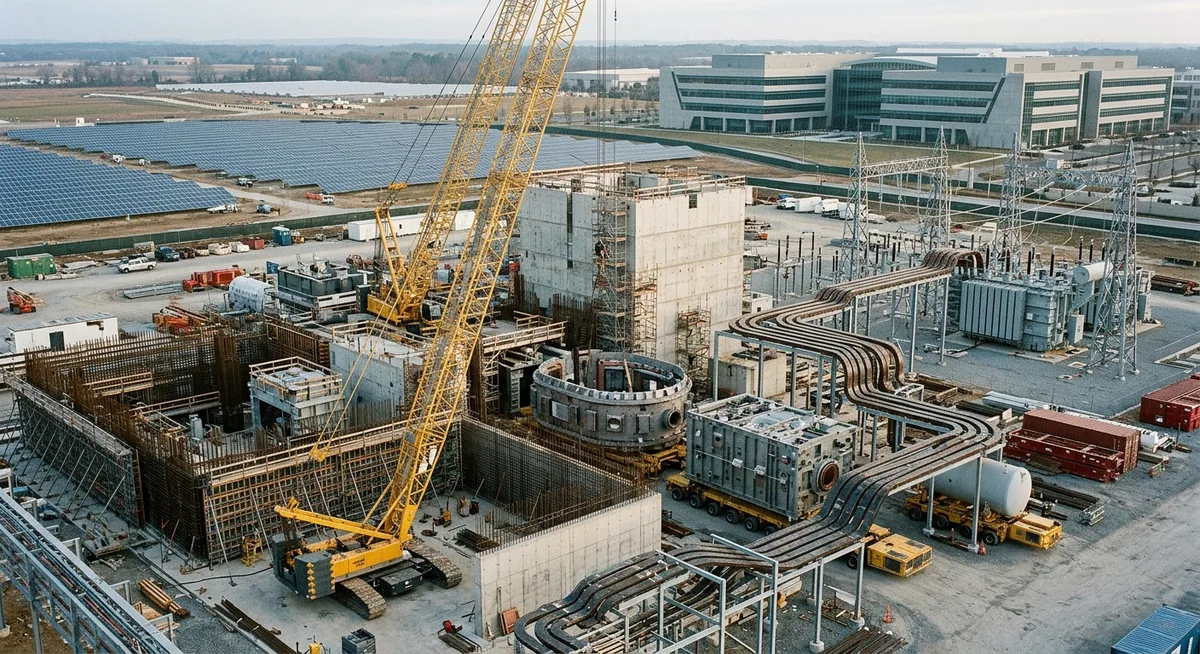
At an active industrial site in Chelan County, Washington, the future of the American electrical grid is being assembled from massive magnets and high-speed capacitors. This facility, known as “Orion,” is where Helion Energy intends to achieve a goal that has eluded generations of researchers: generating net electricity from nuclear fusion.
For decades, fusion—the process that powers the sun—has been characterized as a technology that is perpetually “30 years away.” However, a fundamental shift has occurred in the capital markets and industrial planning sectors. Fusion has moved from the theoretical realm of physics journals to the balance sheets of major corporations. The evidence of this transition is found in commercial contracts rather than laboratory aspirations.
In May 2023, Microsoft signed a first-of-its-kind Power Purchase Agreement (PPA) with Helion, committing to purchase at least 50 megawatts of fusion-generated power with a target start date of 2028. This agreement represents a commercial obligation that treats fusion not as a scientific experiment, but as a future utility. While Google has not signed a similar PPA, the company has positioned itself as a major stakeholder in the industry, acting as a lead investor in Commonwealth Fusion Systems (CFS).
This shift is supported by a surge in private investment that now significantly outpaces public funding. According to the Fusion Industry Association’s (FIA) 2024 Global Industry Report, cumulative private investment in the sector has reached $7.1 billion. The velocity of this funding is notable; over $900 million was raised in the year leading up to the report, representing a sustained increase in investor confidence since 2021.
The Capital Pivot: From Research to Hardware
The economic logic of fusion has been redefined by recent technical milestones and a growing institutional appetite for carbon-free baseload power. In December 2022, the National Ignition Facility (NIF) at Lawrence Livermore National Laboratory achieved scientific ignition, producing more energy from a fusion reaction than the laser energy used to drive it.
While NIF is a federally funded research tool, private companies are leveraging these breakthroughs to advance their own commercial designs. Commonwealth Fusion Systems, a spinout from MIT, has emerged as a leader in capital acquisition. The company’s funding rounds have included participation from Breakthrough Energy Ventures and Google, bringing its total capital to approximately $2 billion.
This capital is being directed toward heavy industrial infrastructure. CFS is currently constructing its SPARC demonstration facility in Devens, Massachusetts. According to company hardware updates, the project is transitioning from a construction phase to an operational phase as the tokamak—the device that confines the plasma—is assembled.
The industry’s growth is also evident in its labor requirements. The Fusion Industry Association reports that private fusion employment has reached over 4,000 direct jobs. The composition of this workforce has evolved to include procurement specialists, civil engineers, and supply chain managers in addition to plasma physicists. In its 2024 analysis, the FIA noted that supply chain spending by fusion firms has increased significantly, with companies increasingly sourcing specialized components from domestic manufacturers.
The Procurement Model: Corporate Integration
The Microsoft–Helion PPA marks a shift in how deep-tech energy projects are financed. Historically, energy infrastructure is built before a buyer is secured. By establishing a contract with a high-credit-quality customer like Microsoft, a fusion company can potentially leverage future revenue to secure project financing for current construction.
This structure is designed to bridge the gap between venture capital and traditional infrastructure finance. For technology giants, the incentive is driven by the escalating energy demands of artificial intelligence and data centers. Fusion offers a potential solution to the limitations of current renewables: it provides carbon-free, baseload power with a minimal land footprint compared to solar or wind farms.
The transition toward commercial infrastructure is further evidenced by grid integration planning. Companies in the sector have begun the process of filing for grid interconnection, a necessary step for any facility intended to supply power to the public. These filings move projects from the realm of laboratory research into the queue of actual energy infrastructure projects alongside natural gas and solar installations.
A Global Strategic Competition
While the U.S. leads in private capital, it faces competition from state-directed energy programs. China has designated fusion as a key national strategic technology, with reports indicating substantial public funding aimed at centralizing its supply chain. Estimates suggest Chinese public spending on fusion may exceed $1 billion annually, focusing on rapid prototyping and state-owned enterprise development.
In response, the U.S. has updated its regulatory landscape to accelerate domestic deployment. In 2023, the U.S. Nuclear Regulatory Commission (NRC) voted to establish a standalone regulatory framework for fusion energy.
By deciding to regulate fusion under 10 CFR Part 30—the framework used for particle accelerators and medical isotopes—the NRC has distinguished fusion from the more complex regulatory requirements of nuclear fission. Fission plants typically face lengthy licensing processes and high compliance costs due to their different risk profiles. The NRC’s decision acknowledges that fusion does not carry the same risks of a runaway chain reaction or long-lived high-level waste, which industry analysts suggest could significantly reduce the timeline and cost for deploying the first generation of commercial plants.
Other nations are also expanding their domestic programs. Germany has increased its fusion research budget, and Japanese industrial conglomerates have begun investing in U.S.-based fusion startups, signaling a global race to secure the first viable commercial supply chain.
The Engineering Reality: From Plasma to the Power Grid
Despite the influx of capital, achieving a functional power plant requires overcoming significant technical hurdles. A critical distinction exists between “scientific breakeven” (Q-Scientific) and “commercial gain” (Q-Total). While the NIF experiment proved the plasma can produce more energy than it absorbs, a commercial plant must achieve wall-plug efficiency. This means the facility must generate enough electricity to power its own massive magnets, cryogenic cooling systems, and control hardware, while still providing a surplus for the grid.
Fuel supply also remains a focus of current engineering efforts. Many commercial designs rely on a mixture of deuterium and tritium. While deuterium is easily extracted from water, tritium is rare. To address this, companies like CFS are developing “breeding blankets” designed to produce tritium within the reactor walls during operation. Other firms, such as Helion, are pursuing alternative fuel cycles like deuterium and helium-3, which avoid the tritium requirement but necessitate much higher operating temperatures.
According to the Fusion Industry Association, the industry is currently moving from the prototype stage to industrial-scale component procurement. The primary risk in this transition is the reliability of components under the extreme conditions required for continuous operation.
The Industrial Economics of Fusion
The long-term economic goal for fusion is to achieve a levelized cost of electricity (LCOE) that is competitive with existing baseload sources. Unlike fossil fuels, fusion has no fuel cost volatility; once a plant is operational, the marginal cost of production is remarkably low.
The initial impact of this technology will likely be felt in energy-intensive industries. For the burgeoning AI sector and high-tech manufacturing hubs, such as semiconductor fabrication plants, fusion represents a potential end to energy scarcity. These facilities require massive, uninterrupted power supplies that are increasingly difficult to secure from an aging and congested electrical grid. By co-locating fusion reactors with data centers or industrial parks, companies could decouple their growth from the constraints of regional power availability.
As the industry moves toward its 2028 and 2030 targets, the focus is shifting to “First-of-a-Kind” (FOAK) costs. While the initial plants will require significant capital expenditure, the goal is to standardize reactor designs to allow for modular construction. If the current development timelines hold, the transition of fusion from a scientific pursuit to a corporate procurement reality will redefine the relationship between economic expansion and energy production. For the first time, the timeline for commercial fusion is being measured by construction milestones and procurement cycles rather than decades of theoretical research.
Sources
The information presented is for educational and informational purposes only and does not constitute investment advice. MainStreet uses AI to generate content — always verify with qualified financial professionals before making investment decisions. How MainStreet works →
Discussion