Your Local Farmland Is Quietly Powering the AI Boom — Here Is How the Map Is Changing
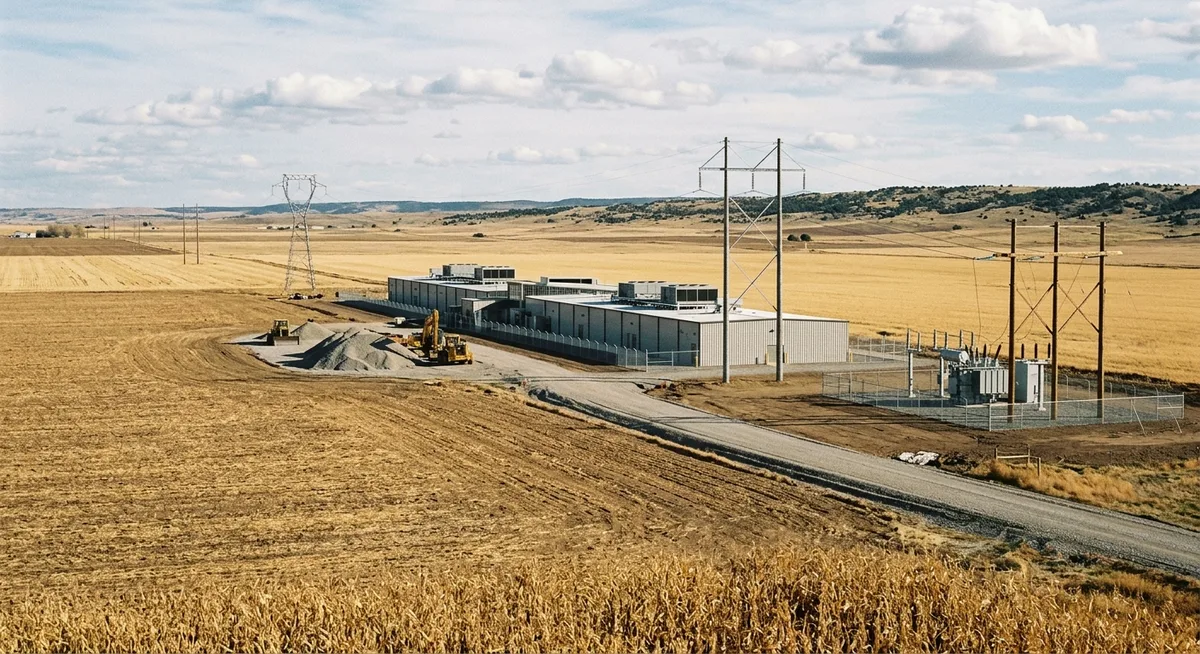
In the rolling hills of Licking County, Ohio, the rhythm of life once followed the seasons of corn and soy. Today, the landscape is being rewritten. Across thousands of acres, the green horizon is broken by massive, windowless gray boxes, flanked by a dense thicket of electrical substations and high-voltage transmission towers. This infrastructure buildout represents a shift in the global race to construct the “agent economy.”
Artificial intelligence is often discussed as an ethereal cloud—a series of abstract algorithms. But AI agents, the autonomous systems now beginning to manage everything from personal schedules to industrial supply chains, have a physical footprint. Every time an agent processes a task, it triggers a chain reaction of heat and energy that terminates in a specific plot of land, cooled by millions of gallons of water and powered by a grid experiencing unprecedented load.
This infrastructure expansion mirrors the construction of the interstate highway system in the 1950s in both scale and speed. Today, the roads are fiber optics and the transit hubs are gigawatt-scale data centers. As of late 2024, data indicates this shift is moving from the digital fringe to the center of the American economic map.
The Physical Price of Thinking
Five hundred billion dollars: That is the price tag for the physical foundation of the agent economy. Global data center capital expenditure—the money spent on land, buildings, and hardware—is projected to exceed this figure by 2027, according to a Wall Street Journal analysis of industry trends. This represents a nearly threefold increase from the $180 billion spent in 2022. Tech firms have committed more toward AI data centers in the past three years than the inflation-adjusted cost of building the entire U.S. interstate highway system over four decades.
Source: JLL / Industry Estimates, April 2026
The unique appetite of AI drives this spending. A traditional data center, which hosts email or streaming services, is relatively lean. An AI-driven facility consumes five to ten times more power per square foot. While a standard server rack might draw 10 kilowatts of power, high-density racks required for autonomous agents are now drawing over 120 kilowatts, according to 2024 data from Brookfield.
This demand is split into two phases: training and inference. Training involves the heavy lifting of model development. A single frontier AI training cluster can draw 500 megawatts of power, enough to sustain a city of 400,000 people. In 2025, the growth is shifting toward “inference” data centers—the locations where trained agents operate. Because agents run in continuous autonomous loops, they require constant, high-density throughput, turning occasional spikes in data demand into a permanent, heavy load on the environment.
Mapping the New Digital Geography
For years, the global epicenter was Northern Virginia’s “Data Center Alley.” In Loudoun and Prince William counties, the concentration of facilities is so high that they anchor the global internet. However, grid constraints in Virginia have led developers to look for new frontiers.
Texas has emerged as a primary beneficiary. With its permissive permitting processes and the ERCOT region’s independent power grid, the state is seeing a surge in massive new builds. According to ERCOT projections, peak summer power demand will surge significantly through 2031, with over 30 gigawatts of that new demand coming specifically from data centers and large-scale computing.
The map is also expanding into the American heartland. Arizona, Georgia, and Ohio have become magnets for investment, aided by state-level tax incentives and large tracts of land. In early 2024, CBRE reported that Atlanta, Georgia, surpassed Northern Virginia in annual net absorption of data center space for the first time, recording 705.8 megawatts of positive absorption.
Source: CBRE Data Center Solutions, Feb 2025
The search for power has pushed developers into remote regions. In August 2024, CoreWeave and Applied Digital finalized an $11 billion lease for a data center campus in Ellendale, North Dakota. The facility is planned to reach 1 gigawatt of capacity, a massive scale for a rural town of roughly 1,000 residents. Applied Digital’s corporate filings indicate this agreement is part of a broader commitment to building AI infrastructure in the U.S. heartland.
International markets are facing similar pressure. Ireland reached a tipping point in 2023 when data centers consumed 21 percent of the country’s total metered electricity—exceeding the consumption of all urban dwellings combined. In Asia, Singapore has implemented strict green criteria for new builds to manage land and power, while Malaysia has absorbed the resulting overflow of demand.
The Great Power Scramble
For fifteen years, electricity demand in the United States remained essentially flat due to energy efficiency gains. Regional grid operators now forecast a sharp reversal. PJM Interconnection, which coordinates the movement of wholesale electricity in all or parts of 13 states and the District of Columbia, has doubled its 15-year annual load growth forecast, citing data center development as a primary driver. Demand is projected to grow by 2 to 3 percent annually through 2030.
This has triggered a “nuclear renaissance.” Tech giants are signing multi-billion-dollar deals for reliable, carbon-free baseload power. Microsoft, Amazon, and Meta have all pursued deals for nuclear energy, including the effort to restart the Three Mile Island facility to serve data center loads.
The International Energy Agency (IEA) reports that global electricity consumption from data centers could double from 2022 levels to reach more than 1,000 terawatt-hours by the end of 2026—roughly equivalent to the entire electricity demand of Japan.
Source: IEA / World Bank, 2024-2026
To bridge the gap until new nuclear or geothermal capacity comes online, natural gas is playing a central role. Gas plants are being built in the mid-Atlantic and Texas specifically to serve AI clusters. Simultaneously, hyperscalers remain the world’s largest corporate buyers of renewable energy, accelerating wind and solar buildouts to meet carbon-neutral pledges. The result is a dual-track energy strategy: expanding renewable capacity while relying on gas and nuclear to ensure agents remain online.
The Transmission Bottleneck
While a data center can be constructed in roughly 18 months, the infrastructure required to connect it to the grid—transmission lines and substations—often takes seven to twelve years under current U.S. permitting rules. This mismatch is the primary friction point in the agent economy.
Currently, more than 1.5 terawatts of power projects are sitting in utility interconnection queues, with wait times stretching to five years. CBRE data suggests that equipment shortages are compounding these delays. Shortages of transformers and switches could lead to power delivery delays of up to four years.
To bypass these grid constraints, some tech firms are moving “behind the meter.” This involves building on-site power generation—such as small modular reactors or large-scale natural gas turbines—directly at the data center. By generating their own power, they avoid the wait for utility connection, creating digital islands that operate independently of the public grid.
The Rural Windfall and the Risk
For small rural communities, the arrival of a data center can significantly alter the local economy. In Licking County, Ohio, Commissioner Timothy Bubb has noted that these projects represent a massive expansion of the local tax base, providing funding for schools and infrastructure. Land in Central Ohio that was once valued at $30,000 per acre as farmland is now commanding prices exceeding $150,000 per acre when rezoned for data centers, according to data from DataCenters.com.
In Virginia’s Prince William County, offers from developers have reached as high as $3 million per acre. While construction provides temporary jobs, a finished data center typically employs a few dozen permanent staff. This creates a shift in local economic dynamics where high property tax revenue must be balanced against low long-term employment density.
Water is another point of focus. AI servers generate immense heat, and liquid cooling is often the most efficient management method. In 2024, Microsoft reported its global water consumption increased by 34 percent to 6.4 million cubic meters, largely for cooling AI facilities. In Council Bluffs, Iowa, Google’s data center consumption reached 1.3 billion gallons of potable water in 2023—equivalent to the daily needs of thousands of households.
Source: DataCenters.com / Farm Equipment / WSJ, 2025-2026
This consumption has sparked concern in communities with limited water resources. In Tucson, Arizona, and Prineville, Oregon, residents have raised questions about the long-term sustainability of hosting digital hubs in arid environments. Engineering data from Virginia Tech suggests that the environmental cost of data centers depends heavily on the specific cooling technologies and local climate conditions where they are sited.
The Cascading Effect on Ordinary Americans
The scale of this buildout is beginning to influence the cost of living for those nowhere near a data center. In regions with heavy concentrations of these facilities, residential electricity bills have risen as utilities pass on the costs of grid upgrades to the customer base. In Northern Virginia, residential bill increases have been partially attributed to the infrastructure needed to support “Data Center Alley.”
There is also growing competition for industrial capacity. Manufacturers looking to build new factories in the U.S. are finding themselves in competition for grid access. In some cases, battery plants or steel mills may face multi-year waits for power because neighboring data centers have already claimed available capacity.
The “agent economy” is no longer just a software trend. It is a story of steel, concrete, and high-voltage wire—the physical foundation of a new digital age that is deeply rooted in the ground. Every autonomous task executed by an AI agent relies on a physical network that is currently remaking the American landscape.
Sources
- IEA — Data centre electricity use surged in 2025, Jan 2024
- CBRE — North American Data Center Construction Hit New Heights in 2024, Feb 2025
- OpenAI — Announcing The Stargate Project, Jan 2025
- JLL — Secondary Markets Will Drive 2024 Data Centre Growth, Jan 2024
- World Economic Forum — How data centres and AI are becoming a new engine of growth, Dec 2025
The information presented is for educational and informational purposes only and does not constitute investment advice. MainStreet uses AI to generate content — always verify with qualified financial professionals before making investment decisions. How MainStreet works →
Discussion