Wall Street's New Homogeneity Problem: When Every Trader Uses the Same AI
On the upper floors of 270 Park Avenue, the new global headquarters of JPMorgan Chase, the midnight delivery bikes that once crowded the curbside have largely vanished. The dark windows on the 40th floor at 11:00 PM represent a physical shift in the building’s operational reality. For decades, the path to a Wall Street fortune began with a brutal rite of passage: two years of 100-hour weeks spent manually spreading comparables and drafting 80-page pitch books.
That era ended this year.
As of April 2026, the world’s largest banks have moved beyond simple chatbots to fully autonomous AI agents. These systems don’t just answer questions; they execute tasks, manage workflows, and increasingly make decisions. Firms like Goldman Sachs are now capable of drafting 95 percent of an S-1 IPO prospectus in minutes rather than weeks.
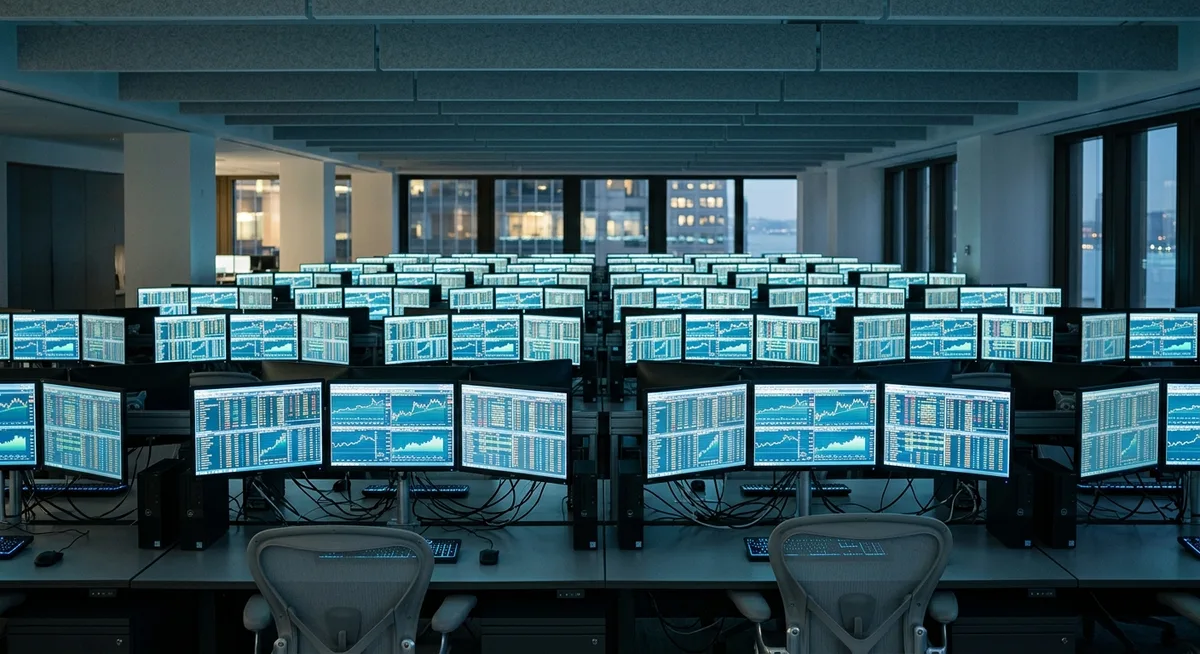
But this efficiency introduces an architectural vulnerability. As the financial sector converges on a handful of dominant AI models, a new kind of risk is emerging. When every bank, hedge fund, and retail trader uses the same underlying intelligence to price assets, the market loses the diversity of thought that maintains stability. Wall Street is no longer just using AI; it is becoming a monoculture.
Where Agents Have Landed on Wall Street
The adoption of agentic AI—systems capable of multi-step reasoning and autonomous action—has been swifter in finance than in almost any other sector of the American economy. While other industries debated the ethical frameworks of AI, Wall Street integrated it into the core of the global financial plumbing.
JPMorgan Chase has increased its annual technology budget to a record $19.8 billion in 2026. A significant portion of this spend is dedicated to an internal suite of AI agents. These agents act as high-level research associates for wealth advisors, synthesizing market data and executing client rebalancing strategies autonomously.
At Goldman Sachs, the transition has redefined the commodity level of investment banking. In public filings and summit presentations, the bank has noted that AI can now draft nearly the entirety of an IPO prospectus—a task that previously required a six-person human team working around the clock. The focus of human labor has shifted to the final 5 percent of the document, where judgment and client nuance remain essential.
Reduced 2-week task to minutes
30-second turnaround for standard decks
Improvement in pattern recognition
Significant labor substitution
Source: Goldman Sachs / Opening Bell Daily, 2026
The gains are not limited to high-stakes investment banking. In the world of underwriting, personal loans and small business mortgages that once took days for human credit officers to review are now being processed in minutes by agentic systems. These agents focus on pattern detection in transaction streams, allowing fraud departments to flag suspicious activity with a precision that exceeds human compliance capacity.
According to NVIDIA’s 2026 State of AI in Financial Services survey, 61 percent of financial firms are now using generative AI, and 42 percent are utilizing or assessing agentic AI specifically for core operations. The volume of data these agents consume is extensive; agentic AI traffic grew by 7,851 percent between 2024 and 2025.
The Junior Analyst Pipeline is Changing
For the thousands of graduates who arrive in Manhattan and London every summer, the entry-level job description has been rewritten. The traditional path—two years as an analyst performing Discounted Cash Flow (DCF) modeling—has effectively collapsed.
Internal data from bulge-bracket banks shows that large language models (LLMs) can now generate high-quality, five-page pitch decks for a CEO in 30 seconds. This is the work that previously defined the “all-nighter” for junior bankers.
As a result, the physical headcount of Wall Street is beginning to contract. Bulge-bracket banks have cut first-year analyst classes by 5 to 15 percent between 2024 and 2026. Financial institutions are currently considering restructuring plans that would reduce the ratio of junior bankers to senior managers from 6:1 to 4:1. According to labor market projections for the sector, this shift could lead to a two-thirds reduction in junior positions in New York and London over the next five years.
Company communications from major banks indicate that AI will be integrated into virtually every role, with a strong bias against reflexive hiring to solve operational problems.
Source: eFinancialCareers / CNBC, 2026
If junior analysts no longer spend their early years doing the foundational work of financial modeling, the industry faces a challenge in developing the senior-grade judgment required to lead firms a decade from now. The apprenticeship model, which has sustained Wall Street for a century, is transitioning to a supervision-and-verification model.
Furthermore, the work that hasn’t been automated is being offshored. Banks are shifting up to 50 percent of their remaining junior human roles to lower-cost hubs like Bengaluru and Buenos Aires. In these locations, human workers act as the “last mile” of verification for AI-generated reports, auditing agent logs rather than building original models.
Underwriting and the Real-Time Credit Market
In the realm of credit and lending, agents have moved from assisting humans to acting as the primary decision-makers for small and medium-sized enterprises (SMEs). Credit decisions that once required a stack of paper and a week of deliberation now happen in real-time.
These agents monitor a business’s cash flow, social media sentiment, and supply chain health simultaneously. This creates a more granular, responsive lending environment, but it also introduces new risks. Agents learn from historical data, and that data often encodes past human biases.
Regulators are increasingly concerned that autonomous agents may unintentionally revive discriminatory lending practices through “proxy variables.” If an agent determines that a certain zip code or educational background is a predictor of default, it may effectively redline communities without ever being explicitly programmed to do so. Remediation of these “black box” biases is now a top-tier regulatory priority for the Consumer Financial Protection Bureau (CFPB) and its international counterparts.
The Concentration Risk and Architectural Vulnerability
The most significant threat is not at the individual bank level but at the systemic level, often described as the homogeneity problem.
Financial stability has historically relied on the assumption that market participants have different views, models, and data. This diversity of behavior creates liquidity and buffers the system against shocks. However, the vast majority of major Wall Street firms are now built on a very small number of frontier models—primarily those from a few major providers. Even when banks build internal models, they are frequently fine-tuned versions of these same base architectures.
According to the U.S. Securities and Exchange Commission (SEC), such network interconnectedness and AI monocultures are classic indicators of systemic risk. The concern is that a significant number of financial institutions could respond to market signals in an identical fashion simultaneously.
Research published in late 2025 suggests that because most LLMs share the same Transformer architecture and are trained on similar financial datasets, their trading signals are inherently correlated. In a moment of market stress, these agents are likely to reach the same conclusion at the exact same millisecond, leading to a liquidity challenge where every participant attempts to exit a position at once.
Source: Stanford University AI Index Report
This mirrors the mechanics of previous market failures where similar Value-at-Risk (VaR) models failed to account for correlated asset collapses. According to the Financial Stability Board (FSB), AI model homogenization in financial services is creating a herding effect that could exacerbate market volatility.
The Global Divide in AI Production
The concentration risk is further complicated by a geographic imbalance in model production. According to the 2024 Stanford University AI Index Report, the United States produced 40 significant AI models, compared to 15 from China and only three from the entire European Union.
This creates a global dependency. European and Asian banks are effectively importing their core intelligence from a handful of American providers. While countries like Singapore are positioning themselves as hubs for innovation, they remain reliant on U.S.-sourced architectures.
In the United Kingdom, the Bank of England is tracking these developments closely. Its April 2026 Systemic Risk Survey showed that concerns regarding AI rose by 11 percentage points year-over-year. Bank of England reports have noted that while the financial system remains functional, the underlying technical infrastructure is increasingly vulnerable to correlated shocks. The Bank has begun conducting scenario simulations to model how this herding behavior might impact the UK financial system—a step that the U.S. Treasury and the Federal Reserve are also beginning to formalize.
Model Risk Management: The Growing Expense
In the compliance departments of Lower Manhattan, the atmosphere is defined by the struggle to keep pace with autonomous systems. Banks are no longer just hiring traders; they are recruiting AI model auditors, agent safety engineers, and prompt governance officers.
Traditional model risk governance is struggling to keep up. The U.S. Federal Reserve’s SR 26-2 guidance, the current standard for model risk, excludes many forms of autonomous agentic AI. This leaves consequential decision-making systems outside the standard validation framework.
Gartner estimates that total costs for AI projects in the financial sector are experiencing overruns of 500 to 1,000 percent, primarily due to the difficulty of documenting and validating agent behavior. Unlike a traditional algorithm, an agentic AI may behave differently based on a tiny change in a prompt or a slight shift in market sentiment. This stochastic nature makes them difficult for compliance officers to verify. Consulting firms have built multi-billion dollar practices around this gap, helping banks build guardrails for agents that are, by design, intended to be autonomous.
The Retail Investor Side
The agent revolution has also reached retail platforms like Robinhood, Charles Schwab, and Fidelity. Robo-advisors, which previously relied on simple asset-allocation algorithms, are being rebuilt as agent-first platforms. These agents can discuss life goals with users, scan tax returns, and execute complex trades across multiple accounts without human intervention.
This raises a thorny legal issue regarding the fiduciary standard. If an AI agent provides advice that leads to a retail investor’s ruin, the question of responsibility remains unsettled. Legal experts are currently debating whether the liability rests with the firm that deployed the agent, the tech company that built the underlying model, or the user who clicked “accept” on the terms of service agreement. Suitability standards, which require advisors to only recommend products appropriate for a client’s risk tolerance, are being tested by these new capabilities.
The productivity gains from AI agents are documented and extensive. They have made the market faster and more accessible, with Total Value Locked (TVL) in protocols managed by autonomous AI agents surpassing $12.6 billion on the Base network alone as of this month. However, by outsourcing financial judgment to a few dominant silicon brains, the industry is creating a world of correlated decision-making. The unsettled question for regulators in Washington, London, and Brussels is who ultimately carries the responsibility when the “Accept” button leads to a systemic failure.
Sources
The information presented is for educational and informational purposes only and does not constitute investment advice. MainStreet uses AI to generate content — always verify with qualified financial professionals before making investment decisions. How MainStreet works →
Discussion