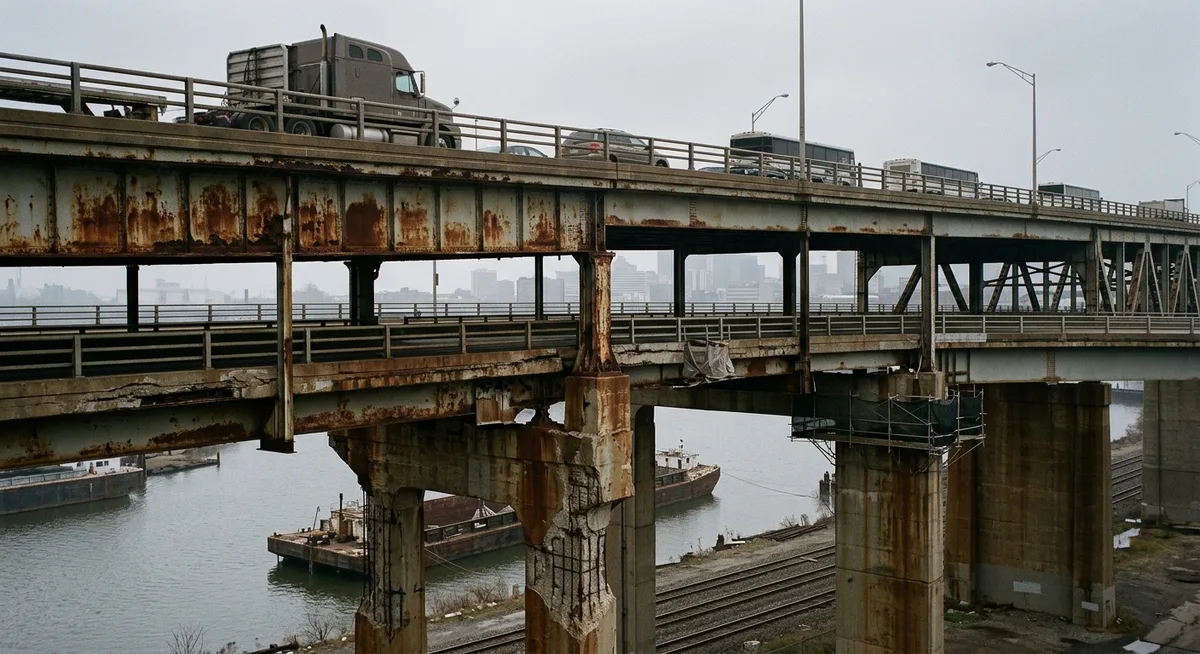
Why Your Commute Is Getting Longer: America’s Aging Bridges Are Falling Behind
Every single day, approximately 167 million vehicles cross a bridge classified by engineers as being in “poor” condition.
This figure represents more than just a data point in a federal ledger; it reflects the physical state of a national transport network that is aging beyond its intended design life. According to 2024 analysis from the American Road & Transportation Builders Association (ARTBA), 36 percent of all U.S. bridges—roughly 221,800 structures—require major repair or total replacement.
The primary challenge facing the network is a structural deficit driven by age and use. The average American bridge is now 44 years old, with many spans approaching the 50-year service limit for which they were originally engineered. As of 2024, the United States is managing an infrastructure system where the rate of degradation frequently competes with the pace of federal and state investment.
The $319 Billion Repair Requirement
According to ARTBA data, the estimated cost to clear the national bridge repair backlog has reached $319 billion. This valuation reflects a combination of structural deterioration and the rising costs of construction materials and labor.
Data from the American Society of Civil Engineers (ASCE) indicates that the rate of bridge improvement is not keeping pace with the number of structures entering the “poor” category. At current spending levels, analysis suggests the repair of all bridges currently rated in poor condition could take several decades, a timeline that exceeds the remaining service life of many other “fair” condition structures.
The economic and social impact of this backlog is most concentrated in rural regions. In states like West Virginia and Iowa, where nearly one-fifth of bridges are rated in poor condition, a closure or weight restriction—known as “load-posting”—creates immediate logistical barriers. In Webster County, Iowa, the closure of rural spans like the E-57 bridge over the Des Moines River forces agricultural equipment and local transit onto secondary routes. For these communities, a load-posted bridge means school buses and emergency vehicles must take significant detours, adding time to response cycles and increasing fuel expenditures for local governments.
Investment vs. Construction Inflation
The Infrastructure Investment and Jobs Act (IIJA), enacted in late 2021, provided $40 billion in dedicated funding for bridge repair, marking the largest federal investment in the sector since the creation of the Interstate Highway System. By 2024, a significant portion of these funds, including $27.5 billion distributed via formula-based programs, has been made available to state departments of transportation.
However, the efficacy of this funding has been impacted by economic volatility. According to analysis from the Brookings Institution, construction inflation has significantly reduced the purchasing power of infrastructure allocations since the bill’s inception. The Producer Price Index for highway and street construction reflects rising costs for steel, concrete, and asphalt, meaning that while the dollar amount of investment is historic, the volume of physical work those dollars can purchase has diminished by an estimated 20 to 30 percent.
Source: ARTBA 2024 / FHWA
The structural churn of the network remains a constant pressure. Every year, several thousand bridges that were previously classified as “fair” or “good” transition into the “poor” category. This cycle creates a scenario where new funding often addresses existing failures rather than expanding the network’s overall health or capacity.
Supply Chain Impacts and Economic Costs
Bridge deficiencies have a direct correlation with national supply chain efficiency. When a critical artery is restricted or closed, the economic consequences are felt immediately across the logistics sector. A prominent example occurred in 2021 with the closure of the I-40 Hernando de Soto Bridge over the Mississippi River. Following the discovery of a structural crack, the bridge’s temporary closure cost the trucking industry an estimated $2.4 million per day in lost productivity and increased fuel consumption.
Federal Highway Administration (FHWA) data shows that such disruptions filter down to the consumer level. Load-posted bridges add mileage and time to the transport of essential goods, including timber, grain, and dairy. The ASCE estimates that continued infrastructure deficiencies will lead to a cumulative increase in costs for U.S. households by 2039, driven by higher prices for goods and lost time in transit.
Currently, 1 in 13 bridges—approximately 7 percent of the national inventory—is classified as being in poor condition. While this does not necessarily mean a bridge is at imminent risk of collapse, it indicates that the structure has significant erosion or decay in its primary components. These bridges require frequent monitoring and eventual rehabilitation or replacement to remain in service.
“The challenge for modern infrastructure management is moving from a reactive 'fail-and-fix' model to a data-driven strategy that prioritizes maintenance based on life-cycle costs and structural risk.”
A Shift Toward Data-Driven Maintenance
To address the gap between available resources and infrastructure needs, there is an increasing shift toward predictive maintenance and asset management. Research from institutions such as Northwestern University suggests that using sensors and automated monitoring can help identify structural risks before they manifest as visible cracks or failures.
Economic analysis indicates that preventive maintenance is significantly more cost-effective than emergency repair or full replacement. Addressing a bridge while it is in “fair” condition can prevent the much higher costs associated with “poor” condition remediation. In an environment of high interest rates and material costs, the fiscal argument for early intervention is becoming a central tenet of state transportation planning.
As IIJA funds are utilized through the middle of the decade, the primary policy question remains how to sustain these levels of investment. Without a long-term, inflation-indexed funding mechanism, the nation faces the prospect of returning to a cycle where bridge degradation outpaces repair.
The future of American connectivity depends on a strategic transition in capital allocation. Moving forward, the focus is shifting away from new construction and toward the preservation of existing assets. This policy choice will determine the productivity and safety of the U.S. transportation network for the next several decades. Until the repair backlog is significantly reduced, the nation’s 167 million daily crossings will continue to be a primary focus of federal and state safety efforts.
Sources
The information presented is for educational and informational purposes only and does not constitute investment advice. MainStreet uses AI to generate content — always verify with qualified financial professionals before making investment decisions. How MainStreet works →
Discussion