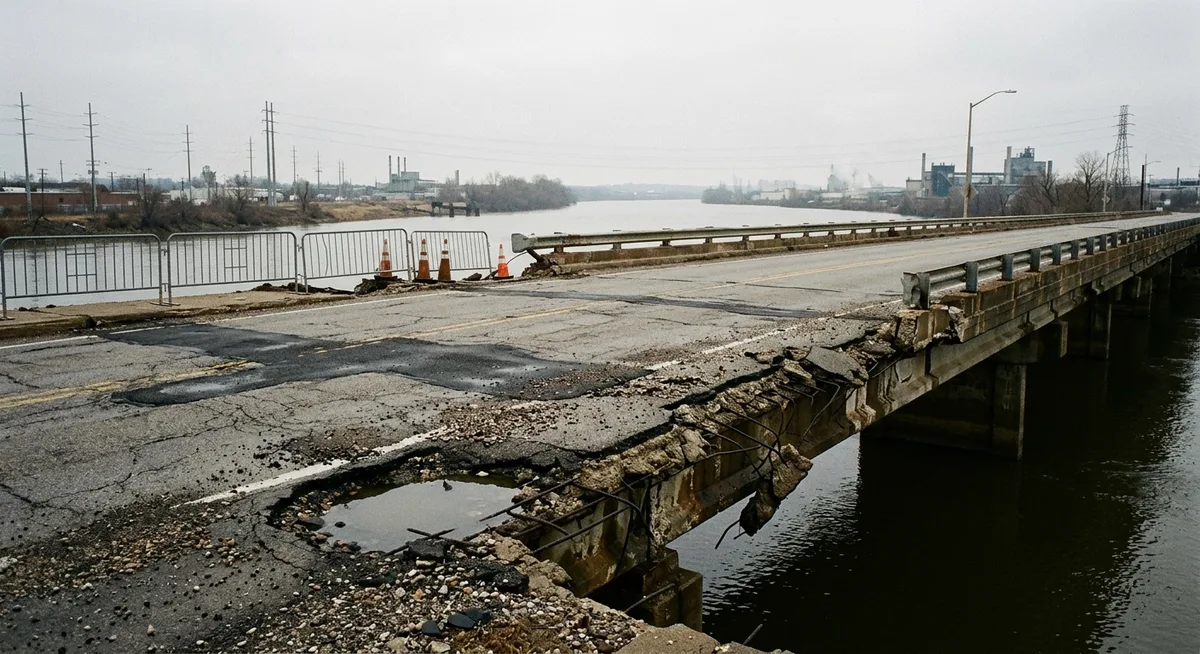
America’s Roads and Bridges Fall Behind as a $50 Billion Defense Bill Takes Priority
Net interest on the national debt is set to hit $1.039 trillion in 2026, marking the first time the U.S. government will spend more to service its past than to defend its future. On February 11, 2026, the Congressional Budget Office (CBO) released a projection that would have been unthinkable a decade ago, confirming that interest payments alone will now exceed the entire national defense budget. This shift occurs as military spending itself crosses the historic $1 trillion threshold for the first time.
Against this fiscal backdrop, the Department of Defense is returning to Congress with a supplemental request. Following the series of strikes across Iran known as “Operation Epic Fury,” briefings from the Pentagon on March 19 indicated that the request to replenish munitions and support ongoing operations could reach $200 billion. The Department’s stated priority is to ensure that stockpiles are not merely refilled but expanded to accommodate heightened global readiness.
The push for expanded military funding is creating a vacuum in domestic investment. While federal focus remains on the Strait of Hormuz, a separate, domestic deadline is approaching. The authorizations for the Infrastructure Investment and Jobs Act (IIJA) and the Inflation Reduction Act (IRA) are set to expire in 2026. Without renewal, the U.S. faces a sharp decline to 2019 investment levels. This shift could sideline the foundations of American commerce just as global competitors are increasing their own strategic investments.
Source: CBO and House Budget Committee, February 2026
The Math of Opportunity Cost
Economic policy involves a constant assessment of trade-offs. The $50 billion initially signaled by the Department of Defense on March 4 represents a discretionary supplemental—additional funding pulled from the same finite pool that supports highway repairs and medical research.
The trade-off is particularly stark because the return on investment for these two types of spending is not equal. According to a RAND Corporation analysis from August 2025, every dollar spent on civilian infrastructure generates approximately $1.50 in economic activity (GDP). Defense spending, by contrast, typically returns between $0.60 and $1.20. Analysis from Win Without War suggests that framing defense spending as a primary path to economic growth overlooks its lower returns compared to investments in the civilian sector.
Advocacy groups have begun to quantify the potential of that $50 billion if it were directed toward domestic needs. The funds requested for “Operation Epic Fury” could alternatively cover the cost of universal pre-K or the construction of 100,000 units of affordable housing—sectors currently facing acute shortages. Instead, the White House Office of Management and Budget (OMB) warned in mid-March that the scale of the war supplemental may force a 15 percent reduction in projected non-defense discretionary spending. This affects the country’s physical capacity to move goods and generate power.
Source: RAND Corporation / RUSI, August 2025
The Infrastructure Cliff
The American Society of Civil Engineers (ASCE) gave U.S. infrastructure a “C” grade in its 2025 Report Card—the highest mark ever, due largely to the infusion of funds from the 2021 IIJA. However, the ASCE also warned of a $3.7 trillion investment gap through 2033.
The progress made over the last few years is fragile. If the IIJA is not renewed by the end of 2026, modeling by EBP Global suggests the resulting drop in investment could cost the U.S. $600 billion in lost GDP by 2027. This manifests in specific regional bottlenecks. In Georgia, for instance, the planned expansion of logistics corridors near the Port of Savannah faces delays as federal match funding is deprioritized in favor of emergency military appropriations. Similarly, the modernization of the I-10 bridge in Louisiana, a critical artery for Gulf Coast energy transport, risks losing its timeline for completion as the fiscal year 2026 budget shifts.
According to the ASCE, American households lose an average of $2,700 per year due to poor infrastructure. This cost includes wasted fuel, time spent in traffic, and vehicle maintenance caused by deteriorating roads. If current federal investment levels are not maintained, these costs are projected to rise as authorizations expire.
The urgency of conflict in the Middle East may crowd out the long-term necessity of domestic repair. As munitions stockpiles are replenished, the funding for bridges and power grids may decline. J.P. Morgan analysts noted on April 10 that while defense stocks have benefited from the conflict, the U.S. is facing a “balancing act” as debt-to-GDP reaches a record high of 123 percent, limiting the government’s ability to fund both domestic and foreign priorities simultaneously.
A Global Perspective: The Building Race
While the U.S. debates its domestic trade-offs, global competitors are addressing the dilemma of military and domestic needs through different mechanisms.
In March 2025, the German Bundestag amended its constitution to bypass its strict “debt brake,” creating a €500 billion ($540 billion) special fund designed to modernize both its military and its domestic infrastructure concurrently. This move allows Germany to meet new NATO defense targets—which were raised to 3.5 percent of GDP in June 2025—without reducing its industrial base.
China, meanwhile, continues to pivot resources toward strategic infrastructure. In 2026, China’s outbound strategic investment in global infrastructure is growing twice as fast as that of the United States. Furthermore, China currently possesses three times more power generation capacity than the U.S.—an advantage that is becoming a bottleneck for American expansion in artificial intelligence and heavy manufacturing.
According to a BlackRock 2026 Global Outlook Report, the U.S. AI buildout faces political, financial, and physical factors that stand in contrast to the strategic rollout seen in competitors. A critical domestic manufacturing gap remains: as of April 15, 2026, U.S. imports of electronic components for AI infrastructure exceed domestic production by a factor of six.
Source: BlackRock Global Outlook, DLA Piper, ASCE — 2026
The Inflationary Backlash
The cost of “Operation Epic Fury” extends beyond the defense budget. The conflict has created a “double squeeze” on the global economy.
On March 26, 2026, the OECD downgraded its global growth outlook for the year by 0.3 percentage points, citing the inflationary impact of the Middle East conflict. The closure of the Strait of Hormuz has sent energy prices climbing, making the materials needed for domestic construction—such as asphalt and steel—significantly more expensive.
According to OECD reporting, there is high uncertainty regarding the duration of the conflict, which presents significant downside risks of lower growth and higher inflation. For the U.S. federal budget, this creates a cycle where higher inflation could drive interest payments beyond the projected $1.039 trillion if the Federal Reserve maintains elevated interest rates. As more of the budget is consumed by debt interest and defense, mandatory spending—which already consumes 75 percent of the federal budget—leaves limited room for discretionary investments that drive long-term growth.
A Decision of Decades
The supplemental defense package currently moving through Congress involves choices that will be felt for decades. When funding for a bridge is deferred or when an AI data center is built in a competing nation because the U.S. power grid lacks the capacity to support it, the cost of “Operation Epic Fury” becomes a long-term drag on American competitiveness.
Research from TD Economics indicates that meeting the new NATO target of 3.5 percent of GDP would require an additional $400 billion in annual appropriations by 2035. This presents a significant fiscal challenge for the U.S. as debt-to-GDP levels continue to rise.
The decision for the 2026 budget cycle rests on a fundamental choice between immediate tactical readiness and the resilience of the nation’s industrial foundation. As J.P. Morgan analysts noted in April, the U.S. is facing a “balancing act” as debt-to-GDP reaches a record 123 percent. This limit forces a recognition that funding for both foreign priorities and domestic infrastructure cannot expand indefinitely without a cohesive fiscal strategy. Without a renewal of domestic investment to match the surge in defense, the U.S. risks maintaining a high level of military readiness while its internal capacity to keep pace with the global economy diminishes.
Sources
- Bloomberg Government — Defense Industry Expects $50 Billion Package to Boost Munitions
- CBO — The Budget and Economic Outlook: 2026 to 2036
- ASCE — 2025 Report Card for America’s Infrastructure
- Breaking Defense — Hegseth confirms potential $200 billion request for Iran operations
- OECD Ecoscope — Defence spending: Economic gains or lasting fiscal challenges?
- DLA Piper — Germany’s turning point for infrastructure and defense funding
- https://oecdecoscope.blog/2026/03/27/defence-spending-economic-gains-or-lasting-fiscal-challenges/
The information presented is for educational and informational purposes only and does not constitute investment advice. MainStreet uses AI to generate content — always verify with qualified financial professionals before making investment decisions. How MainStreet works →
Discussion