U.S. Spending on Cinco de Mayo Surpasses $6 Billion as Celebration Outpaces Regional Mexican Roots
In the weeks preceding May 5th, the freight corridors between Mexico and the United States reach peak capacity. In 2025, more than 96,000 tons of avocados were imported into the U.S. specifically for the Cinco de Mayo window. For Mexican restaurants, which now constitute 11% of all U.S. dining establishments, the date has evolved from a cultural niche into a $6 billion retail powerhouse that dictates annual profitability for thousands of independent operators.
Cinco de Mayo is no longer merely a date on the calendar; it is a $6 billion cultural economy. What began as a commemoration of the 1862 Battle of Puebla—a conflict where an outnumbered Mexican army defeated French forces—has been reconfigured as a mainstream economic engine. In terms of impact on the food and beverage sectors, the holiday now rivals the Super Bowl.
While historical misconceptions persist—many consumers conflate the date with Mexico’s Independence Day on September 16—the economic reality is centered on a trade relationship that reached $872.83 billion in two-way commerce in 2025. Data for the 2026 season reveals a vibrant intersection of tradition and a sustained consumer demand for Mexican-origin products and hospitality experiences.
The American Cinco de Mayo Economy
The scale of spending surrounding May 5th has elevated the date to a Tier-1 retail event. According to industry data and projections from the National Retail Federation, total U.S. spending for the holiday is estimated to exceed $6 billion in 2026. This represents a massive concentration of capital into a window of roughly 48 hours.
The most significant revenue lifts occur in the restaurant sector. Mexican food is currently the most popular “ethnic cuisine” category in the United States. Independent business owners and larger chains report year-over-year sales increases of 87% to 88% when the holiday falls on a weekday. For many small-scale Mexican-American entrepreneurs, this single day of high-volume sales provides a critical buffer for annual operating margins.
Source: Industry Data and Research Findings, 2025-2026
The logistical machinery supporting this surge requires months of coordination. Industry briefings from casual dining groups indicate that inventory scheduling typically begins 120 days in advance. High-volume operators must manage significant volatility; weather patterns and slight temperature shifts can lead to a 100% variance in expected foot traffic.
The grocery sector experiences a corresponding boom. Despite inflationary pressures that saw Tex-Mex grocery categories rise by 22.5% at major retailers in recent years, consumer demand remains price inelastic. The American public has continued to prioritize the holiday as a social event, demonstrating a willingness to pay premiums for staples like limes and corn-based products regardless of fluctuating retail prices.
The Food and Beverage Bonanza
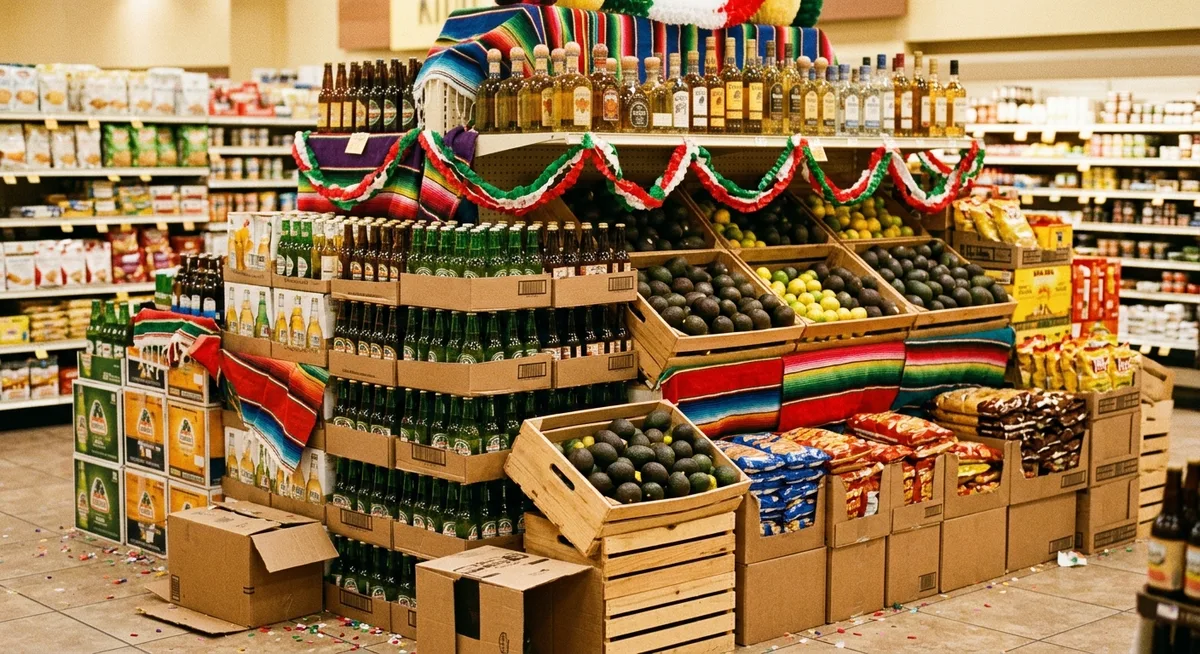
Beer and tequila serve as the primary economic drivers of the holiday. Cinco de Mayo is now a top-tier beer-selling day in the United States, frequently surpassing the Super Bowl and St. Patrick’s Day in total volume. In 2025, U.S. consumers spent between $600 million and $745 million on beer for the occasion.
This demand has fundamentally altered the hierarchy of the American beverage market. Modelo Especial has unseated long-standing domestic brands to become the top-selling beer in the United States. This shift underscores a broader market reality: growth in the beverage sector is now inextricably linked to the Latino consumer base and the broader adoption of Mexican cultural products by the general public. According to data from Molson Coors, success in the contemporary beer business requires specific resonance within the Hispanic market.
Tequila has maintained an even more aggressive growth trajectory. The U.S. agave spirits market, including tequila and mezcal, was valued at approximately $6 billion as of 2022, following 500% growth over the previous decade. On Cinco de Mayo, tequila sales in the U.S. have been recorded to jump by as much as 400% in a single 24-hour period. Furthermore, the rise of ready-to-drink (RTD) cocktails has created a new revenue stream, with margarita-in-a-can sales surging 190% during the week of the holiday.
Source: Market Research Data
The avocado industry has also successfully synchronized its production cycles with the holiday. Americans consume an estimated 81 million pounds of avocados for Cinco de Mayo. To satisfy this demand, Mexico—the world’s primary supplier—exported over 96,000 tons of the fruit for the U.S. market in 2025. Avocados From Mexico® projects a total of 2.5 billion pounds of avocado imports for the 2025-2026 season, reflecting the scale of the integrated supply chain.
Evolution of a Regional Commemoration
The disparity between how the day is observed in the U.S. and Mexico is a notable feature of this economy. In Mexico, May 5th is not a federal holiday; banks and government offices remain operational in most states. The celebration is largely regional, centered in Puebla, where approximately 300,000 visitors participate in military parades and battle reenactments.
The holiday’s prominence in the U.S. has deep historical and demographic roots. Research by David Hayes-Bautista, Professor and Director of the Center for the Study of Latino Health and Culture at UCLA, suggests the holiday originated in 1860s California. Mexican residents in the West celebrated the victory at Puebla as a symbolic stand for democracy during the American Civil War.
“By celebrating Cinco de Mayo, we were celebrating resistance... It is, at its heart, a Mexican American holiday.”
The modern commercialization of the holiday accelerated in the 1980s and 1990s. Major brewing companies identified the growing Latino consumer base and established dedicated marketing departments to link the holiday with consumer products. These coordinated marketing efforts successfully transitioned the event into a generalized celebration, broadening its market reach across all demographics.
A 2020 YouGov survey indicated that only 22% of Americans are aware of the actual history of Cinco de Mayo, while 41% believe it is Mexico’s Independence Day. However, this lack of historical precision has not hindered economic performance. The holiday’s transition into a broad consumer event has allowed it to capture a wider share of the retail market.
Mexican-American Economic Influence
The commercial success of Cinco de Mayo reflects the expanding economic power of the Mexican-American community. With more than 37 million people of Mexican descent living in the United States, they represent the largest Latino group in the country. This demographic possesses a buying power exceeding $1 trillion annually.
This influence is reflected in the saturation of Mexican business models. As of 2024, 85% of all U.S. counties contain at least one Mexican restaurant. These businesses serve as vital economic anchors, providing significant employment and contributing to local tax bases across diverse geographic regions.
The relationship is also a cornerstone of international trade. Mexico is now the leading trading partner of the United States. The billions of dollars spent on avocados, tequila, and beer are components of a highly integrated North American supply chain. For Mexican producers, the U.S. demand during the Cinco de Mayo season is a vital source of foreign exchange and rural employment.
Global Parallel: Cultural Events as Catalysts
Cinco de Mayo follows a global trend where cultural traditions are adopted as economic catalysts. When a tradition achieves mainstream adoption, the financial impact extends far beyond its community of origin.
Munich’s Oktoberfest generates approximately €1.5 billion in economic impact for the city, but its global footprint includes thousands of events that drive beer and hospitality sales worldwide. Similarly, St. Patrick’s Day has evolved into a $7 billion spending event in the U.S., driven by the Irish diaspora and sustained marketing by the beverage industry.
| Holiday | Primary Market | Estimated Spending | Core Sector |
|---|---|---|---|
| Chinese New Year | China/Global | $100 Billion+ | Retail & Travel |
| St. Patrick's Day | United States | $7 Billion | Beverage & Hospitality |
| Cinco de Mayo | United States | $6 Billion | Food & Beverage |
| Oktoberfest | Germany/Global | $1.6 Billion | Tourism & Beer |
Source: NRF, World Bank, and Industry Reports 2024-2025
Other cultural economies are seeing similar growth. Diwali is gaining commercial visibility in the U.K. and U.S., with major retailers developing dedicated product lines. These events demonstrate that culture is a significant commodity in the modern economy.
Market Tensions and Cultural Reclamation
The commercialization of Cinco de Mayo frequently triggers debates regarding cultural appreciation versus appropriation. For many Mexican-American families, the widespread use of stereotypes in marketing can obscure the historical significance of the Battle of Puebla.
José M. Alamillo, Professor and Chair of Chicana/o Studies at California State University, Channel Islands, notes that corporate focus on the Latino consumer base will continue to drive the holiday’s transformation into a selling opportunity. He observes that while the holiday suggests a unified community experience, it often reflects broader demographic shifts and associated social anxieties.
However, many Mexican-American business owners utilize the holiday’s visibility to introduce consumers to more sophisticated aspects of Mexican cuisine and spirits. This allows the holiday to serve as a gateway to regional mezcals or traditional culinary techniques, potentially deepening consumer engagement beyond the single-day surge.
The economic data indicates that Cinco de Mayo has completed its transition into a permanent fixture of the American retail landscape. It is a day defined by the movement of 81 million pounds of avocados and a 400% spike in tequila sales. The long-term trend suggests a continued upward trajectory as Mexican-American purchasing power grows and Mexican imports maintain their dominant position in the American beverage hierarchy. The holiday is no longer just a celebration of a 19th-century battle; it is a fundamental driver of the 21st-century North American trade relationship.
Sources
The information presented is for educational and informational purposes only and does not constitute investment advice. MainStreet uses AI to generate content — always verify with qualified financial professionals before making investment decisions. How MainStreet works →
Discussion