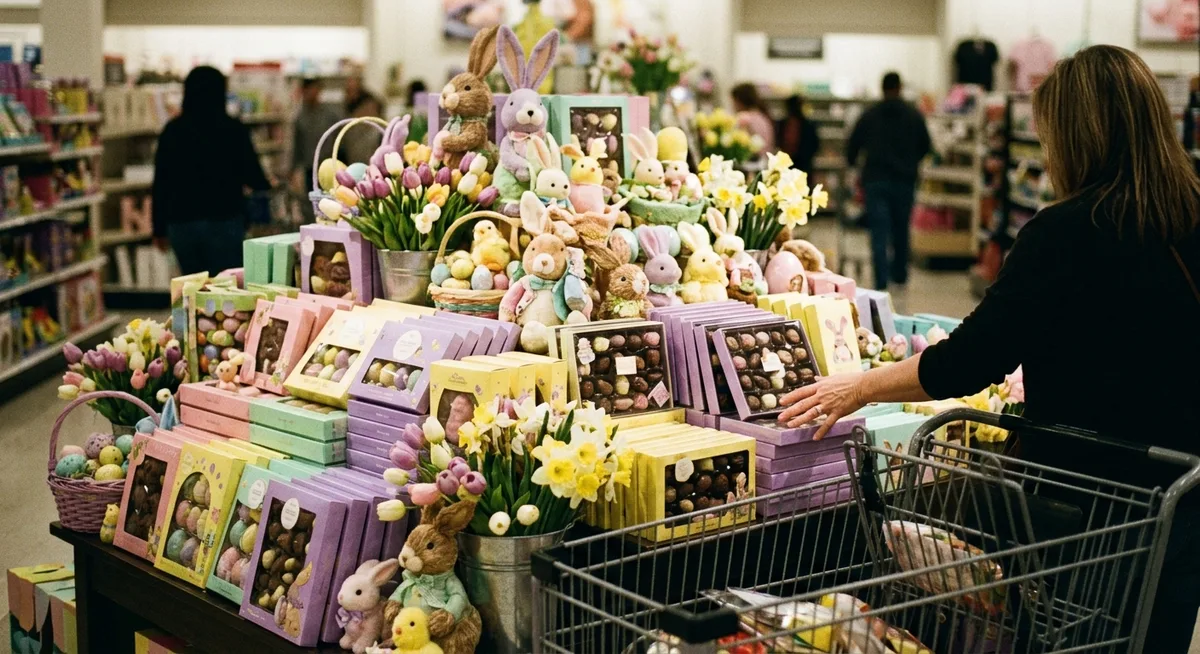
Pastel Palettes and Chocolate Eggs Spark a $25 Billion Spring Retail Rally
Easter spending in the United States is projected to reach a record $24.9 billion in 2026, according to the National Retail Federation and Prosper Insights & Analytics (survey released March 23, 2026). This surpasses the previous high of $24 billion in 2023 and pushes average per-person spending to a record $195.59.
Taken together, these numbers show a 2026 consumer who is price-sensitive but unwilling to cut back on high-meaning rituals like shared meals, travel to see family, and children’s baskets.
This multibillion-dollar surge represents a concentrated period of economic activity that significantly impacts grocers, florists, apparel retailers, and confectioners. In an increasingly fragmented retail environment, Easter has maintained its status as a primary “appointment shopping” event, where consumer behavior remains anchored to specific traditions despite fluctuations in the broader economy.
Inside the Easter Basket
The breakdown of the projected $24.9 billion spend indicates that consumers are prioritizing communal gatherings and dining. Food is the largest expenditure category, with Americans expected to spend $7.5 billion on holiday meals. This is more than double the $3.5 billion projected for candy, which remains a staple of the holiday but represents a smaller portion of the total budget. While food captures the largest share of dollars, candy remains the most universal purchase, with about 9 in 10 Easter shoppers planning to buy sweets in 2026.
Source: National Retail Federation, March 2026
The apparel sector is also anticipating a seasonal increase, with spending projected at $3.7 billion. Retailers are reporting high sell-through rates for new spring collections, particularly those featuring pastel palettes. According to reports from Who What Wear in February 2026, the season is defined by soft tones that are driving demand for fresh inventory. Industry analysis suggests that rather than clearing old winter stock through heavy discounting, retailers are successfully maintaining margins by leaning into these new seasonal trends.
NRF survey data shows the vast majority of celebrants follow consistent rituals—roughly 9 in 10 plan to buy food and candy, and more than half plan to cook a holiday meal or visit family and friends. This helps explain why Easter behaves more like a ‘fixed’ line in the spring budget than a discretionary splurge.
The Lagged Impact of Global Cocoa Markets
While consumer participation remains high, the cost of traditional holiday items has risen. Candy prices are up about 11–12% over the past year, based on February 2026 Consumer Price Index data cited in recent coverage, even as raw cocoa futures have fallen back from their 2024 extremes. This inflation is the result of a long-term supply chain reaction involving global cocoa production.
In 2024, raw cocoa prices exceeded $12,000 per ton following three consecutive years of poor harvests in West Africa, a region that produces roughly 60 percent of the world’s supply. While commodity prices for cocoa have retreated to approximately $3,300 per ton as of early 2026, these lower costs have not yet reached consumers.
Source: Oxford Economics, Wells Fargo
Most of the chocolate on 2026 shelves was produced from beans bought when cocoa traded near record highs, so retail prices still reflect last year’s shortages rather than today’s calmer futures market. According to agribusiness analysts at ANZ, the chocolate products purchased for Easter 2026 were manufactured using cocoa harvested 12 to 18 months ago when prices were at historic highs. Because of this production lag, the 2026 season represents a high-cost inventory event for manufacturers. Oxford Economics notes that while the commodity market is cooling, the retail price of chocolate eggs and bunnies reflects the peak costs of the previous year’s harvest.
“2024 was the culmination of three successive years of unfavourable weather events in West Africa... That is bad news for chocolate-driven holidays.”
How Easter Spending Differs by Country
The economic impact of the Easter period varies by region, reflecting different consumer priorities. Retail analysis from Savvy and others projects UK Easter-related sales at around £1.6 billion, up roughly 14% from 2025, with shoppers trading up on some items but also hunting for value. British shoppers are facing a 16.7 percent rise in cocoa-related costs. UK reports highlight classic ‘shrinkflation’: some chocolate SKUs have quietly dropped in weight while holding price, helping brands cope with cocoa-linked cost pressures. In response, many consumers are shifting toward non-chocolate confectionery and alternative sweets to manage their budgets.
In Australia, the holiday serves as a significant catalyst for the travel and home improvement sectors. Survey work from Roy Morgan and industry groups suggests Australians will spend in the low-teens billions of AUD across travel, food and DIY projects over the Easter break, with roughly AUD 11B earmarked for travel and around AUD 6–7B for home improvements. Unlike the U.S. market, which is driven by retail goods, a large portion of the Australian spend is directed toward travel and DIY projects.
Source: NRF, ARA, Savvy (March 2026)
Logistics and Operational Costs
The cost of delivering billions of dollars in perishable goods remains a significant challenge for the retail industry. While overall inflation has stabilized, transportation and logistics costs for temperature-controlled freight have remained elevated. Industry data from March 2026 suggests that the cost of moving seasonal inventory—such as fresh hams and $2.2 billion worth of floral arrangements—has risen due to increased fuel surcharges and labor costs in the logistics sector.
Flowers are a smaller but operationally complex category: NRF estimates Americans will spend about $2.2B on floral arrangements for Easter 2026, most of which must move through temperature-controlled supply chains on tight timelines. The Society of American Florists notes that transportation now accounts for a larger share of the retail price of holiday bouquets than in previous decades. For example, the specialized shipping required for Easter lilies can add significantly to the final shelf price, as these products require precise climate control and rapid delivery windows. Similarly, the logistical costs associated with moving thousands of tons of fresh produce and protein for holiday meals have pressured the margins of major grocery chains.
Despite these operational headwinds, consumer demand has remained steady. Retailers are managing these costs by leveraging data-driven inventory management and focusing on high-margin seasonal items. The NRF reports that many businesses are absorbing a portion of these logistical costs to ensure they remain competitive during a period of high consumer engagement.
How Shoppers Stretch Easter Budgets
The record-setting total spend for Easter 2026 is accompanied by a clear shift toward value-seeking behavior. According to NRF research, 55 percent of celebrants planned to shop at discount stores this year. This suggests that while total spending is at an all-time high, middle-income households are being more strategic with their budgets.
More than half of Easter shoppers plan to visit discount stores, and over 4 in 10 will shop department stores, underscoring a mix of trading down on price while still using traditional department and specialty channels for key items. About 56 percent of consumers identified cooking a holiday meal as their primary activity, while 52 percent planned to visit friends and family. These tradition-heavy activities necessitate specific purchases, which helps explain why spending remains high even when economic conditions are complex.
Source: Global Easter Snapshots, April 2026
Economic Outlook Following the Holiday
As the Easter season concludes, economists view the spending data as a key indicator of consumer sentiment for the remainder of the year. Because the holiday occurs in the first half of the year, it serves as a measure of the American household’s willingness to sustain high levels of personal consumption.
The 2026 figures suggest a strategic but resilient consumer base. Households are willing to pay the higher prices associated with lagged cocoa costs and logistical surcharges because the holiday holds a significant non-monetary value. Whether it is the $11.1 billion AUD travel budget in Australia or the $7.5 billion spent on meals in the United States, the economics of the season demonstrate a consistent commitment to communal celebrations.
If households sustain Easter-level spending on summer travel and back-to-school, it would support a soft-landing narrative for the consumer economy in 2026: slower but still positive real spending growth, with dollars reallocated toward experiences and ritual-driven categories.
As the retail industry moves into the summer months, the Easter rally provides a clear signal: the consumer remains active, though they are increasingly focused on value and tradition-based spending. This trend of strategic resilience is expected to shape retail strategies throughout the 2026 calendar year.
What this means for you
- For households:
- Plan for elevated candy/chocolate prices again in 2027, since manufacturers will still be working through high-cost contracts and hedges.
- If you travel, book earlier; Easter travel budgets in both the US and Australia look robust, which supports higher prices.
- For small retailers:
- Easter is a high-intent period—lean into tradition-anchored SKUs (meals, candy, flowers) and visible value messaging, not broad discounting.
Sources
- NRF — Easter Spending Expected to Reach a Record $24.9 Billion, March 24, 2026
- Oxford Economics — Why Easter eggs are still expensive in 2026, April 1, 2026
- BNN Bloomberg — Cocoa prices are falling — but not in time for Easter, April 5, 2026
- A1 Retail Magazine — Easter sales forecast to rise 14 percent, March 26, 2026
- Roy Morgan — DIY projects, travel and food lead Easter holiday spend, April 2026
- Who What Wear — Pastel Colors Will Be the Big 2026 Color Trend, February 11, 2026
- Reuters — US Easter spending to touch record $24.9 billion in 2026, NRF forecasts, March 24, 2026
- SAN — Easter Spending to Reach Record $24.9 Billion This Year, March 25, 2026
- KEYT — Cocoa prices are falling — but not in time for Easter, April 4, 2026
- Axios — Easter candy prices remain high despite falling cocoa futures, April 3, 2026
- Retail Risk — Egg-cellent news: Easter sales forecast to rise 14 percent, March 27, 2026
- Grocery Gazette — Easter spending tipped to hit £1.6bn as shoppers seek value and trade up, March 26, 2026
- Talk Business & Politics — Easter spending expected to top $24.9 billion, March 26, 2026
The information presented is for educational and informational purposes only and does not constitute investment advice. MainStreet uses AI to generate content — always verify with qualified financial professionals before making investment decisions. How MainStreet works →
Discussion