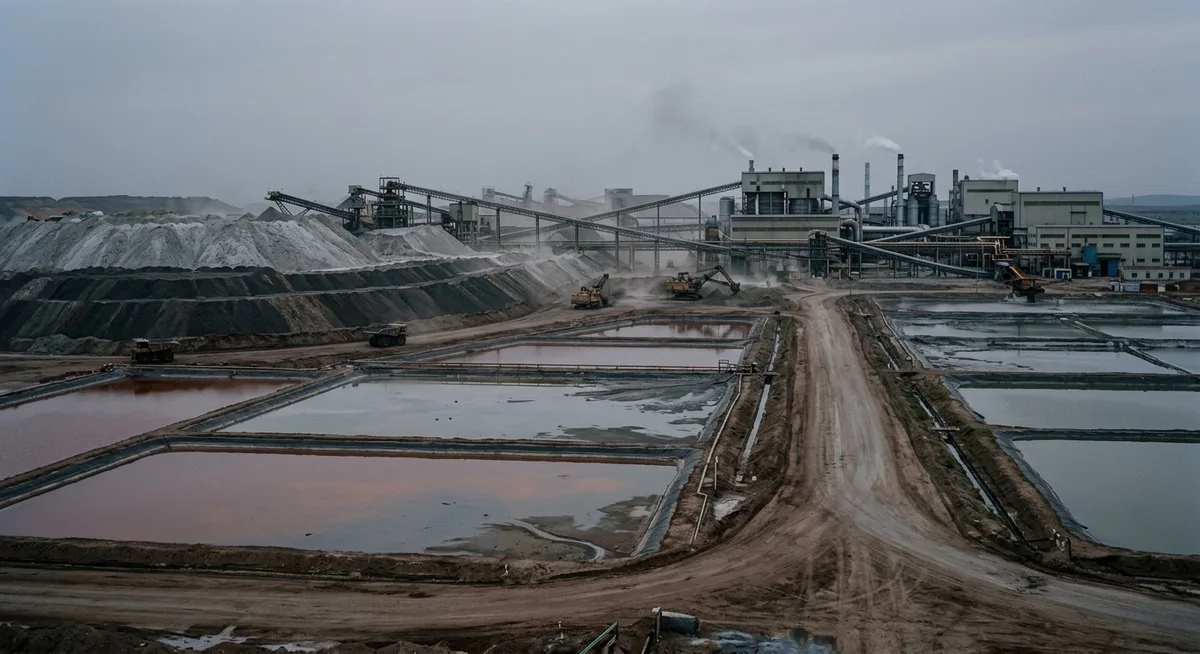
The Mineral Chokepoint: How China’s Monopoly on Rare Earths Holds the West’s Future Hostage
A single U.S. Navy submarine is a marvel of engineering, a silent predator designed to project power across the globe. It is also a massive underwater collection of Chinese-processed minerals.
To build just one of these vessels, the American defense industry requires more than 9,200 pounds of rare earth elements, according to data from Forecast International. The F-35 Lightning II combat aircraft requires another 920 pounds. These materials—including terbium, dysprosium, and neodymium—are essential components of modern technology, required for everything from cruise missiles to smartphones and electric vehicle motors.
The current challenge facing policymakers in Washington, Brussels, and Tokyo is a matter of supply chain control: while Western firms design the advanced machinery, the refining process for the necessary ingredients is concentrated in China.
As of late 2024, China accounts for approximately 90 percent of the global rare-earth refined market value and 91 percent of the world’s refining and processing capacity, according to the International Energy Agency (IEA). While the minerals themselves are distributed globally, the industrial infrastructure required to transform them into high-tech components remains concentrated in Chinese facilities.
The Weaponization of the Periodic Table
The vulnerability of this arrangement has become increasingly apparent over the last two years. In late 2023, Beijing officially restricted the export of gallium and germanium, followed by additional controls on antimony in 2024. These moves were widely viewed as a response to U.S. restrictions on advanced semiconductor technology.
The impact on global markets was immediate. By late 2024, research from the Swedish National China Centre indicated that gallium prices in Europe had surged significantly, while germanium prices saw similar dramatic increases. Antimony, a critical component for ammunition and flame retardants, experienced a price spike of over 400 percent following the announcement of export restrictions, according to industry price tracking data.
According to Goldman Sachs research, Beijing’s control of over 90 percent of refining capacity and nearly 98 percent of magnet production provides significant leverage in global trade negotiations. This position was reinforced in mid-2024 when China’s Ministry of Commerce implemented strict export licensing requirements on several specific rare earth elements—including samarium, gadolinium, and yttrium—which are vital for defense and high-tech sectors, according to the Center for Strategic and International Studies (CSIS).
For a global economy increasingly focused on electrification, these are strategic commodities. Unlike the oil market, where the U.S. has achieved a high degree of energy independence through shale production, the mineral trade remains heavily reliant on a single external source for processing.
The Magnet Trap
The primary bottleneck in the supply chain is not the extraction of ore, but the complex chemical refining that follows. While U.S. domestic rare earth production reached approximately 43,000 metric tons in 2023—primarily from the Mountain Pass mine in California—most of this concentrate is still shipped to China for processing, according to U.S. Geological Survey data.
For three decades, Western nations have largely outsourced the energy-intensive and chemically complex work of refining to Chinese firms. During this period, China developed a dominant position in the production of permanent magnets.
Source: Visual Capitalist / Investing News Network
China currently controls 94 percent of the world’s rare earth permanent magnet manufacturing, according to data from P&S Intelligence. These magnets are essential for electric vehicle motors and wind turbines. Defense industry analysis indicates that modern weapons systems rely on materials that are difficult to source and replace once domestic inventories begin to tighten, making twenty-first-century military readiness dependent on these specialized supply chains.
In response to these conditions, the U.S. Treasury Department has characterized the ongoing export controls as a strategic move to consolidate power over global supply chains. Official reports suggest that if the current level of supply chain concentration persists, Western nations will be forced to accelerate efforts to develop independent processing capabilities.
For procurement officers at mid-tier defense contractors, these macro-economic shifts manifest as a daily logistical struggle. Since the implementation of stricter export licensing by Beijing, the acquisition of specialized sensors and high-performance alloys has become a paperwork-intensive ordeal. Sourcing teams now spend weeks verifying end-user certificates and navigating shipping delays that did not exist two years ago. This administrative burden, combined with the need to maintain larger safety stocks of gallium and germanium, has increased operational costs and extended lead times for critical aerospace components.
The Global Response
Efforts to develop alternative supply chains face significant hurdles. The U.S. Department of Energy warned in recent reports that establishing independent, domestic supply chains for materials like gallium and germanium could require five to ten years of sustained investment.
The U.S. remains exposed to these vulnerabilities. In 2024, the United States was 100 percent reliant on imports for 12 critical minerals and over 50 percent reliant for an additional 28, according to the Climate Leadership Council. This dependency persists even as the U.S. economy continues to expand, with GDP reaching an annualized rate of over $28 trillion in 2024, according to the Bureau of Economic Analysis.
International partners are facing similar pressures. The European Union’s Critical Raw Materials Act (CRMA) has established a target for at least 40 percent of the bloc’s annual consumption of strategic raw materials to be processed within the EU by 2030.
Source: HSF Kramer / IEA
Australia is also increasing its investment in the sector. The Australian government has committed AU$600 million to expedite projects such as the Nolans/Arafura site to provide an alternative to Chinese processing, according to reports from Investing News Network. Despite these efforts, Australia’s total production in 2024 remained a small fraction of China’s total output.
Japan serves as a historical reference point for these challenges. After a 2010 disruption in rare earth supplies, Japan spent a decade diversifying its sources. However, when faced with renewed export pressures in 2024, the difficulty of completely detaching from the existing global infrastructure became evident, highlighting the long-term nature of supply chain diversification.
The Cost of Sovereignty
The global push for mineral independence has led to a significant increase in capital investment. Global public funding for rare earth projects has reached into the billions as governments attempt to de-risk their supply chains, according to Bloomberg Intelligence.
Market analysis suggests that China’s total dominance of the rare earth industry may begin to decline as production in Australia, Vietnam, and Brazil scales up over the next several years. Bloomberg Intelligence predicts that non-Chinese production could gain more market share by 2030 as these projects reach commercial viability.
However, the financial cost of this transition is substantial. The market value of Neodymium-Praseodymium (NdPr), the most essential elements for high-strength magnets, is projected to rise as trade tensions continue to influence global pricing. For American consumers, this shift likely results in higher manufacturing costs for a wide range of products, from air conditioning units to high-end consumer electronics.
Research from Chatham House indicates that the most recent export controls serve as a catalyst for Western nations to build more resilient supply chains. This shift represents a broader recognition among policymakers that economic security is tied directly to the availability of these raw materials.
Source: Investing News Network
While temporary pauses in trade restrictions have occasionally provided relief, supply chain risks remain at historically high levels. Most analysts view such pauses as tactical adjustments rather than permanent shifts in policy. Data from the Federal Reserve indicates that the U.S. trade balance continues to reflect a deep integration with Chinese manufacturing hubs.
The drive toward mineral sovereignty represents a fundamental tension between the immediate needs of the American consumer and the long-term requirements of national security. As the U.S. works to re-establish a domestic industrial base, the transition period remains fraught with volatility. The true cost of this independence is currently being integrated into the price tags of the next generation of Western technology, where the premium for a secure supply chain is no longer a choice, but a necessity.
Sources
- Bloomberg Intelligence — World Scrambles for Rare Earths to Erode China's Dominance, March 2026
- IEA — Global Critical Minerals Outlook 2024, May 2024/March 2026
- CSIS — The Consequences of China's New Rare Earths Export Restrictions, April 2025
- Swedish National China Centre — China's Mineral Export Restrictions: Market Impacts, October 2025
- Visual Capitalist — Visualizing 30 Years of Rare Earth Production, October 2025
The information presented is for educational and informational purposes only and does not constitute investment advice. MainStreet uses AI to generate content — always verify with qualified financial professionals before making investment decisions. How MainStreet works →
Discussion