A Roof of One’s Own: Why Singapore and Denmark Succeeded Where America Stalled
In Phoenix, Arizona, the median rent for a one-bedroom apartment climbed nearly 30% between 2020 and 2024. According to the U.S. Census Bureau’s Household Pulse Survey data from mid-2024, approximately 15% of renting households in the Phoenix metro area reported they were “not at all confident” they could make next month’s payment. For these families, the start of a new month requires calculated sacrifices: data from the Consumer Financial Protection Bureau (CFPB) indicates that rent-burdened households are significantly more likely to defer essential medical care or skip vehicle maintenance to maintain a roof.
According to the Harvard Joint Center for Housing Studies (JCHS) 2024 report, a record 22.4 million U.S. renter households are now “cost-burdened,” meaning they spend more than 30 percent of their income on housing. For 12.1 million of those families, the situation is classified as “severely burdened,” as they allocate more than half of their pre-tax paychecks to rent.
The Harvard JCHS 2024 report highlights that while headline numbers in some markets showed stabilizing rents in late 2023, the actual cost of living for lower and moderate-income renters remained at historic highs due to a persistent shortage of affordable units and the expiration of pandemic-era protections.
While the U.S. struggles with a housing market constrained by high interest rates and zoning-induced supply shortages, other nations have treated housing as a foundational infrastructure rather than a speculative asset. Across the Pacific, Singapore maintained a homeownership rate of 89.7 percent as of 2023. Across the Atlantic, Denmark has developed a system where 20 percent of the total housing stock is “common housing,” accessible to citizens across the income spectrum.
The American housing crisis is often framed as an unsolvable math problem. However, global data suggests that high rates of affordability and ownership are the results of specific, long-term policy frameworks.
The Singapore Model: Housing as Social Integration
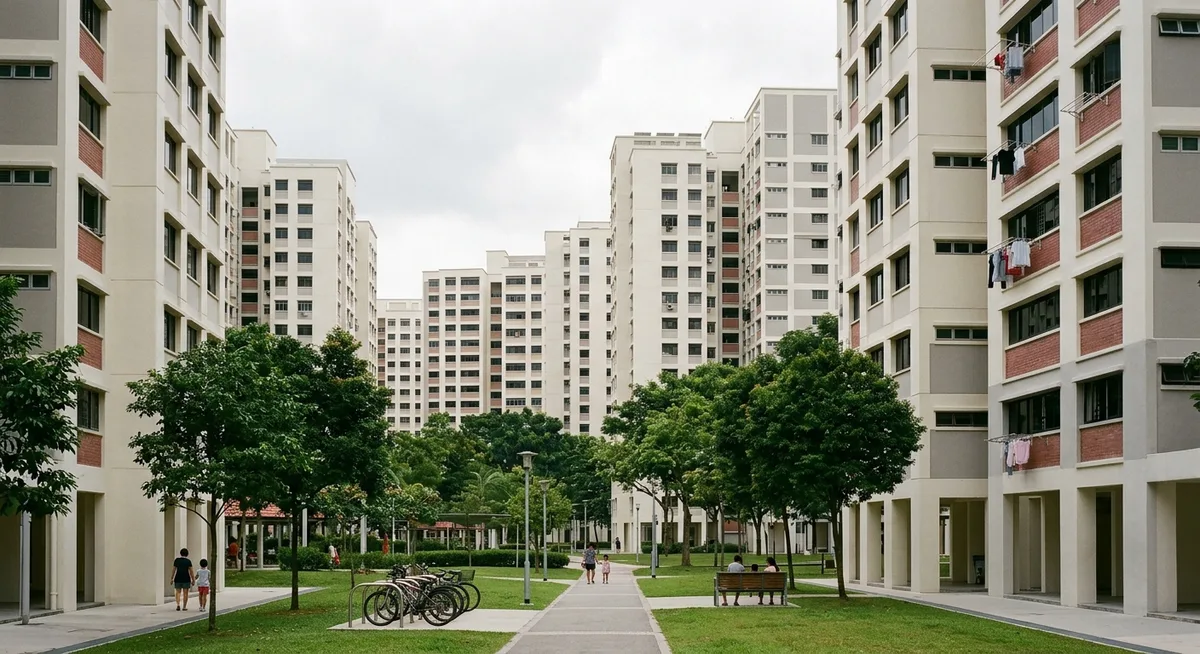
Singapore, a city-state with limited land, manages its housing market through the Housing and Development Board (HDB). In 2023, the government increased the Additional Buyer’s Stamp Duty for foreigners to 60 percent, a move intended to prioritize residential access for citizens and insulate the local market from global speculative capital.
Roughly 80 percent of the resident population lives in HDB flats. These units are part of a master-planned system where the Ethnic Integration Policy (EIP) is strictly enforced. According to the HDB, this policy ensures that every apartment block and neighborhood reflects the nation’s ethnic proportions, intentionally preventing the formation of segregated enclaves. While this promotes social cohesion, it can also lead to practical challenges; some residents report longer wait times to sell their flats, as they must find a buyer from the same ethnic group to maintain the mandated ratios.
Source: Statistics Singapore
Singaporeans finance these homes through the Central Provident Fund (CPF), a mandatory social security savings scheme. As of 2024, the contribution rate for workers under 55 is 37 percent—17 percent from the employer and 20 percent from the employee. These funds are used for down payments and monthly mortgage payments, creating a system of forced savings that translates directly into home equity.
According to the Urban Land Institute’s 2024 Home Attainability Index, the median price-to-income ratio for HDB flats was 4.7. By comparison, the U.S. median home price reached approximately $412,000 in early 2024, nearly five times the median household income, significantly exceeding the historically recognized affordability ratio of three. However, the Singaporean model involves a trade-off in choice; residents often face wait times of five years or more for “Built-to-Order” (BTO) flats, and the architectural uniformity of these high-rise estates is a common critique of the system.
The Danish ‘Third Way’: Renting Without the Risk
In Denmark, housing policy focuses on long-term security through Almenbolig, or “common housing.” Unlike U.S. public housing, which is largely restricted to the lowest earners by federal law, Danish common housing is open to all citizens regardless of income.
This system is financed through the Landsbyggefonden, or National Building Fund. According to data from Housing Europe, this fund operates as a revolving credit facility. Once the original construction loans for a housing project are repaid, the tenant rents continue to flow into the central fund rather than to private shareholders. This capital is then used to finance the renovation of existing properties and the construction of new social housing. It is a self-sustaining financial cycle that reduces the need for continuous government subsidies.
Source: Housing Europe / OECD
The New York City Housing Authority (NYCHA) currently faces a capital repair backlog exceeding $78 billion, a deficit exacerbated by the absence of a dedicated revolving maintenance fund similar to Denmark’s. In the Danish model, rents are “cost-based,” meaning they are set only to cover the operational and debt service costs of the building. This frequently results in rents that are significantly lower than market rates in neighboring private developments.
To prevent the concentration of poverty, Danish law since 2022 has empowered municipalities to require that 25 percent of all new housing construction in designated areas be social housing. This ensures that as urban centers grow, essential workers—such as teachers and healthcare staff—are not priced out of the communities they serve.
The American Constraint
The U.S. ability to implement similar large-scale public housing is restricted by the Faircloth Amendment. Passed in 1998, this federal law prohibits the Department of Housing and Urban Development (HUD) from funding the construction of new public housing units if it would increase the total number of units a public housing agency owned or operated as of October 1, 1999. This has effectively capped the national supply of public housing for 25 years, despite significant population growth.
While the U.S. private sector saw housing starts reach an annual rate of 1.36 million in mid-2024, much of that inventory was targeted at the luxury or high-end market. Between 2001 and 2022, median U.S. rents rose by 21 percent after inflation, while median renter income grew by just 2 percent, according to JCHS data.
Source: Harvard JCHS
The path to homeownership for many renters is further obstructed by lending conditions. In May 2024, the average 30-year fixed mortgage rate fluctuated around 7 percent. This rate, combined with record-high home prices, has created a “lock-in” effect where current homeowners are reluctant to sell, and prospective buyers are unable to enter the market.
In Copenhagen, cooperative housing—known as Andelsbolig—accounts for approximately one-third of the city’s housing. In this model, residents do not own their individual units but rather a share in the cooperative association. This share entitles them to live in a unit and gives them a vote in building management. By decoupling the right to live in a home from the pursuit of speculative profit, these cooperatives have maintained affordability across generations.
The Statistical Reality of Divergence
The outcome of these differing philosophies is reflected in the OECD Affordable Housing Database. In the United States, approximately 50 percent of low-income tenants spend more than 40 percent of their disposable income on rent. In Denmark, the median housing cost burden across all households was 19.9 percent of disposable income in late 2023.
According to the Harvard JCHS, the lack of affordable housing now affects 25 percent of households earning between $45,000 and $75,000 annually, a demographic that historically found the market accessible. As the U.S. moves through 2024, it faces a market where a significant portion of the workforce is effectively trapped in a cycle of high-interest debt and rising rents.
The models in Singapore and Denmark demonstrate that housing stability is often the result of deliberate state intervention. In Singapore, that means mandatory savings and ethnic integration; in Denmark, it means revolving funds and cost-based rent. In the United States, the current trajectory is defined by a 25-year-old cap on public units and a widening gap between what workers earn and what landlords require. According to the National Low Income Housing Coalition, there is no state in the U.S. where a full-time worker earning the federal minimum wage can afford a modest two-bedroom apartment at fair market rent. For the 22.4 million households currently burdened by these costs, the “market-rate” solution remains out of reach.
Sources
- Harvard JCHS — America’s Rental Housing 2026
- Governing Magazine — Addressing America’s Housing Crisis: Lessons from Denmark
- Urban Land Institute — 2025 Asia Pacific Home Attainability Index
- SPUR — Housing for Everyone, the Danish Way
- OECD — Affordable Housing Database 2025
- Trading Economics — Singapore Home Ownership Rate
- Danmarks Nationalbank — Twin speed housing market
The information presented is for educational and informational purposes only and does not constitute investment advice. MainStreet uses AI to generate content — always verify with qualified financial professionals before making investment decisions. How MainStreet works →
Discussion