Four Dollars a Gallon: How Gas Prices Ripple Through Every Corner of the Economy
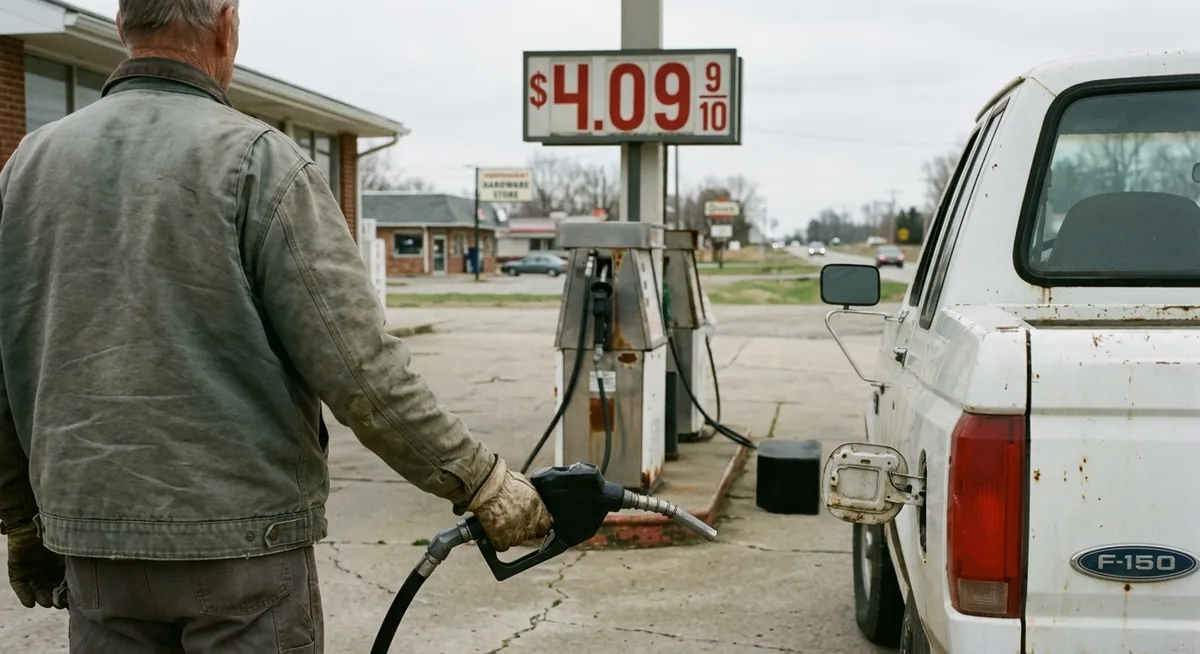
The number on the gas station sign reads $3.94. According to AAA, that is the national average price of a gallon of regular unleaded gasoline as of March 22, 2026 — a 32 percent increase in just three weeks, the fastest sustained climb since the oil shocks of 2022. In California, drivers are already paying $5.53. In Kansas, the cheapest state, it’s $3.15. Across the country, the psychologically potent $4 threshold is either here or imminent.
But the figure on the pump, as painful as it is to watch tick upward, captures only the most visible layer of what rising fuel prices do to an economy. Gasoline and its heavier cousin, diesel, are not merely consumer products. They are inputs that touch virtually every price in the economy — the cost of shipping a head of lettuce, flying to a job interview, heating a school building, manufacturing a car seat, and fertilizing a soybean field. When gas crosses $4, the shock doesn’t stay at the pump. It radiates outward through freight lanes, supply chains, airline routes, and grocery aisles, ultimately landing on every household budget in the country.
Here is how it happens, and what the data says about how far the damage extends.
Why Gas Hit $4
The proximate cause is a war. On February 28, 2026, the United States and Israel launched Operation Epic Fury against Iran, triggering a chain of events that effectively closed the Strait of Hormuz — the narrow waterway through which roughly 20 percent of the world’s oil supply flows. Iran’s Islamic Revolutionary Guard Corps declared the strait closed, attacked commercial vessels, and began laying mines. Tanker traffic collapsed. Insurance companies pulled war-risk coverage for any vessel transiting the region.
The result was immediate. Brent crude, the global oil benchmark, surged from approximately $67 per barrel before the conflict to over $120 — a 50 percent increase. Because crude oil accounts for roughly 60 percent of the retail price of gasoline, pump prices followed with a lag of about one to two weeks.
Source: AAA / EIA
Since the war began, American families have collectively paid an estimated $4 billion more for gasoline than they would have at pre-conflict prices, according to Jalopnik’s analysis of EIA data. That works out to more than $300 million in additional fuel costs every single day — money that is not being spent at restaurants, retail stores, or on rent.
The $10 Rule: Oil’s Multiplier on Inflation
Federal Reserve Chair Jerome Powell has quantified the relationship between oil prices and the broader economy in congressional testimony: every $10 per barrel increase in crude oil prices raises inflation by 0.2 percentage points and reduces GDP growth by 0.1 percentage points.
Since February 28, crude oil has risen by roughly $55 per barrel. Applying the Fed’s own arithmetic, that implies an inflation increase of approximately 1.1 percentage points and a GDP drag of 0.55 percentage points — in an economy where inflation was running at 2.4 percent in January and growth was already moderating.
CBS News reported that analysts warn oil could reach record highs if the Strait of Hormuz remains closed. Goldman Sachs said prices may stay in triple digits for years. CNN noted that the last time Brent sustained above $100 for an extended period, in 2011-2014, it coincided with stagnant wage growth across developed economies.
Fortune warned that the current surge could push US inflation from 2.4 percent to 3.5 percent or higher when March data is released — and possibly above 4 percent in April.
Diesel: The Invisible Tax on Everything You Buy
Gasoline gets the headlines, but diesel is the fuel that actually moves the economy. Roughly 70 percent of all goods in the United States are transported by truck, and trucks run on diesel. The current national average for diesel is $4.83 per gallon — a 28 percent increase since the war began.
The Federal Highway Administration has documented the transmission mechanism: when diesel prices rise, trucking companies face an immediate cost increase that they pass through to shippers within weeks. Shippers pass it to distributors. Distributors pass it to retailers. Retailers pass it to consumers.
Source: FHWA / American Trucking Associations
The effect is not uniform. Fresh produce — lettuce, strawberries, avocados — must be transported quickly in refrigerated trucks, which consume more fuel. Their prices respond fastest and hardest. Canned goods and packaged foods, which can be shipped in bulk and stored, absorb the shock more slowly. PBS reported that food experts predict a 2.3 percent increase in food prices in 2026 — but cautioned that this estimate was made before the full impact of the oil surge was factored in.
Jet Fuel and the Cost of Flying
Global prices for jet fuel have surged approximately 83 percent over the past month, according to industry data. For airlines, fuel typically represents 25 to 40 percent of total operating costs — and for some carriers, it approaches half.
The transmission to ticket prices is rapid. Airlines operate on razor-thin margins, and sustained fuel increases force immediate repricing. Business travelers, who book at higher fares and shorter lead times, are relatively inelastic — they’ll pay. Leisure travelers are not. When fares rise, discretionary travel drops, which in turn hits hotels, rental car companies, restaurants in tourist destinations, and the local economies that depend on them.
Source: IATA / Bureau of Transportation Statistics
Agriculture: Fuel Powers the Food Supply Chain
The connection between oil and food is deeper than most people realize. Fuel powers nearly every step of the food supply chain — tractors in the field, irrigation pumps, grain dryers, refrigerated storage, processing plants, and the trucks and ships that transport food from farm to fork.
But the most consequential link is fertilizer. Natural gas is the primary feedstock for nitrogen-based fertilizers, which are essential for growing corn, wheat, and rice. When energy prices spike, fertilizer prices spike with them — and they were already elevated from the post-2022 supply disruptions.
Fortune reported that fertilizer costs are rising just ahead of the spring planting season in the Northern Hemisphere, when demand peaks. For American farmers, the timing could not be worse: planting decisions are made months in advance, and higher input costs either squeeze margins or get passed through to the price of grain, which eventually reaches the bread aisle.
The K-Shaped Economy Gets More Lopsided
CNBC economists described the oil surge as deepening America’s “K-shaped economy” — where high-income households are largely insulated while lower-income households bear a disproportionate burden.
The math is straightforward. A household earning $200,000 that spends $250 per month on gas will barely notice a $70 monthly increase. A household earning $40,000 that spends the same amount will feel that $70 acutely — it’s the equivalent of a week’s worth of groceries, a child’s after-school program, or a credit card minimum payment.
Source: BLS Consumer Expenditure Survey / CNN analysis
The Yahoo Finance analysis framed it bluntly: rising gas prices function as a “regressive energy tax” — one that is never voted on, never debated in Congress, and falls hardest on the people least equipped to absorb it.
The Fed’s Dilemma
The timing of the oil shock creates a particularly difficult problem for the Federal Reserve. Before the conflict, the Fed had been preparing markets for rate cuts later in 2026 as inflation trended toward its 2 percent target. Now, with energy-driven inflation potentially pushing above 3.5 percent, cutting rates risks looking reckless. But holding rates high when consumer spending is being squeezed risks tipping the economy into recession.
NBC News reported that mortgage rates, which had been drifting lower, reversed course as bond markets priced in the inflationary impact of sustained high oil prices. The 30-year fixed rate climbed back above 7 percent — closing the window for refinancing that millions of homeowners had been waiting for.
Goldman Sachs raised its probability of a US recession by five percentage points. Oxford Economics modeled scenarios in which oil remains above $100 for two months — enough, they concluded, to push the eurozone, the UK, and Japan into contraction.
What Comes Next
The trajectory depends almost entirely on geopolitics. If the Strait of Hormuz reopens within weeks, oil prices will retreat and the economic damage will be a transient shock — painful but contained. If the closure persists for months, the second- and third-order effects — higher food prices, transportation costs baked into contracts, capital expenditure deferrals, and consumer confidence erosion — will compound in ways that standard economic models struggle to capture.
The last time oil sustained above $100 per barrel for an extended period, from 2011 to 2014, the global economy avoided recession but experienced a prolonged period of below-trend growth that economists later called “the slow squeeze.” The difference now is that the starting conditions are worse: household savings buffers accumulated during the pandemic have been spent, consumer debt is at record levels, and the Federal Reserve has less room to cut rates.
Four dollars a gallon is not just a number on a gas station sign. It is an economic event that touches every household, every supply chain, and every policy decision in the country. And as of this writing, it is still rising.
Sources
- AAA — National Average Gas Prices
- EIA — Gasoline and Diesel Fuel Update
- FRED — US Regular All Formulations Gas Price
- CNN — What $4-a-gallon gasoline means for you and the economy
- NPR — Gasoline prices are still rising as the Iran war stretches into its third week
- Fortune — Your grocery bill, gas tank, and heating bill are all about to get more expensive
- CNBC — Iran war, oil price surge worsen K-shaped economy
- PBS — The Iran war and surging oil prices are affecting consumers
- Yahoo Finance — The energy tax: Analysts weigh impact of surging gasoline prices
- TIME — From Gas to Groceries, the War in Iran Will Worsen America's Cost-of-Living Crisis
- NBC News — The Iran war already hit gas prices. What it's coming for next.
- CNN — Global oil price stuck in triple digits. Goldman says it may stay there for years
- CBS News — Oil prices could reach record highs, analysts warn
- Al Jazeera — US consumers express dismay over rising gas prices
- Jalopnik — Rising Gas Prices Have Already Cost U.S. Drivers An Extra $4 Billion
- Visual Capitalist — Mapped: Gas Prices by State Right Now
- IMF — Oil Prices and the Global Economy (Working Paper)
- Harvard Kennedy School — Oil Intensity: The curious relationship between oil and GDP
- Wikipedia — Economic impact of the 2026 Iran war
- FHWA — Impacts of Higher Fuel Costs
The information presented is for educational and informational purposes only and does not constitute investment advice. MainStreet uses AI to generate content — always verify with qualified financial professionals before making investment decisions. How MainStreet works →
Discussion