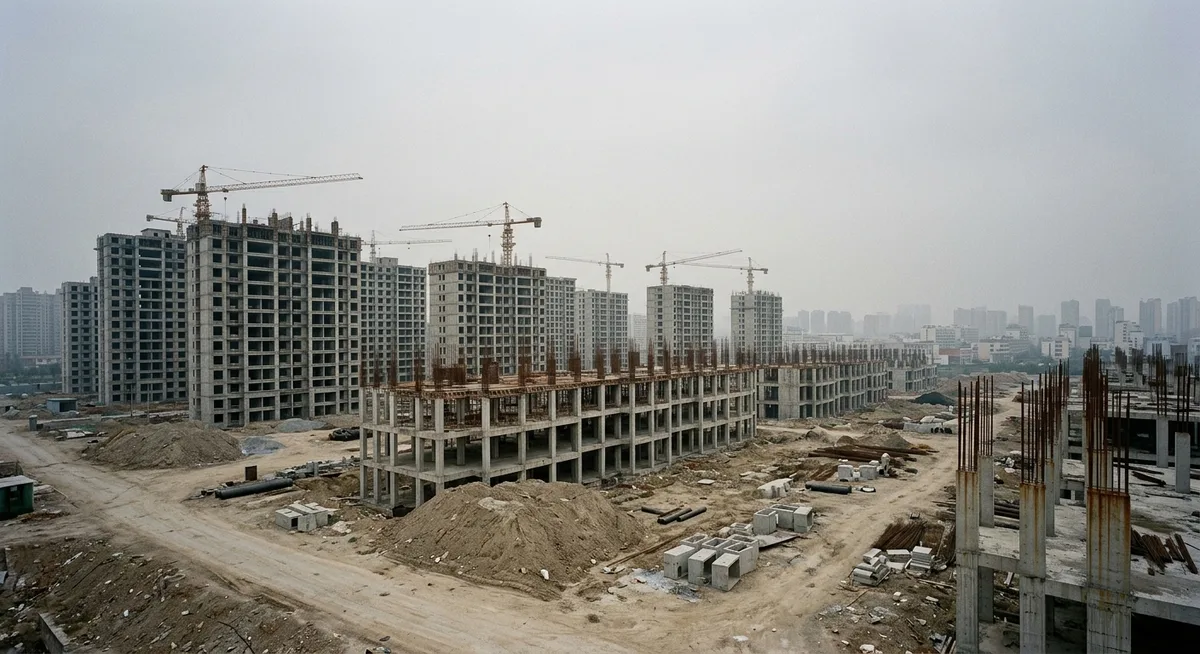
The Great Stall: Inside China's Economic Reckoning and What It Means for the World
In March 2026, China’s government announced an economic growth target of 4.5 to 5 percent — the lowest in decades. The number, delivered at the National People’s Congress in Beijing, was presented as prudent management. But behind the carefully calibrated figure lies a more unsettling reality: the engine that powered four decades of the most spectacular economic expansion in human history is sputtering, and nobody — not Beijing, not Washington, not the International Monetary Fund — is entirely sure how to restart it.
The numbers tell a story that no target can disguise. Property investment has fallen for five consecutive years. For the first time in three decades, total fixed-asset investment — the combined spending on housing, manufacturing, and infrastructure that has been the backbone of China’s growth model — declined in 2025. Consumer confidence sits near historic lows. Bank loans actually shrank in July 2025, as households chose to pay down existing debt rather than borrow. And 20 million young Chinese between 16 and 24 cannot find work.
This is not a cyclical downturn. This is a structural reckoning with a growth model that has reached its limits — and its consequences will be felt in every economy on Earth.
The Property Sinkhole
To understand what went wrong, start with real estate. In China, property is not merely a sector of the economy. It is the economy. Together with infrastructure, real estate accounts for over 31 percent of GDP. It is also where Chinese households hold the vast majority of their wealth — roughly 70 percent, according to the People’s Bank of China. When property prices fall, Chinese families don’t just lose equity. They lose confidence, spending power, and any willingness to take economic risks.
The fall has been catastrophic. Since Evergrande’s collapse in 2021 — the company carried $330 billion in debt, equivalent to 2 percent of GDP — the property sector has entered a self-reinforcing downward spiral. The National Bureau of Statistics reported an 8.6 percent year-on-year decline in new residential prices by late 2024. Real estate development investment fell 15.9 percent in the first eleven months of 2025. Nearly one million Chinese households bought apartments from Evergrande that the company no longer has the means to finish.
Source: National Bureau of Statistics of China / Rhodium Group
Analysts at CNBC project prices will fall another 2.5 percent in 2025 before potentially stabilizing in late 2026 — but “stabilizing” in this context means flatlining at depressed levels, not recovering. The wealth destruction is already baked in.
The result: a deflationary psychology has taken hold. Since mid-2023, China’s nominal GDP growth has fallen below real GDP growth — the textbook definition of economy-wide deflation. Consumers are not spending because they feel poorer. Businesses are slashing prices because nobody is buying. And the government’s 2 percent inflation target has become aspirational fiction.
Twenty Million Young People With Nowhere to Go
The human dimension of the slowdown is starkest in the labor market. China’s urban youth unemployment rate for 16- to 24-year-olds hit 18.9 percent in August 2025, when a record cohort of 12.22 million university graduates — the largest class in Chinese history — entered the workforce. By February 2026, the rate had eased to 16.1 percent, but that improvement masked a deeper problem: many graduates had simply stopped looking or accepted jobs far below their qualifications.
Newsweek reported that approximately 20 million Gen Z workers are jobless in urban China. The South China Morning Post noted that graduates are increasingly “settling for less” — taking factory or delivery jobs that require no university degree. Officials acknowledge that mismatches between skills and available jobs, alongside weak domestic demand, continue to weigh on hiring.
The demographic headwinds make this worse, not better. China’s working-age population peaked in 2015 and has been declining ever since. The country currently has 323 million people over age 60, or 23 percent of the population — a share projected to reach 28 percent by 2040. By 2050, China will go from eight workers per retiree to two. CSIS, RAND, and the World Economic Forum have all warned that this demographic trajectory threatens to strain pension and healthcare systems while shrinking the productive labor force that drives growth.
Source: CSIS ChinaPower / RAND Corporation
The Export Machine That Can’t Sustain Itself
Faced with collapsing domestic demand, China has leaned harder than ever on exports. In 2025, exports climbed 5.5 percent and accounted for a third of economic growth — the highest share since 1997, according to Fortune. China’s trade surplus with the rest of the world has ballooned as its factories, unable to sell to Chinese consumers, have flooded global markets with goods at aggressively low prices.
The scale of this export dependency is creating what the Peterson Institute for International Economics calls “the next China shock.” PIIE researcher Brad Setser documented that China’s trade surplus is “everywhere” — not just in electronics and textiles, but increasingly in medium- and high-tech goods like electric vehicles, solar panels, batteries, and advanced machinery.
Source: Carbon Brief / NBS China
Clean energy alone — electric vehicles, batteries, and solar panels — drove more than a third of China’s GDP growth in 2025, according to Carbon Brief analysis. BYD, China’s leading EV manufacturer, is on track to export one million vehicles in 2025, with ambitions to reach five million.
But this model has a fatal flaw: it depends on the rest of the world absorbing China’s excess production. And the rest of the world is pushing back. The European Union imposed tariffs of up to 45 percent on Chinese EVs in 2024. The United States maintained sweeping tariffs on Chinese goods, and bilateral US-China trade fell more than 35 percent from the prior year. The Rhodium Group warned that China’s overcapacity is not just a trade issue — it is actively holding back emerging economies like Vietnam, India, and Brazil, whose own manufacturers cannot compete with Chinese prices.
Chinese capacity utilization hovered around 76 percent in late 2024, according to the Atlantic Council — well below the 85 percent benchmark considered healthy. Factories are running, but they’re running to produce goods the world doesn’t want at the prices China needs.
What It Means for the United States
The US-China economic relationship has entered uncharted territory. PIIE analysis shows that China essentially stopped buying American exports in April 2025. When Beijing retaliated against Trump’s tariffs, US goods shipments to China fell to levels not seen since the 2008-09 financial crisis. Total bilateral trade is down more than 35 percent year-over-year.
Source: PIIE / US Census Bureau
For American farmers, manufacturers, and service exporters, the Chinese market has effectively closed. But the impact extends far beyond bilateral trade. A China that stops growing is a China that stops importing raw materials from Australia, Brazil, and Africa; stops buying machinery from Germany and Japan; and stops driving demand for commodities from oil to copper. The International Monetary Fund has repeatedly warned that a prolonged Chinese slowdown would shave percentage points off global growth, with commodity-exporting developing nations hit hardest.
There is also the financial dimension. Chinese local government debt, bank exposure to the property sector, and the shadow banking system represent systemic risks that, if they crystallize, could trigger capital flight and contagion in emerging markets.
What Happens Next
The most consequential question in the global economy right now is whether China can engineer a transition from investment-led growth to consumption-led growth — the same transition that Japan attempted in the 1990s and largely failed to achieve, leading to three decades of stagnation.
Source: World Bank / IMF
At 38 percent of GDP, China’s household consumption is extraordinarily low — nearly half the US level and well below every other major economy. Raising it would require a fundamental reallocation of income from the state and corporate sectors to households: stronger social safety nets, higher wages, property tax reform, and a financial system that serves consumers rather than state-owned enterprises.
Beijing has signaled it understands the problem. The government announced expanded social spending, tax incentives for consumer goods, and modest stimulus measures. But the scale of the challenge dwarfs the response. AlixPartners reported that Chinese consumer spending intent swung from positive 10 percentage points in 2025 to negative 8 percentage points for 2026 — a dramatic reversal that reflects not policy failure but a deep erosion of confidence that policy alone may not restore.
The American Enterprise Institute posed the most provocative question of all: “When does China stop growing entirely?” Their analysis argued that demographic decline, debt saturation, and diminishing returns on investment could push China’s trend growth rate below 2 percent by the early 2030s — a rate that, adjusted for population decline, would mean falling per-capita income.
The implications of that scenario — the world’s second-largest economy entering a structural decline while carrying $50 trillion in debt and facing a halving of its workforce within a generation — are ones that no existing economic model is equipped to handle.
China’s economic miracle lasted four decades. Its reckoning, by all indications, is just beginning.
Sources
- CNN — China sets lowest economic growth target in decades
- CNBC — China dials down growth ambitions with decades-low target
- East Asia Forum — No easy way out of China's slowdown
- Fortune — China's export-led growth is looking more unsustainable
- Rhodium Group — China's Economy: Rightsizing 2025, Looking Ahead to 2026
- PIIE — Fasten your seat belts for the next China shock
- PIIE — China no longer buys US exports
- AEI — When Does China Stop Growing (Entirely)?
- CNBC — China's property crisis: Is recovery possible in 2026?
- Wikipedia — Chinese property sector crisis (2020-present)
- Newsweek — 20 Million Gen Z Are Jobless in Urban China
- South China Morning Post — Youth unemployment eases to 16.9%
- Rhodium Group — How China's Overcapacity Holds Back Emerging Economies
- Atlantic Council — China's manufacturing overcapacity threatens global green goods trade
- Carbon Brief — Clean energy drove more than a third of China's GDP growth in 2025
- CFR — China's Massive Surplus is Everywhere
- CSIS ChinaPower — How Severe Are China's Demographic Challenges?
- RAND — China's Aging Population and What It Means for Security
- AlixPartners — Competing for the Cautious Chinese Consumer in 2026
- McKinsey — Mid-2025 update on China's consumer markets
- China Briefing — China's Economy November 2025: Year-End Review and 2026 Outlook
The information presented is for educational and informational purposes only and does not constitute investment advice. MainStreet uses AI to generate content — always verify with qualified financial professionals before making investment decisions. How MainStreet works →
Discussion