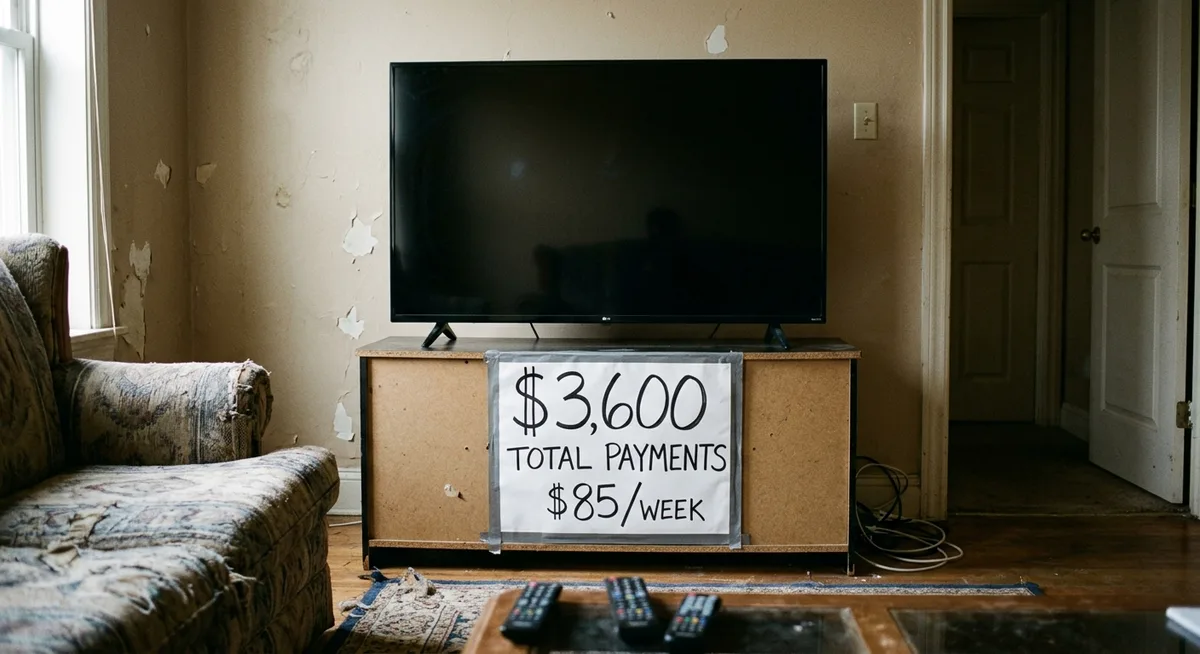
The $3,600 Television: How the Rent-to-Own Industry Profits from the Poverty Premium
A $1,000 price tag serves as an insurmountable wall for millions of families living paycheck to paycheck. While a consumer with ready cash can buy a top-of-the-line 4K high-definition television at any big-box retailer, those without it are funneled toward showrooms offering the same item for $60 a week. By the time a household secures ownership 14 months later, the total cost reaches approximately $3,640—more than triple the retail price.
This is the primary engine of the rent-to-own (RTO) industry. As of March 2026, the sector generates $11.5 billion in annual revenue by capitalizing on the “poverty premium.” This phenomenon forces the poor to pay more for basic goods because they lack the lump-sum capital or credit scores necessary to access traditional retail markets.
Data from the Association of Progressive Rental Organizations (APRO) indicates that 4.63 million households—about one in every 29 American homes—rely on rent-to-own services as of early 2026. The industry markets these transactions as a flexible alternative to traditional debt, yet the underlying structure is designed to extract maximum wealth from those with the least.
The Illusion of Affordability
The industry sells the weekly payment because the annual rate is indefensible. When these payments are translated into traditional financial terms, the cost of capital is staggering. Effective annual percentage rates (APRs) for furniture and appliances frequently range between 100% and 468%, based on November 2025 data from Ascentra Credit Union.
Companies frequently market these services as “interest-free” by exploiting a specific legal loophole. These contracts are technically leases rather than loans. Because a customer can return the item at any time, the transaction remains outside the jurisdiction of the federal Truth in Lending Act. This exemption allows RTO providers to bypass the requirement to clearly disclose triple-digit APRs to their customers.
“For decades, the rent-to-own industry has evaded core consumer protection laws to target and drain wealth from families, especially households of color, already living on the edge,” said Brian Highsmith, a Skadden Fellow at the National Consumer Law Center (NCLC).
These markups apply to essential household goods as well as electronics. Refrigerators, washers, and stoves are subject to identical pricing logic. Research from RentConfident in January 2018 shows that RTO items are typically marked up 2 to 4.5 times their retail value. In low-income urban neighborhoods in Ohio, studies found RTO stores charging four times the retail price for basic kitchen appliances compared to stores in wealthier zip codes.
Source: RentConfident / NCLC
Criminalizing Financial Distress
Missing a payment on a rented sofa is not merely a civil dispute; in 47 U.S. states, it is a criminal matter. While an unpaid car loan or credit card bill results in a hit to a credit score, RTO companies utilize “rental theft” laws to pursue felony charges against customers who miss payments and fail to return merchandise within a strict timeframe.
In states such as Texas and Illinois, the failure to return property within 10 days of a formal notice can lead to prosecution as a Class 4 Felony. This legal leverage gives the industry a collection tool unavailable to traditional banks: the threat of incarceration.
“The objective of these efforts is not to discourage intentional theft, but rather to compel low-income consumers to make payments they cannot afford on predatory RTO contracts,” said Margot Saunders, Senior Attorney at the National Consumer Law Center.
Federal Trade Commission (FTC) data reveals that nearly 50% of RTO customers have been late with a payment. For these individuals, a financial setback can trigger a knock on the door from local law enforcement rather than a simple repossession. While California’s Attorney General secured a $15.5 million settlement from Rent-A-Center in 2022 over deceptive marketing and violations of the Karnette Rental-Purchase Act, most of the country still operates under a legal framework that treats missed lease payments as crimes.
A Global Scourge with Local Variations
The United States maintains one of the most permissive environments for the RTO industry globally. In jurisdictions where regulators have intervened, the business model has struggled to survive.
The United Kingdom’s largest RTO firm, BrightHouse, collapsed into administration in 2020 after the Financial Conduct Authority (FCA) ordered the company to pay £14.8 million in redress to 249,000 customers. The FCA determined the firm engaged in unaffordable lending practices. The Guardian reported that the firm’s reputation never recovered after it was accused of sidestepping payment guidance during the COVID-19 pandemic.
The Australian Securities and Investments Commission (ASIC) took similar action against Thorn Group, which operated as Radio Rentals. In 2018, ASIC levied $20 million in fines and refunds after finding the company failed to verify the financial stability of 270,000 customers.
“The law requires lenders to verify a consumer’s financial situation to make sure that consumers are not being put into unaffordable loans or leases,” said Peter Kell, Deputy Chair of ASIC.
Source: California AG, ASIC, FCA
In Canada, the Consumers Council of Canada found that RTO prices are 20% to 150% higher than retail before rental fees are even applied. Reports indicate Canadian families have paid over $3,300 for refrigerators with a retail value of less than $1,000 under these long-term lease-to-own agreements.
The Frictionless Digital Trap
The industry is moving away from traditional showrooms and into “frictionless” digital platforms. This shift toward “omnichannel” retail allows RTO companies to capture consumers at the exact moment of purchase intent.
In 2024, the fintech firm IQVentures Holdings acquired The Aaron’s Company for approximately $504 million. This acquisition marked a pivot toward digital lease-to-own models that integrate directly into the checkout pages of mainstream retailers. E-commerce RTO revenue for major brands increased by 79.4% in August 2024, according to PR Newswire.
This digital integration removes the physical friction of visiting a rent-to-own store, making it easier for consumers to enter into high-cost contracts with a single click. Despite the sleek new interface, the customer demographic remains the same. January 2018 data shows that 59% of RTO customers earn $25,000 or less annually. Black consumers represent 31% of the customer base, a figure disproportionately high relative to the general U.S. population.
Source: RentConfident
“Fringe credit is very costly, and usually the borrowers who are forced to use it are already in a serious financial bind,” said Jim Hawkins, Professor of Law at the University of Houston Law Center.
Market leader Rent-A-Center, operating under Upbound Group, holds a 31.7% market share with $4.24 billion in revenue for the year ending July 2025. While physical store counts have dropped to roughly 5,800 locations, the industry’s reach continues to expand through these digital avenues.
The Future of the Living Room
The global rent-to-own furniture market is on track to reach $22.4 billion by 2032. Tightening credit standards in the primary lending market and increasing urbanization are driving this growth. As traditional banks retreat from subprime lending, RTO firms occupy the resulting vacuum.
A stark divide has emerged between the North American model and the European approach. In the European Union, the market is shifting toward a “circular economy” model that emphasizes sustainability and temporary use for mobile professionals. In America, the model remains firmly anchored in the subprime tradition, serving as a primary source of high-cost essential goods for the working poor.
For the 4.63 million American households currently bound by these contracts, the choice is between an empty apartment and a lease that may cost triple the item’s value. When families hit a stretch of bad luck, the price of that sofa or washing machine can include not just their financial stability, but their legal freedom. The poverty premium ensures that those with the least continue to pay the most.
Sources
- APRO — 2025 Annual Rent-to-Own Industry Health Survey, March 2026
- NCLC — The Rent-to-Own Racket: Using Criminal Courts to Coerce Payments
- The Guardian — Rent-to-own BrightHouse accused of sidestepping Covid payment guidance, August 2020
- ASIC — $2 million penalty for Thorn's Radio Rentals, 2018
- Consumers Council of Canada — High Prices, Little Protection for Canada's Rent-To-Own Customers
- Matrix BCG — Competitive Landscape of Rent-A-Center Company 2025, November 2025
The information presented is for educational and informational purposes only and does not constitute investment advice. MainStreet uses AI to generate content — always verify with qualified financial professionals before making investment decisions. How MainStreet works →
Discussion